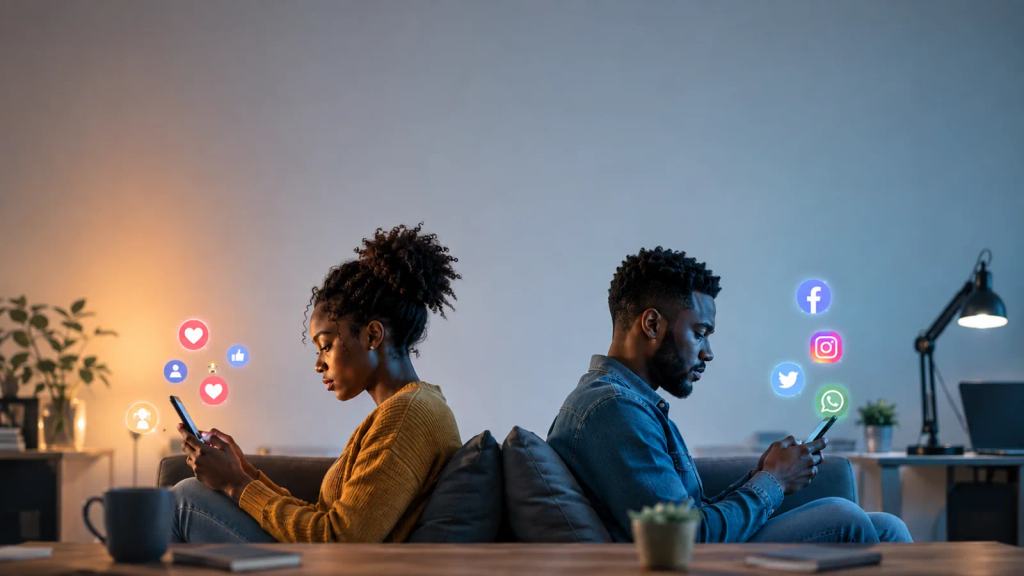
Social media has changed the way we communicate, fall in love, maintain friendships and experience relationships. Today, something as small as a like, a comment, a follow, a private message or even a notification appearing on a partner's phone can create questions that did not exist before.
I believe this is why social media has become one of the biggest tests of trust and boundaries in modern relationships. The issue is not always that someone has done something wrong. Sometimes, the problem begins because two people have completely different ideas about what is acceptable online, and neither person took the time to discuss it.
For one person, liking another person's picture may mean absolutely nothing. For another, especially when the person receiving the attention is attractive or someone with whom there has been a previous history, that same like can feel disrespectful. One partner may consider private conversations with an ex completely innocent, while the other may see those conversations as crossing a line.
This is where social media becomes complicated because what happens on a screen can produce very real emotions in someone's heart.
Research from the Pew Research Center found that 23% of partnered adults whose significant others use social media had felt jealous or uncertain about their relationship because of how their partner interacted with other people on social media. Among adults aged 18 to 29, that figure rose to 34%.
Those figures are important because they remind us that online behaviour cannot always be dismissed as something that happens only on the internet. A comment can cause an argument at home. A private message can create suspicion. A photograph can trigger insecurity, while a follow request can reopen questions about an old relationship.
And because of this, couples need to have conversations about their digital boundaries instead of assuming that love automatically means both people understand what is acceptable.
What happens when an ex sends a message? Is replying okay? What if someone repeatedly flirts in the comments? Is it appropriate to respond? Should relationship problems be discussed publicly? Is it acceptable to post private photographs without asking your partner? Should couples share their passwords? And what exactly counts as cheating in a world where emotional connections can begin through a screen?
These questions may not be romantic, but they are necessary.
The truth is that two people can genuinely love each other and still have completely different opinions about digital boundaries. One person may believe that being in a relationship does not mean giving up personal privacy, while the other may feel that partners should have complete access to each other's phones. One person may see following attractive people as harmless, while the other may consider it disrespectful.
Neither person should automatically be labelled unreasonable simply because they see things differently.
What matters is the conversation that follows.
A healthy relationship requires people to explain what makes them uncomfortable, listen to what their partner is saying and find boundaries that both people can respect. It is much better to have that conversation when everything is calm than to wait until jealousy, anger and suspicion have already taken over.
At the same time, we have to be careful not to confuse trust with surveillance.
Having your partner's password does not automatically mean you trust them. Checking their phone every night does not necessarily create security. Monitoring who they follow, who they like and when they are online may give you information, but information is not the same thing as peace of mind.
Pew Research found that 75% of partnered adults had shared their cellphone password with their partner, while 42% had shared the password to at least one social media account. However, 70% said it was rarely or never acceptable for someone to look through their partner's cellphone without their knowledge.
That distinction says a lot about the complicated relationship between privacy and trust.
You can voluntarily share your password because you are comfortable doing so, but that does not mean your partner has the right to secretly search through everything whenever suspicion appears.
At the same time, privacy should never become an excuse for dishonesty. There is a difference between wanting reasonable personal space and deliberately hiding conversations because you know they would hurt your partner if discovered.
That is where honesty becomes more important than passwords.
Another issue I think we need to take seriously is comparison. Social media has created an environment where people are constantly exposed to other people's relationships. We see couples celebrating anniversaries, travelling together, buying gifts, getting engaged, posting romantic messages and publicly declaring how much they love each other.
After seeing this repeatedly, it can become easy to look at your own relationship and wonder whether something is missing.
But there is a problem with comparing your private reality with someone else's public presentation.
We see the photograph, but we do not see the argument that happened before it. We see the anniversary celebration, but we do not know what the couple has been dealing with privately. We see the expensive gift, but we do not know the financial situation behind it. We see the smiling faces, but we do not know what happens when the camera is turned off.
This is why I believe social media should never become the measuring tape for the success of a relationship.
Even something as simple as posting your partner can become a source of conflict when expectations are not communicated.
One person may ask, “Why don't you ever post me?”
Another may respond, “Why does posting you prove that I love you?”
Both people may have genuine feelings, but the solution is not going to be found in Instagram, Facebook or TikTok. It has to come from an honest conversation between them.
The same thing applies to messaging.
Smartphones have made people feel as though everyone should always be available. Messaging apps can show when someone was last online, when a message was delivered and sometimes when it was read. These features may seem useful, but they can also create unnecessary anxiety.
Someone sees their partner online and wonders why they have not replied.
Someone notices that a message has been read and immediately assumes they are being ignored.
Someone sees their partner active on another platform and begins asking questions.
Sometimes there is a perfectly innocent explanation. Other times, there may genuinely be a problem. The point is that an online status cannot tell you which one is true.
That is why communication should come before assumption.
Instead of creating an entire story in your head because someone has not replied, ask. Instead of secretly investigating because something feels strange, communicate. Instead of allowing an algorithm or notification to determine how you feel about your relationship, remember that you are dealing with a human being, not a digital status indicator.
And while communication is important, so is knowing what should remain private.
One of the most damaging habits people can develop is taking relationship disagreements to social media. When someone is angry, it can be tempting to post an indirect message, share a cryptic quote or tell followers what their partner has done.
The problem is that once private problems become public, they are no longer controlled by the two people in the relationship.
Friends may take sides. Family members may become involved. Strangers may begin commenting. People who know only one part of the story may start making judgments.
A disagreement that could have been solved through one honest conversation can suddenly become a public spectacle.
Not every problem needs an audience.
Sometimes the strongest thing two people can do is put their phones down and talk to each other.
However, I also do not think we should paint social media as the enemy of relationships. Technology can also bring people closer together. Couples who live far apart can communicate throughout the day, share photographs, celebrate achievements and remain emotionally connected despite the distance.
The same phone that can create jealousy can also create closeness.
The difference is how we use it.
And this is where I think the conversation becomes bigger than relationships.
Our smartphones have become some of the most powerful tools we carry every day, yet many people use them mainly to watch what other people are doing. We scroll through other people's relationships, lifestyles, businesses, holidays and achievements, then compare them with our own lives.
But what if we started using that same phone to build something?
What if instead of spending hours monitoring someone else's online activity, we used some of that time to develop a skill? What if we learned content writing, social media management, graphic design, video editing, affiliate marketing or digital product creation?
The smartphone that can create relationship problems can also create opportunities.
Someone who enjoys writing can start creating useful articles from their phone. Someone who understands fashion, food, beauty, education, business, parenting or technology can build content around that knowledge. Someone with design skills can offer social media graphics to small businesses. Someone who has valuable knowledge can package it into an ebook, guide, template or online resource.
The point is not that everyone needs to become an internet entrepreneur.
The point is that we should not allow social media to consume our attention without giving us anything valuable in return.
If we are going to spend time online, we can also learn how to create value online.
That shift in mindset is especially important because digital opportunities are becoming increasingly accessible. You do not always need a physical office, expensive equipment or a large amount of money to begin. In many cases, a smartphone, an internet connection, a useful skill and consistency can be enough to take the first step.
But just as we need boundaries in relationships, we also need boundaries with our own digital habits.
We need to know when to put the phone down.
We need to know when not to compare ourselves with strangers.
We need to know when a conversation belongs privately between two people.
We need to know when to stop scrolling and start creating.
Most importantly, couples need to understand that trust cannot be built through surveillance.
Trust is built through honesty, consistency, communication and respect.
A relationship should not depend on whether someone has access to a partner's phone. It should depend on whether both people are committed to behaving in ways that protect the relationship.
Likes do not prove loyalty.
Followers do not prove happiness.
Public displays of affection do not automatically prove that a relationship is healthy.
And having someone's password does not guarantee trust.
What matters is what happens when nobody else is watching.
Social media will continue to influence relationships because it is now deeply connected to how we communicate and interact with the world. The answer is not necessarily to delete every social media account or demand access to every private conversation. Instead, couples need to create clear boundaries, communicate honestly and understand that privacy and loyalty can exist together.
If something online makes you uncomfortable, talk about it.
If you do not know whether something is acceptable, ask.
If your partner tells you that something you are doing online is hurting them, listen before becoming defensive.
And if you are constantly afraid of what your partner might be doing, ask yourself whether the relationship needs more communication, more reassurance or a deeper conversation about trust.
At the end of the day, the strongest relationships are not necessarily the ones that look perfect online. They are the ones where two people can put their phones down, sit together and still feel secure about what they have built.
Social media can test trust, expose insecurity and blur boundaries, but it can also teach us something valuable about how we communicate, how we protect the people we love and how we use technology.
The phone in your hand can be a source of jealousy, comparison and distraction, but it can also become a classroom, a creative studio, a communication tool and even the beginning of an income-generating business.
The difference is ultimately in how you choose to use it.
If you have an article, opinion piece, event or news story you would like published, or you are ready to begin your journey toward building a profitable online content-writing business from your phone or laptop, Global News Arena would love to hear from you. Send an email to advertise@globalnewsarena.com.