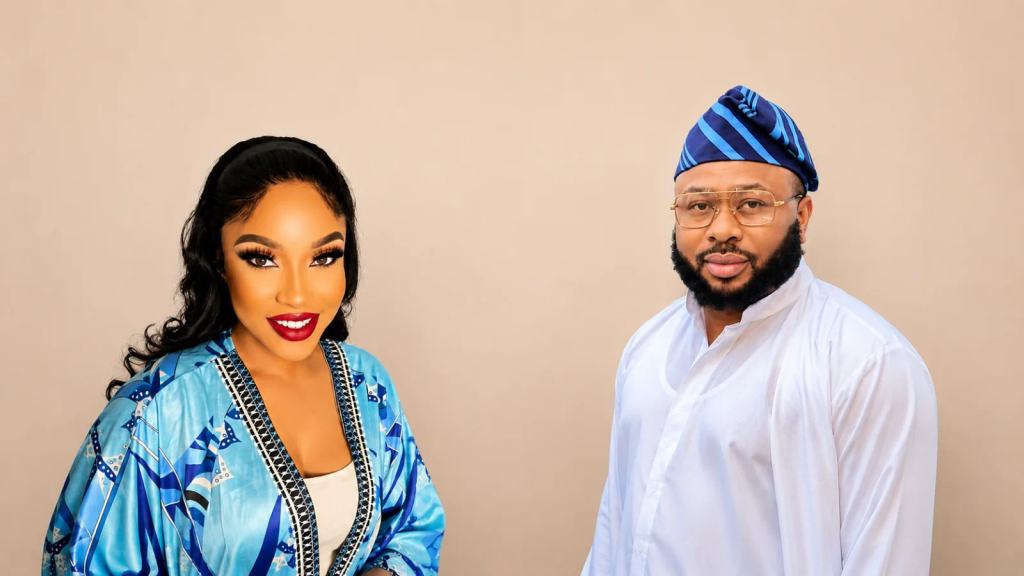
Tonto Dikeh has revealed that her reconciliation with her former husband, Olakunle Churchill, has gone far beyond bringing peace to her own family. According to the Nollywood actress, her decision to forgive and reconcile has also encouraged other women to take another look at broken relationships, with at least 10 women reportedly reaching out to her and later reconciling with their partners.
For me, this is what makes Tonto's latest revelation more interesting than the usual celebrity relationship story. It is not simply about two people who were once married finding a way to communicate again. It is about what can happen when a painful chapter in someone's life eventually becomes a lesson that another person can learn from.
Tonto shared the revelation on August 24, 2026, saying hundreds of women contacted her after learning about her reconciliation with Churchill. Many wanted to know how she had been able to forgive after years of conflict. Although she could not respond to everyone, she said she reached out to some women whose experiences reminded her of her own, and at least 10 of them eventually reconciled with their partners. Some, she said, were able to restore peace in their homes and work towards healthier co-parenting relationships.
That is a significant development because Tonto Dikeh and Churchill's relationship had once been one of the most publicly discussed celebrity marriages in Nigeria. Their marriage ended after a highly publicised conflict, and for years, the relationship appeared to be defined by disagreements, accusations and painful public exchanges.
Then something changed.
In January 2026, Tonto announced that she and Churchill had reconciled after years of conflict. She spoke about forgiveness, prayer, humility and the importance of finding peace, particularly because they share a son, King Andre.
The reconciliation did not necessarily mean that everything between them returned to the way it was before. In fact, Tonto later explained that the relationship was primarily about restoring their roles as parents and creating a healthier environment for their son.
That distinction is important because reconciliation does not always mean getting back into a romantic relationship.
Sometimes, reconciliation means being able to communicate without fighting.
Sometimes, it means forgiving someone without forgetting what happened.
Sometimes, it means putting personal differences aside because a child deserves to have a healthy relationship with both parents.
And sometimes, it simply means choosing peace after spending years carrying anger.
This is where I think people need to look beyond the celebrity names in this story.
It is very easy to read “Tonto Dikeh reconciles with Churchill” and immediately focus on the entertainment value. But beneath that headline is a question many ordinary people have had to answer at some point in their lives: what do you do when someone who once hurt you is still part of your life?
There is no universal answer.
Forgiveness does not mean tolerating abuse. It does not mean returning to an unsafe relationship. It does not mean forgetting your boundaries or pretending that nothing happened.
A person can forgive someone and still choose not to be with that person.
A parent can forgive an ex-partner and still maintain healthy boundaries.
Two people can decide to co-parent peacefully without becoming husband and wife again.
That is why Tonto's explanation about her relationship with Churchill deserves to be understood within its proper context rather than reduced to a simple “they are back together” narrative.
Her story also became more significant because of the impact she says it had on other women.
According to her, women began contacting her because they wanted to understand how she was able to move beyond the pain of the past. Some of these women were apparently dealing with their own relationship struggles, and her experience gave them a reason to consider whether peace was still possible.
I find that part of the story particularly powerful because it shows how personal experiences can sometimes become useful to other people.
We often assume that the difficult things we go through have no value. We look at failure, disappointment, heartbreak, financial struggles or mistakes and wish we could erase them from our history.
But what if some of those experiences are actually lessons?
What if the thing you struggled to understand five years ago is now something another person desperately needs help understanding?
What if the skill you learned because you had no choice is now a skill someone else would happily pay you to teach them?
That is where Tonto's story connects with something much bigger happening in today's digital world.
People are increasingly turning their experiences, knowledge and skills into content. They are recording videos, writing articles, creating digital guides, teaching online and building communities around problems they understand.
And the interesting thing is that you do not need to be a celebrity to do this.
You may have only a smartphone.
You may have a small social media following.
You may not even consider yourself an expert yet.
But if you know how to solve a problem that other people are struggling with, you already have something that can become useful content.
Someone who has learned how to sell products through WhatsApp can teach another beginner.
Someone who knows how to create attractive designs with Canva can create tutorials.
Someone who has learned how to use AI tools can teach small business owners how to save time.
Someone who has experience writing, cooking, tutoring, editing videos, managing social media or running a small business can document what they know and gradually build an audience around it.
The smartphone makes the barrier to entry much lower than it used to be.
You can record your first video from your bedroom.
You can write your first article from your phone.
You can create a simple PDF guide.
You can answer questions on social media.
You can offer a small digital service.
Then, if people find your content useful, trust begins to grow.
And when trust grows, opportunities can follow.
That is why I do not think the most important lesson from Tonto Dikeh's story is simply that she forgave Churchill.
The deeper lesson is that a personal experience can create an impact far beyond the person who experienced it.
Tonto went through something that was very public and very painful. Years later, she says that the same journey has given her the perspective to speak with women who are facing their own relationship problems.
Whether someone agrees with her decision or not, there is value in understanding the transformation.
The goal of healing is not always to change the past.
Sometimes, it is to change what the past does to your future.
And that is something many people can relate to, even if they have never experienced a celebrity relationship.
Maybe your past relationship ended badly.
Maybe you were betrayed by someone you trusted.
Maybe a business partnership collapsed.
Maybe you lost money.
Maybe you failed at something you thought would succeed.
Maybe you spent years learning a skill that you never thought would become useful.
Your experience does not have to remain a private story that disappears with time.
When you learn from it, you can use it to make better decisions.
When you document it, you can help someone else.
And when you package that knowledge properly, it can even become the foundation of a legitimate digital business.
That does not mean exploiting personal pain for attention. It means identifying the useful lesson without exposing private information that should remain private.
There is a big difference between telling the internet everything about your life and sharing a valuable lesson from your life.
That difference matters, especially now that social media rewards people for oversharing.
Not every experience needs to become content.
But every experience can teach you something.
And sometimes, the best content comes from asking a simple question: “What did I learn from this that could help someone else?”
That question can turn an ordinary smartphone into a powerful tool for communication, education and business.
Tonto's story also reminds me that people do not always need perfect people to learn from. Sometimes, they connect more deeply with people who have made mistakes, experienced setbacks and eventually found a better way forward.
That is because real life is not perfect.
People struggle.
People make mistakes.
People change.
And sometimes, people who once could not communicate eventually learn how to communicate.
That is the human side of this story.
At the same time, it is important not to turn reconciliation into an instruction that everybody must follow. Every relationship is different, and nobody should be pressured into returning to a situation that threatens their safety or wellbeing. Forgiveness is personal, and reconciliation should only happen when it is healthy and genuinely appropriate for the people involved.
For Tonto Dikeh, however, the experience appears to have opened a new chapter, particularly in her relationship with Churchill as co-parents. And if her account is anything to go by, that new chapter has also encouraged other women to seek peace in their own situations.
That may ultimately be the most meaningful part of the story.
A relationship that once represented years of public conflict is now being discussed in the context of forgiveness, parenting and helping others.
And that makes me think about how we view our own lives.
We are often too quick to believe that a difficult chapter means the end of the story.
It may not be.
Sometimes, it is simply the chapter where you learn something you will need later.
Sometimes, the mistake becomes the lesson.
Sometimes, failure becomes an experience.
Sometimes, the pain becomes the wisdom.
And sometimes, what you thought was only your personal struggle becomes the very thing that helps somebody else find a way forward.
That is why I believe the bigger message from Tonto Dikeh's latest revelation is not about celebrity gossip at all. It is about transformation, forgiveness, knowledge and the possibility of turning personal experience into something useful.
If you have learned something valuable from your own journey, do not underestimate it. Start documenting it. Share it responsibly. Teach what you know. Use your smartphone to create something that can help another person.
You may be surprised by how many people are looking for the exact knowledge you already have.
And if you build consistently, that knowledge can become more than social media posts. It can become an audience, a digital product, a service or even the beginning of a sustainable online business.
In the end, Tonto Dikeh's reconciliation with Churchill is still their personal story, and only they truly know everything that happened behind the scenes. But her latest revelation has opened a much bigger conversation about what happens when people choose healing over bitterness and use what they have learned to encourage others.
Perhaps that is the part worth remembering after the social media noise disappears: your past may explain where you have been, but it does not have to decide where you are going.
And sometimes, the most valuable thing you can do with an experience is not simply survive it, but learn from it well enough to help someone else.
If you have an article, opinion piece, event or news story you would like published, Global News Arena would love to hear from you. If you are ready to begin your journey toward building a profitable online content-writing business from your phone or laptop, you can also start today by turning what you know into useful content, learning consistently and building an audience around real value.
Send your article, opinion piece or publication request to advertise@globalnewsarena.com.