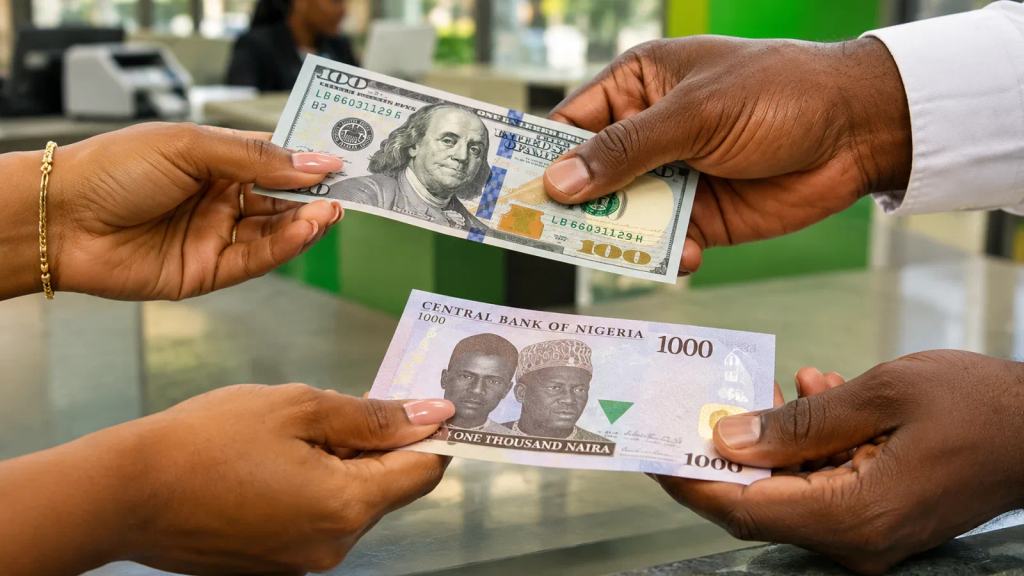
Intense public and corporate interest has returned to the financial sector as the Dollar-to-Naira exchange rate today commands trending searches across Nigerian digital networks and trading floors. Across both the official Nigerian Foreign Exchange Market and street-level Bureau De Change hubs, market participants have witnessed fresh friction between foreign currency supply and an aggressive surge in commercial demand. For millions of citizens whose purchasing power is intimately tethered to the health of the local currency, every tick of the currency ticker carries immediate, real-world consequences.
READ: Where to Get Your Professional Website in Just 72 Hours
Read: Need a professional website in 72 hours? Contact Auxi Chat
Sitting in Dubai and observing global financial flows, one is constantly reminded that currency valuations are never merely abstract numbers on a central bank dashboard. In an import-dependent economy like Nigeria, the exchange rate dictates the price of imported wheat in northern bakeries, the cost of manufacturing components in eastern industrial clusters, and the tuition bills of families supporting students in overseas universities. When the spread between official bank quotes and informal street rates begins to widen, market confidence inevitably reacts with heightened sensitivity.
READ: Nigerian Americans Win Key Seats in 2026 Midterms.
The Widening Gap Between Official and Street Rates
Trading data released on Thursday illustrates the dual reality confronting commercial actors in the economy. In the official window, transactions fluctuated within an intraday band between ₦1,346.00 and ₦1,349.50 per dollar, with the Central Bank of Nigeria reporting an official indicative closing rate hovering around ₦1,347.30. While this showed modest technical stability compared to earlier chaotic trading seasons, the underlying liquidity tells a much more nuanced story.
Concurrently, on the parallel market, currency dealers in major commercial hubs such as Lagos, Abuja, and Kano quoted dollar purchases at ₦1,380 and sales at ₦1,390. This dynamic established a clear premium of approximately ₦42.70 per dollar between the formal banking window and the informal retail market. Whenever that margin expands, it creates immediate arbitrage temptations and signals that businesses requiring immediate hard currency are struggling to fulfill their documentation through standard banking pipelines.
Read: Need a professional website in 72 hours? Contact Auxi Chat
Decoding the Dollar to Naira Exchange Rate Today
To truly understand why the Dollar to Naira exchange rate today has captured such widespread attention, one must examine the macroeconomic headwinds converging on the market simultaneously. Foremost among these is a noticeable decline in daily market turnover, which dropped by over fifteen percent during mid-week trading sessions. When institutional supply tightens even slightly, corporate buyers scrambling for raw material clearance find themselves bidding up available supplies, triggering short-term rate volatility.
At the same time, central bank reports indicated that gross external reserves experienced a five-day contraction, easing to approximately 55.15 billion dollars. While this reserves position remains historically robust compared to previous crisis years, any downward movement immediately prompts speculative caution among portfolio investors and foreign exchange operators. Analysts are closely watching whether the apex monetary authority will step into the market with targeted dollar injections to satisfy pending commercial backlogs.
The Inevitable Year End Import Rush
A major seasonal catalyst driving the current frenzy is the structural nature of Nigerian fourth-quarter commerce. November is traditionally the month when manufacturers, retailers, and multinational distributors rush to finalize overseas payments for holiday inventories. Importers must open and fund letters of credit for fast-moving consumer goods, electronics, textiles, and packaging materials that must arrive at maritime ports before December festivities begin.
This seasonal compression creates an acute demand shock that tests even the most disciplined monetary policy frameworks. Small and medium enterprises, often lacking the credit facilities to secure long-term forward contracts through Tier-1 banks, are compelled to source liquidity wherever it is immediately accessible. The resulting run on retail dollar supplies inevitably drives up parallel market premiums, reinforcing the public perception that the currency is under renewed strain.
Monetary Discipline and Structural Production
The Central Bank of Nigeria has repeatedly emphasized its commitment to a transparent, market-driven exchange rate regime, steering clear of artificial currency pegs that drained national reserves in past decades. Interest rate adjustments and regulatory overhauls designed to bring transparency to Bureau De Change operations have indeed eliminated the catastrophic spreads that previously crippled business planning.
Yet, monetary policy alone cannot solve what is fundamentally a structural production deficit. A nation cannot maintain permanent currency stability solely through high interest rates and regulatory pronouncements. Long-term stabilization requires expanding domestic industrial capacity, removing logistical bottlenecks at seaports, reviving non-oil export corridors, and reducing dependence on imported petroleum products and basic agricultural staples. Until local production genuinely substitutes foreign inputs, seasonal currency turbulence will remain an unavoidable feature of the economic calendar.
READ: Dangote Stops Selling Petrol to Some Importers
Navigating Currency Realities in a Changing Market
For Nigerian entrepreneurs and ordinary households, this latest chapter of currency fluctuations reinforces the necessity of proactive financial planning. Businesses must develop sophisticated currency hedging strategies, explore local sourcing options, and structure operational costs with built-in volatility buffers. Speculative panic rarely serves any enterprise well; disciplined inventory management and strategic pricing models are the true defenses against foreign exchange shocks.
As the financial system navigates the remaining weeks of the year, the performance of the local currency will serve as a crucial barometer of economic resilience. The Central Bank of Nigeria possesses the policy instruments and reserve depth required to absorb seasonal demand spikes and preserve market stability. By fostering genuine liquidity, protecting transparent price discovery, and supporting domestic manufacturing, the economy can transition from chronic currency anxiety toward sustainable, production-led growth.
Are you interested in learning how to write professionally and earn money as a writer and content creator? Contact Auxi Chat today to start your writing journey immediately.
Need a professional website in 72 hours? Contact Auxi Chat
If you have an article, opinion piece, event or news story you would like published, Global News Arena would love to hear from you.