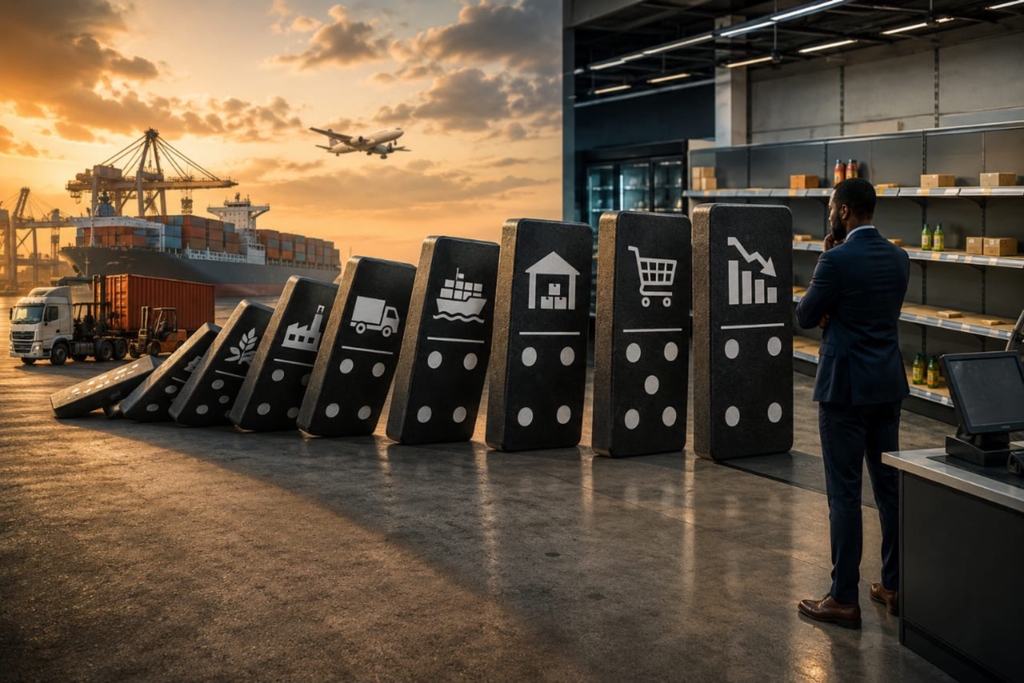
Sometimes the problem begins with something that appears completely unrelated to the business: a war, a blocked shipping route, a fuel shortage, a delayed shipment or a sudden increase in transportation costs. By the time the impact reaches the business owner, the original problem may already be thousands of kilometres away.
That is what makes supply-chain disruptions so difficult. They rarely arrive with a warning that says, “Your business is about to be affected.” Instead, the signs appear gradually. Delivery costs increase. Suppliers change their prices. Customers begin complaining about higher prices. Products become harder to obtain. Profit margins become smaller.
Eventually, the business owner is forced to make decisions under pressure.
The problem becomes worse when a business depends too heavily on one supplier, one distribution channel or one source of customers. When that single point fails, there may be no immediate alternative. A company that has spent years building its operations around one predictable system can suddenly discover that predictability was never the same thing as security.
This is why business resilience starts before the crisis.
A resilient business understands its dependencies. It knows which costs can change quickly, which suppliers have alternatives, which customers are most important, which communication channels actually reach its audience and which parts of the business can continue operating when conditions become difficult.
It also understands that customer communication is part of resilience. When prices change, products are delayed or services are temporarily affected, customers need information. Silence creates uncertainty, and uncertainty can quickly become distrust. A business that communicates clearly has a better chance of keeping customers informed rather than allowing rumours and frustration to speak for it.
The same principle applies to visibility. A company can have a good product and still struggle if customers cannot find it, understand it or remember it. Strong content, consistent social media activity and clear communication are not simply marketing extras. They help a business maintain its relationship with the market when conditions are changing.
This is where businesses can benefit from having the right support instead of trying to manage every function alone. Auxi Sherpa provides business support around areas such as content writing and social media management, helping businesses communicate more consistently and present their services more effectively online.
A supply-chain crisis cannot always be prevented. Neither can a geopolitical event, fuel-price shock or sudden change in the market. But businesses can reduce their vulnerability by building stronger systems, understanding their dependencies and maintaining a direct relationship with their customers.
The goal is not to create a business that never experiences problems. That business does not exist. The goal is to create one that can experience a problem without allowing the problem to become the end of the business.
If you have an article, opinion piece, event or news story you would like published, Global News Arena would love to hear from you.
Send an email to advertise@globalnewsarena.com.