You type a question.
You get an answer.
You ask AI to write something, generate an image, summarise a meeting, and it just
happens, almost instantly.
Tap a button.
Something happens.
But somewhere far away, machines are doing an insane amount of work to make that little
moment on your phone feel effortless.
That part of the story barely gets talked about.
We talk about the newest chatbot, the latest image generator, the app promising to save you
ten hours a week.
Meanwhile, underneath all of that sits a much less glamorous pile of stuff, data centres,
chips, electricity, cooling systems, networks, and actual humans keeping it all running.
That's the infrastructure.
And honestly, it matters more than most of us realise.
When you open an AI tool, it's tempting to assume the intelligence lives inside the app itself.
It doesn't, not really.
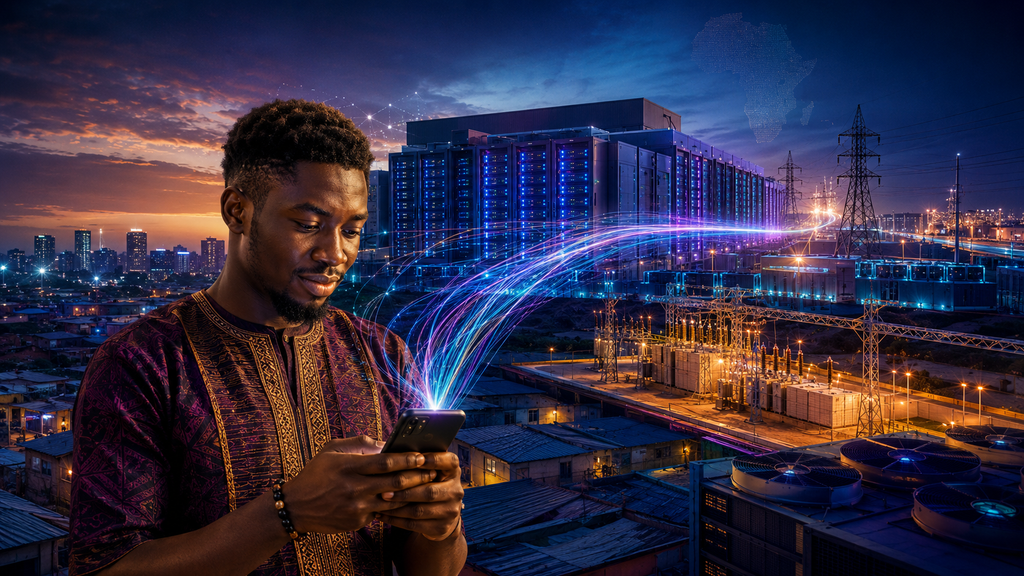
Most of the heavy lifting happens in massive data centres, and those places need enormous
electricity, serious cooling, high speed connections, and expensive equipment built
specifically to handle AI level work.
Which is why the AI boom is honestly becoming as much an infrastructure story as a
software one.
The World Economic Forum recently flagged that African data centre demand could jump
from about 0.4 gigawatts to 2.2 gigawatts by 2030, according to McKinsey.
Same report basically says the AI race is becoming a race for reliable electricity.
Sounds like a government and Big Tech problem.
It's not, not entirely.
Infrastructure trickles down to ordinary people eventually.
It decides how fast your services run, how expensive they get, where companies can even
operate, which businesses get access to new tech first, and how much control a country
actually has over its own digital future.
Africa isn't just sitting this one out either.
Investment is happening.
Data centres are expanding.
Cloud infrastructure is growing.
The IMF recently pointed to a $1 billion green data centre campus planned in Kenya by
Microsoft and G42, a $700 million partnership between Cassava Technologies and NVIDIA
rolling out GPUs across several African countries including Nigeria, and more investment
showing up across the continent.
Nigeria's part of this too, with growing attention around large scale data centre development
in Lagos, including Kasi Cloud's planned facility in Lekki.
So things are genuinely moving.
The question is, can Africa build enough of the actual underlying infrastructure to participate
in the AI economy, or will it remain a place that only consumes what's built elsewhere?
Most people hear "AI infrastructure" and picture rows of expensive computers.
Fair, that's part of it.
But electricity might actually be the bigger issue.
You can have brilliant developers, sharp entrepreneurs, people who know exactly what they
want to build, and none of it matters if the power and connectivity underneath it all aren't
reliable.
Semafor Africa recently made a similar point, Africa has relatively few data centres
compared to the rest of the world, and ageing power systems remain a serious constraint on
expansion.
The IMF flagged the same thing, unreliable infrastructure is basically a binding constraint on
AI adoption across Sub Saharan Africa, limited electricity, limited internet access, and a real
gap in digital skills.
Which is what makes the infrastructure side of AI genuinely fascinating to me.
Everyone's talking about a hyper digital future, but the biggest things needed to build it are
extremely physical.
Power stations.
Fibre cables.
Buildings.
Servers.
Substations.
Land.
None of that is exciting.
Asking a chatbot to write a poem is way more fun to talk about.
But without any of that boring infrastructure, the poem doesn't happen.
Here's where I think small businesses should actually pay attention though.
You might be thinking, "okay, but I'm not building a data centre."
Neither am I.
That's literally the point.
You don't need to own the infrastructure to benefit from it.
Think about what happened with smartphones.
Most people never built a mobile network, never manufactured a single chip, never laid fibre
cable anywhere.
They just learned how to use what already existed.
That alone created entirely new businesses, people selling through their phones, creating
content, running businesses remotely, taking payments, building whole audiences off
devices they didn't build a single component of.
AI is creating the exact same kind of opportunity.
The infrastructure gets built somewhere underneath us, and ordinary people build
businesses right on top of it.
Imagine a small business owner with zero technical background.
She doesn't know how to train a model, doesn't know how GPUs work, definitely isn't
building a data centre.
But she knows customers keep asking the same five questions every single day.
She can use AI to help answer those automatically.
Another business owner spends hours replying to enquiries manually, could automate a
chunk of that instead.
A freelancer needs help researching or drafting, AI assists.
A creator needs ideas or images fast, same thing.
Which is why I don't think the biggest AI opportunity for most people is becoming an AI
engineer.
The real opportunity is becoming someone who knows how to point AI at an actual problem
and solve it.
Much lower barrier to entry, and honestly more useful for most small businesses anyway.
If you're running a business and half your day disappears into routine tasks, you don't
necessarily need another employee.
You just need a better system.
Could be customers keep asking the same questions or you're wasting hours following up
with people who already showed interest, or maybe you're doing manually what could
genuinely run faster with the right setup.
That's exactly where automation starts making sense, and it's part of what tools like Auxi
Sherpa's AI Business Automation are built around.
Forget the phrase "AI automation" for a second. The real question is simpler: “Does this
need to be done manually every single time?”
Way more useful question than "Which AI tool is trending this week?"
The point was never to make your business look futuristic.
It's to make running it a little easier.
The tech underneath can be as complicated as it wants.
Your use of it doesn't have to be.
But here's a question we don't ask enough.
“Who actually owns all this infrastructure?”
Africa's AI infrastructure is pulling investment from companies worldwide, which can
genuinely be a good thing, bringing computing power, jobs, expertise, connectivity and new
services.
But infrastructure also creates power, and if the most important computing resources stay
controlled elsewhere, countries risk becoming heavily dependent on foreign companies for
essential digital services.
So who owns the data?
Who controls the computing capacity.
Where does the money actually flow?
Are local companies able to build on top of what's there?
Are African developers solving African problems, in African languages, for African realities?
Those questions matter, because having access to technology and having actual control
over it are not the same thing at all.
Here's the part that genuinely excites me though.
A few years ago, starting an online business meant needing a website, a laptop, a designer,
a writer, a social media manager, basically a small team just to get moving.
Now, tech has quietly knocked a lot of that down.
You can build a website, produce content, research a market, generate visuals, automate
customer service, organise leads, analyse information, mostly solo.
Doesn't mean people become unnecessary.
It means the person running the business gets more leverage, and as the infrastructure
underneath AI keeps growing, that leverage keeps growing too.
The smallest team could end up doing what once needed a whole department.
Catch is, having access to powerful tools doesn't automatically make you good with them.
That's where the real advantage sits going forward, not just knowing AI exists, but knowing
exactly where it belongs in your actual business.
Every week there's a new AI product, a new model, a new "revolutionary" app.
You could spend your whole day testing tools and finish having done a lot of AI adjacent
activity while building literally nothing.
Been there myself.
Download, test, watch a tutorial, try another one, and somehow the actual work never moved an inch.
That's not progress, that's just motion.
The real goal is solving an actual problem.
Maybe AI helps you answer customers faster, produce content consistently, research before
big decisions, or turn one piece of content into five useful formats.
Start there.
Ask what's actually eating your time.
Then ask if tech can make that easier without making the result worse.
Way better question than "which AI tool should I try today."
When I think about AI infrastructure now, I don't picture servers anymore.
I picture what happens once ordinary people get their hands on more powerful tools.
A student learning faster.
A freelancer serving more clients.
A business responding quicker.
A Nigerian company building something for customers across the whole continent.
Those outcomes are the actual point.
The data centres matter because they make those outcomes possible.
The electricity matters because the data centres need it.
The skills matter because somebody still has to know what to actually do with all this power.
And the businesses matter because none of this technology means anything until somebody
applies it to a real problem.
Which is why this conversation shouldn't be reserved for engineers and government officials.
It's really about who gets to participate in the next version of the internet.
You don't need to wait until everything's perfect to get in.
Start learning now.
Experiment now.
Find a problem worth solving now.
Build something small now.
While the biggest companies build the machines underneath the AI economy, another group
is quietly figuring out what to actually do with all that power once it's accessible.
That second group deserves just as much attention.
The future of AI isn't only being built inside massive data centres.
It's also being built by whoever figures out what to do with all that power once they can
finally reach it.
If you have an article, opinion piece, event or news story you would like published or you are ready to begin your journey toward building a profitable online content writing business from your phone or laptop, Global News Arena would love to hear from you. Send an email to advertise@globalnewsarena.com