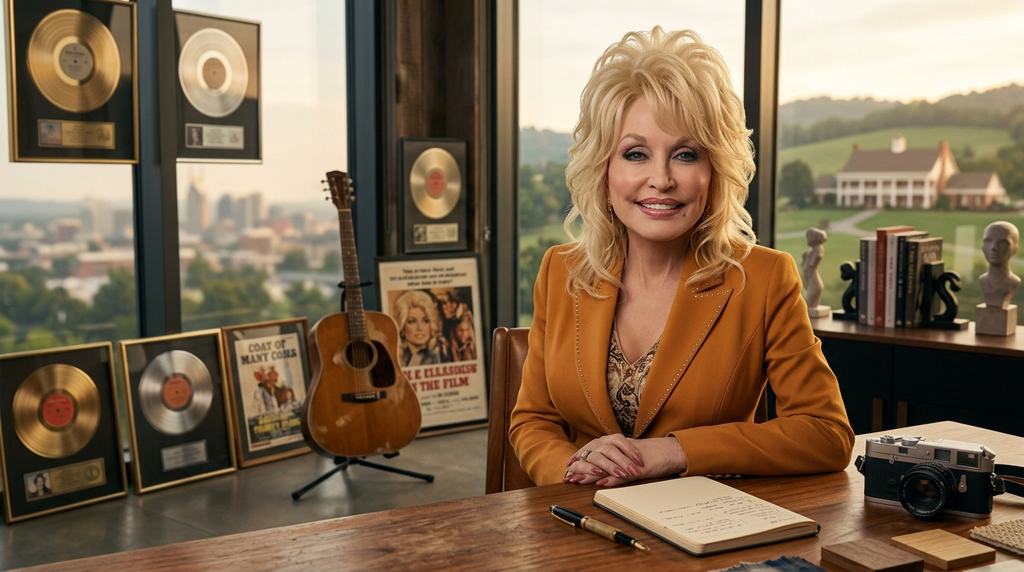
There are some celebrities you admire.
Then there are some who somehow become part of the furniture of your life.
Dolly Parton was the second kind.
You didn't have to be a country music fan to know Dolly. You knew the voice. You knew the blonde hair. You knew the eyelashes, the rhinestones, the humour, the stories about growing up poor in Tennessee.
You knew Jolene, 9 to 5, Coat of Many Colours, Islands in the Stream, Dumb blond, Here you come again. You probably knew at least one person who could sing I Will Always Love You with far more confidence than the rest of us deserved.
And now, suddenly, she's gone.
Dolly Parton died on August 25, 2026, at the age of 80. Her family confirmed her death, and her publicist said she died peacefully in Nashville. Tributes poured in almost immediately from across music, film and pop culture.
It's difficult to talk about Dolly without talking about the artist.
But I think there's another part of her story that deserves a proper goodbye too.
Dolly Parton was an extraordinary businesswoman.
Not like the stereotypical business executive.
Actually, quite the opposite.
She built an enormous business empire while remaining unmistakably Dolly.
And that might be the most interesting thing about her.
She never seemed to believe that becoming successful meant becoming less of herself.
She made herself the brand.
And then she spent decades making sure that brand stood for something.
Dolly was born in 1946 in Locust Ridge, Tennessee, the fourth of 12 children. Her family was poor, and music became part of her life early. She eventually moved from local performances to The Porter Wagoner Show, then built a solo career that would turn her into one of the biggest names in music.
As the "Queen of Country," she wrote over 3,000 songs and landed 25 singles at No. 1 on the Billboard country charts.
She won 11 Grammy Awards (including a Lifetime Achievement Award) and over 40 major music awards throughout her legendary career. She belonged to an elite group of artists who have achieved at least one nomination across all four major American entertainment awards (EGOT).
But here's where Dolly's story gets particularly interesting.
She didn't stop when the music became successful.
She expanded.
And expanded.
And then, because apparently having a legendary music career wasn't enough, she kept going.
In 1986, Dollywood opened in Pigeon Forge, Tennessee, after the former Silver Dollar City was transformed through a partnership involving Dolly and Herschend Family Enterprises.
Think about what that means.
A singer didn't simply put her face on a theme park and call it a day.
She helped create a destination built around the culture, history, music and character of the place she came from.
That's very different from slapping a celebrity's name onto a product and hoping people buy it.
Dolly understood something that plenty of modern businesses still struggle with:
A brand works best when people can actually feel the person behind it.
You knew what Dolly stood for.
She was proud of where she came from.
She was funny about herself.
She loved big hair and bigger dreams.
She didn't hide the fact that she cared about money, either.
And that part is important.
There has always been something refreshing about Dolly's relationship with success.
She didn't pretend ambition was embarrassing.
She wanted to be successful.
She wanted to make money.
She wanted to build things.
And she did.
But she also wanted those things to mean something.
That's where the story becomes bigger than business.
In 1988, she established the Dollywood Foundation, initially focused on helping children in her home county.
Then, in 1995, she launched the Imagination Library, inspired in part by her father, who couldn't read or write.
What began as a programme for children in her home county eventually grew into an international literacy programme. Dolly Parton's official site says the Imagination Library now operates across five countries and sends more than two million free books to children every month.
That is an astonishing legacy.
And I think it tells us something about the difference between having a personal brand and having a meaningful one.
A personal brand isn't just having people recognise your face.
It's what people associate with your name when you're not in the room.
With Dolly, the associations were remarkably consistent.
Talent.
Generosity.
Hard work.
Humour.
Family.
Tennessee.
Big dreams.
And, yes, fabulous hair.
She didn't need to explain her brand every five minutes because she had spent decades demonstrating it.
That's why her name could move from music into television, film, books, attractions, hospitality, philanthropy and countless other ventures without feeling completely random.
People already understood the person behind it.
And there is a lesson here for anyone trying to build something much, much smaller online.
You don't need to become Dolly Parton.
Please don't suddenly open a theme park because I said this.
You simply need to understand what people already trust you for.
Maybe you're a writer.
Maybe you're good at explaining technology.
Maybe you're brilliant at social media.
Maybe people constantly ask you how you organise your business, edit videos, find clients or use AI.
That skill is not necessarily the entire business.
It might be the beginning of one.
That's actually one of the ideas behind the one-person agency model: take something you're already good at, turn it into a clear service, and then gradually build other offers around it.
Dolly did this on a completely different scale.
She didn't abandon songwriting when she became successful.
She built businesses around the world she had already created.
And she kept giving people new ways to experience it.
That's smart.
It's also why I think her story is particularly relevant now, when we're constantly being told to reinvent ourselves.
Every few weeks, there's another platform.
Another trend.
Another "personal branding strategy."
Another person telling you that your niche is dead and you need to pivot immediately.
Dolly's career offers a rather calmer alternative.
You don't always need to become something new. Sometimes you need to become better at being known for something valuable.
She spent decades being Dolly.
And somehow, that was enough.
More than enough, actually.
She also understood the value of owning pieces of what she created.
That's an especially important lesson for creators now.
If your entire income depends on somebody else's platform, algorithm or audience rules, you're building on rented land.
Dolly built assets beyond the stage.
Her music catalogue mattered.
Her entertainment ventures mattered.
Her businesses mattered.
Her intellectual property mattered.
Her name mattered.
Her charitable organisations mattered.
The result was a career that wasn't dependent on one source of income.
Again, most people reading this aren't going to build a Dollywood.
But the principle scales down beautifully.
A freelancer can have clients and digital products.
A content creator can have social media and an email list.
A writer can have articles and paid services.
Someone using AI can offer consulting, automation, training or templates rather than simply selling hours.
You start with one thing.
Then you ask what else can reasonably grow from it.
Dolly seemed to understand that instinctively.
And perhaps the most beautiful part is that her ambition never appeared to require her to become cynical.
She could be commercially successful and generous.
She could be glamorous and grounded.
She could be extremely wealthy and still talk about her humble beginnings.
She could become one of the most recognisable people on earth without acting as though she was too important to laugh at herself.
That combination is rare.
Really rare.
Especially now.
We live in an internet culture where people can spend six months trying to manufacture a "personal brand" before anyone has actually received anything useful from them.
Dolly did the opposite.
She gave people something first.
Songs.
Stories.
Laughter.
Films.
Experiences.
Books.
Eventually, people didn't just buy things from Dolly because they liked Dolly.
They trusted that whatever she put her name behind would probably feel like something she genuinely cared about.
That's a much harder thing to build than followers.
And it lasts much longer.
Dolly Parton's legacy isn't simply that she sold more than 100 million records, earned major awards, crossed from country music into film and television, and built successful businesses. Reuters noted that her career spanned nearly six decades and that she became one of the best-selling female artists in history.
Her legacy is that she made success feel personal.
She made ambition feel joyful.
She made being from somewhere small feel like it didn't have to limit the size of your dreams.
And she proved that you could build an enormous career without sanding away every unusual, funny, distinctive part of yourself to fit the mould.
The person who seemed to understand that the most valuable thing you can build is something people feel connected to.
Dolly once built a career out of songs she wrote from the experiences she knew.
Then she built businesses around the things she believed in.
Then she used those businesses to create opportunities for other people.
That's a pretty remarkable life.
And for anyone building something from a phone, a laptop, a small room or a very modest starting point, there's something comforting in that story.
You don't need to know exactly where everything is going.
You need to know what you have in your hands right now.
A skill.
A story.
An idea.
A little courage.
And maybe a willingness to keep building long after everyone else has decided you've already done enough.
Dolly certainly did.
She gave the world decades.
She gave it songs that will probably still be played long after all of us are gone.
She gave children millions of books.
She gave her hometown a place that carries her name.
She gave audiences laughter, films, stories and memories.
And she gave aspiring entrepreneurs a lesson she probably never intended to teach:
Build something that sounds like you. Take it seriously. Keep expanding it. And never be ashamed of wanting it to succeed.
Rest well, Dolly.
The world is a little quieter without you.
But your voice is going to be around for a very, very long time.
If you have an article, opinion piece, event or news story you would like published or you are ready to begin building a profitable online content writing business from your phone or laptop, Global News Arena would love to hear from you.
Send an email to advertise@globalnewsarena.com