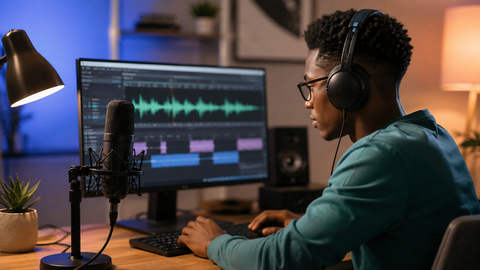

There's this image of an "agency" that involves an office, a team and a logo on a glass door.
Well, that's not the kind of agency I am referring to here.
An "agency" can be one person.
You.
That is what makes the one-person agency model so interesting for beginners.
The idea is actually very simple.
You already know how to do something useful.
Writing.
Graphic design.
Social media management.
Research.
Video editing.
Virtual assistance.
Website design.
Lead generation.
Email marketing.
Instead of treating that skill as something you occasionally help friends with, you turn it into a clear service that someone can actually pay for.
That's the shift.
A skill is not automatically a business.
Let's say you're good at writing.
Don't just tell people:
"I'm a writer."
Tell them what you actually do.
"I help small businesses turn their expertise into weekly blog content."
Now there's something to understand.
I explored this in greater detail here.
Or maybe you're good at social media.
Instead of:
"I manage social media."
You could offer:
"I create and schedule four weeks of social content for small businesses that don't have time to manage their pages."
Much clearer.
The customer doesn't have to guess what they're buying.
That's one of the biggest mistakes beginners make.
They think they need more skills when what they really need is a clearer offer.
You can know how to do twenty things and still struggle to get clients if nobody understands what you're actually selling.
Meanwhile, someone with one useful skill and a very specific offer can be much easier to hire.
That's why I keep coming back to the idea that you don't need huge capital to start an online business.
You need usefulness.
I've written about this in Small Businesses are Desperate for this one thing, and you can provide it with zero experience.
The first version can be extremely simple.
Your phone.
Your laptop.
A portfolio.
A clear service.
A way for people to contact you.
A price.
That's enough to start testing whether anyone actually wants what you're offering.
You can improve the branding later.
You can build a bigger website later.
You can hire people later.
The first job is finding out whether the problem you're solving is valuable enough for someone to pay you.
And yes, your first invoice will probably feel weird.
You'll stare at the amount.
You'll wonder whether you're charging too much.
Then you'll wonder whether you're charging too little.
You'll probably rewrite the message three times before pressing send.
Send it anyway.
Because there's a huge psychological difference between saying, "I want to freelance," and actually sending somebody an invoice.
One is an idea.
The other is a business transaction.
Technology also makes the one-person agency model much more realistic than it used to be.
You can use AI to help with research.
Scheduling tools can handle appointments.
Email systems can follow up with leads.
Platforms like Auxi Sherpa now bring together services including AI research, lead generation, website design, SEO, email marketing and business automation, which means a solo operator can access infrastructure that previously required a much larger team.
That doesn't mean technology does the business for you.
You still need to find customers.
You still need to deliver good work.
You still need to communicate.
You still need to solve problems.
But you don't need to personally do every tiny administrative task forever.
That's the real advantage.
The one-person agency isn't about pretending you're a giant company.
It's about taking one useful skill seriously enough to package it, price it and sell it.
No fancy office required.
No giant team required.
Just a useful skill, a real problem and the courage to send the first invoice.
Frequently Asked Questions
What is a one person agency?
It's a solo business model where one person offers a specific service, writing, design, admin support, as a structured, priced offering rather than an informal favor.
Do I need a business registration to start this?
Not necessarily at the very beginning, though formalizing your business becomes more important as it grows.
How do I price my service as a beginner?
Research what others with similar experience charge, and start at a reasonable rate you can confidently justify based on the value you deliver.
Can a one person agency really replace a full time income?
Yes, over time, especially once you build a steady base of repeat clients paying for ongoing work.
What's the hardest part of starting a one person agency?
Usually sending that first invoice and treating your skill as a real, paid service instead of an informal favour.
If you have an article, opinion piece, event or news story you would like published or you are ready to begin building a profitable online content writing business from your phone or laptop, Global News Arena would love to hear from you.
Send an email to advertise@globalnewsarena.com