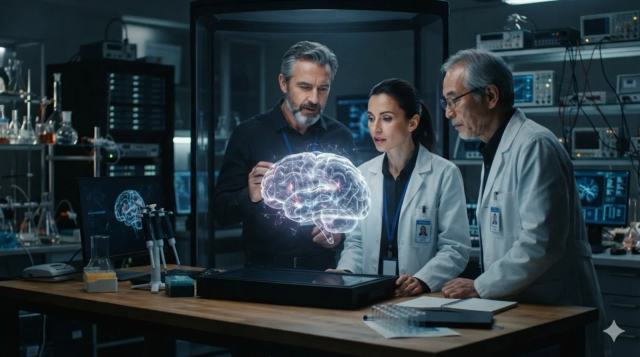
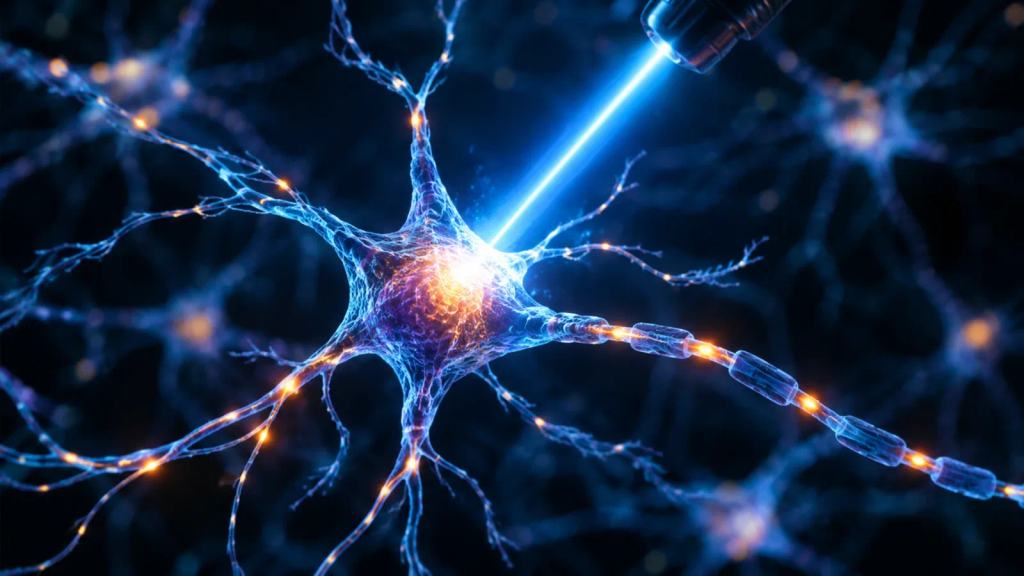
The method is called optogenetics. It allows researchers to control selected nerve cells by making them sensitive to light.
This has given scientists a new way to understand how different parts of the brain work.
The story began with research into a tiny single celled alga.
Scientists Peter Hegemann and Georg Nagel were interested in how the organism sensed light and used it to move.
Their research led them to light sensitive proteins called Channelrhodopsins.
When light reaches these proteins, they open and allow charged particles to move through a cell. This creates an electrical signal.
The discovery became even more important when scientists realized that the light sensitive protein could be placed inside other types of cells.
This meant that cells that were not naturally sensitive to light could be given a new ability.
Karl Deisseroth and his colleagues took the idea further by using the proteins in nerve cells.
They showed that light could be used to control the electrical activity of those cells. This created the foundation for optogenetics.
The technique changed brain research because scientists could target particular groups of nerve cells. They could then study what happened when those cells were switched on or off.
Researchers have used optogenetics to investigate areas connected to memory, movement, emotions, sleep and behaviour.
The method has also helped scientists study conditions affecting the brain and nervous system.
Medical uses are still being developed, so it is important not to treat the technique as an established cure.
However, researchers are exploring its possible use in areas such as restoring vision and treating neurological conditions.
What makes the story remarkable is where it started.
A question about how a tiny organism senses light eventually helped scientists develop a tool for studying the human brain.
That journey shows how basic scientific research can lead to discoveries that change an entire field.
What began with a small organism and a simple question has become one of the important tools used to understand the brain.
If you have an article, opinion piece, event or news story you would like published, Global News Arena would love to hear from you.
Send a message to Global News Arena Contact.