For a long time, I thought a low follower count meant nobody would take me seriously online.
I doubt I'm the only one who has felt like that.
You meet someone new, tell them you create content or run a small business online, and
eventually they check your page.
1,200 followers.
Maybe 700.
Maybe 300.
And you can almost feel the unspoken question, "Wait, is this person actually successful?"
We've turned follower count into a little public scoreboard of importance. Bigger number,
more legit. That's the vibe anyway.
So I spent way too much time chasing that number. How to get more, how to make posts
reach further, how to make my page look bigger. Then I asked myself something less
comfortable, what if I'm spending all this energy attracting people who will never actually
need what I offer?
That question changed everything.
10,000 followers sounds impressive on paper. But 100 people who genuinely trust you, read
your stuff, recommend you, actually buy from you? That's a completely different level of
valuable.
A follower is not automatically a customer.
Not automatically a reader.
Not automatically anything, really, just someone who clicked a button once.
What happens after that click is the actual story.
Think about your own following list. How many accounts do you actually remember, out of
hundreds you follow?
Probably a small fraction. Half of them you followed for one funny video and forgot they
existed a little while later .
So an audience isn't really the number beside your profile picture.
It's the relationship with whoever's actually paying attention.
Let’s say you're a photographer or ghostwriter with 500 followers.
Fifty read your stuff regularly.
Ten have shared it.
Five asked about your services.
Two already hired you.
That account looks tiny next to someone with 100k followers, but if those two clients keep
paying you and referring you to others, your 500 is quietly outperforming a much bigger,
emptier number.
Attention and value are not the same thing.
Which means the better question isn't "how do I get more followers?" It's "how do I become
useful to the people already here?"
If you teach, teach well.
If you write, write things worth reading.
If you sell a service, prove you actually understand the problem.
Usefulness is what gives people a reason to stick around.
Easy to forget though, especially when your feed keeps showing someone else gaining 50k
in three months or announcing a six figure launch off one viral post. Suddenly your own little
progress feels embarrassing, and you start thinking you need a new niche, five posts a day,
more controversy, copy whatever's working for the big accounts.
But the issue isn't slow growth. It's measuring the wrong thing entirely.
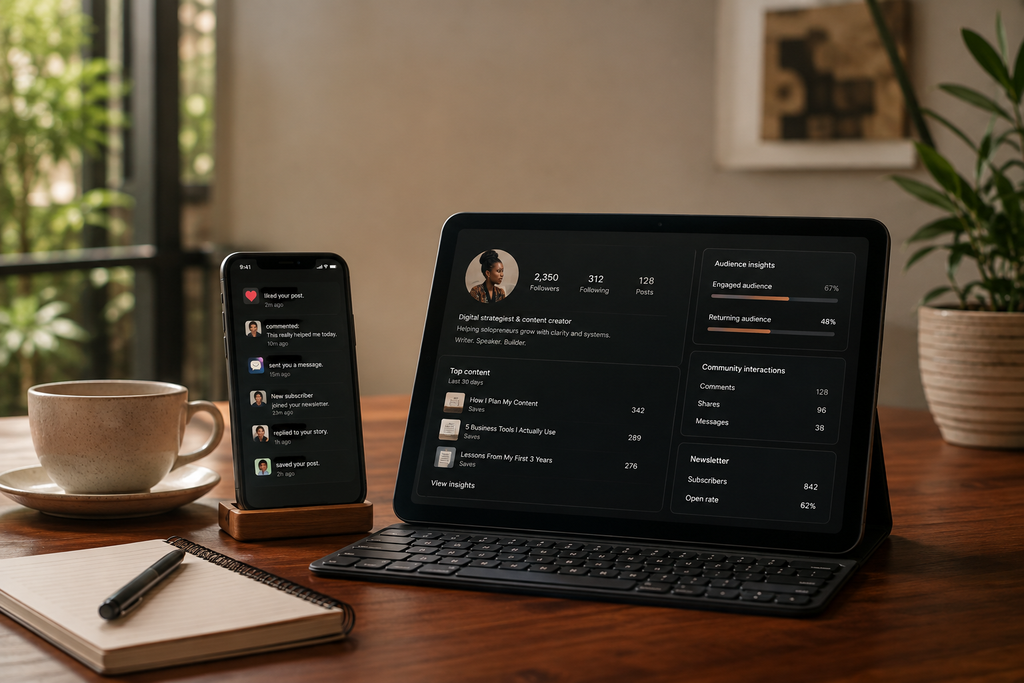
Instead of counting new followers this month, try counting who actually read your work.
Who replied.
Who saved something.
Who visited your website.
Who asked about your service.
Who joined your list.
Who came back.
Who told someone else about you.
Less exciting on a screenshot. Way more useful in real life, because it tells you whether
people genuinely care, and caring is the whole game if you're building a business.
This is also why an actual platform you control matters, not just social media. Social media is
great for discovery, someone stumbles on your post today, cool.
But tomorrow, the algorithm decides what they see next, and they might just never see you
again.
An email list is different, someone handing over their email is basically saying "I want to hear
from you again," and that's worth more than a follow ever was.
You don't need 100,000 people on that list either. Fifty people who genuinely want your
advice, growing to a hundred, then five hundred, all of them trusting you enough to actually
read, reply, and eventually buy, that's an audience doing real work.
Same logic applies to your website, your articles, your portfolio, a solid guide, a digital
product, a good reputation.
None of these show up as a flashy number, but they keep working for you long after you've
stopped thinking about them. Not everything has to disappear after 24 hours or exist purely
for a viral moment.
That's part of what makes something like Auxi Sherpa interesting to me. Using social media
to help people discover you, your website to give them somewhere to go deeper, and email
automation to keep the relationship alive without you personally remembering to welcome
every new subscriber or send every follow up. The system handles these parts so you can
focus on actually creating something worth sending. The goal was never to automate the
relationship, just to make it easier to maintain one.
And honestly, this is where AI makes things even more interesting. It's made producing
content faster, turning one idea into five formats, speeding up research, automating the
boring parts. But faster production doesn't mean every business should just make more
content. If anything, when everyone can produce more, being genuinely useful becomes
rarer, and rarer means more valuable.
Original thinking.
Real experience.
Actual trust.
Knowing your specific audience.
These all get more valuable exactly when everyone else is drowning the internet in generic
AI generated noise.
Nobody needs another 500 posts telling them to "believe in themselves."
So I'd rather have a smaller audience that actually gets what I do than a huge one that
followed because of one lucky viral post.
To be clear, growth still matters.
Reach still matters.
A bigger audience opens doors, makes launches easier, attracts partnerships.
But please, stop treating them as the only proof that you're making progress.
There are writers landing clients from a handful of readers.
Creators selling to small, tight communities.
Consultants with barely any followers but a strong reputation in their specific
industry.
Freelancers who get most of their work through referrals, never a single viral post.
The internet can reach millions, sure, but your actual business might only need a few
hundred of the right people.
Which is a much less scary goal than "go viral” or “blow."
It also changes what you even create.
Instead of "what gets the most views," ask "would the right person find this genuinely
useful?”
Instead of "how do I get another thousand followers?", ask "how do I make the people
already here trust me more?"
Completely different questions, completely different content.
Your audience will basically tell you what to build if you're paying attention, the comments,
the questions people keep asking, the "I wish you had something for this" messages. Those
are all clues. You don't have to guess everything blind.
Building online is mostly building a small group of people who
actually understand why your work matters to them. That takes time, and some months it'll
feel painfully slow, 14 likes on something you spent hours making, an article nobody reads, a
first sale that comes weeks later than you hoped.
Sometimes you're just building the part nobody can see yet,
getting better at writing, learning your audience, figuring out how to sell, building your
portfolio, becoming more confident. That stuff compounds even when the follower count
refuses to move.
So if you're staring at your page wondering why the numbers aren't there yet, don't delete
everything and start copying someone else's whole approach. Look at the people already
there. Ask what they came for, what they actually need, what you can consistently give them.
Build from that.
You might realise you were never actually missing followers. You were missing a real
relationship with the people who were already watching.
Followers can make you look popular. Trust makes you valuable.
If I'm building a business, I know which one I'd rather have.
If you have an article, opinion piece, event or news story you'd like to publish or you're ready to begin building a profitable online content writing business from your phone or laptop, Global News Arena would love to hear from you.
Send an email to advertise@globalnewsarena.com