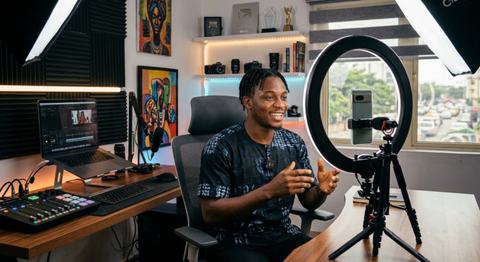
I have always believed that some of the biggest business opportunities don't begin with a huge office, a large team, or millions in funding.
Sometimes, they begin with an idea and a smartphone.
That is why I find the direction of women's entrepreneurship particularly interesting today. Women are no longer simply entering industries that already exist; they are creating businesses around digital skills, online communities, content, education, technology, consulting, e-commerce and services that can reach customers anywhere in the world.
For me, the most exciting part isn't simply that more women are becoming entrepreneurs. It is that the barriers to getting started are changing.
You can learn a skill online. You can find customers through social media. You can communicate with clients through your phone. You can create a digital product without renting a physical shop. You can build an audience before you even have a traditional business.
That doesn't mean building an online business is easy.
It means the starting point is more accessible than it used to be.
And if you're a woman wondering whether digital entrepreneurship is something you can realistically pursue, I think the first step is to stop asking, "What business is everyone else doing?" and start asking, "What problem can I solve?"
That question can lead you somewhere much more valuable.
One mistake I see aspiring entrepreneurs make is believing they need to learn everything before they can start.
You don't.
You need to identify something you already understand or are willing to learn deeply enough to become useful at.
Maybe you're good at writing.
Maybe you understand social media.
Maybe you're an excellent organiser.
Maybe you know fashion, beauty, education, finance, food, photography or another specialised area.
Your knowledge doesn't have to be extraordinary.
It simply needs to solve a problem for someone else.
That is the foundation of a digital business.
For beginners, selling a service can be one of the simplest ways to enter the online economy because you don't necessarily need inventory or a physical location.
A woman who understands social media could offer social media management. Someone with strong writing skills could provide copywriting. A person who understands how businesses find customers could offer lead generation. Someone who knows how to communicate with customers effectively could provide email marketing services.
In fact, "Auxi Sherpa's Lead Generation service" and "Email Marketing service" show how these skills can also become practical business services helping companies find potential customers and stay connected with them.
There is another opportunity I find particularly interesting: digital products.
Instead of exchanging your time for money every single time, you can package your knowledge into something that can be sold repeatedly.
That could be an ebook, template, checklist, workbook, course, guide or collection of useful resources.
A teacher could create revision materials. A designer could create templates. A business consultant could package their knowledge into a practical guide for new entrepreneurs.
The goal isn't to create something complicated.
The goal is to create something useful.
Content creation has also become an important part of digital entrepreneurship.
You don't necessarily need millions of followers.
You need the right audience.
Useful content can build trust, and trust can create opportunities for services, digital products, affiliate marketing, partnerships and other legitimate income streams.
This is why I see content less as "posting on social media" and more as building an asset.
But having a great product isn't enough.
People need to know it exists.
That is why learning how to attract customers, communicate your value and build relationships is just as important as creating the product itself.
One thing I would strongly encourage beginners to avoid is trying to launch five different businesses simultaneously.
Start with one.
Maybe your first goal is to earn your first ₦50,000 from a service.
Then find another customer.
Improve your offer.
Build a portfolio.
Collect testimonials.
Increase your prices as your expertise grows.
Later, you might add a digital product, affiliate marketing, content creation or another service.
A digital business can evolve. It doesn't have to be perfectly designed on day one.
Your smartphone can become your communication centre, research tool, content studio, customer-service desk, marketing platform and even your storefront.
Of course, as your business grows, you may eventually need better equipment or additional tools.
But don't let the absence of expensive equipment become an excuse for never starting.
Start with what you have.
Improve as you grow.
Technology may create opportunities, but technology alone doesn't create successful entrepreneurs.
Mindset matters.
Consistency matters.
Learning matters.
Customer service matters.
Financial discipline matters.
The ability to adapt matters.
And perhaps most importantly, patience matters.
When I think about the future of women's entrepreneurship, I don't imagine every woman becoming a technology founder.
I imagine something broader.
I see women turning professional skills into online services.
I see teachers creating digital learning businesses.
I see creatives building global audiences.
I see consultants selling expertise across borders.
I see women creating digital products from knowledge they once considered ordinary.
I see small businesses using online tools to reach customers they could never have reached through a physical shop alone.
And I think that is the real opportunity.
Digital entrepreneurship doesn't mean abandoning traditional businesses.
It means giving entrepreneurs another way to create, market, sell and grow.
The future will belong to women who are willing to learn, experiment and adapt.
You don't need to know exactly where the journey will take you.
You simply need to take the first step.
Maybe that first step is learning a skill.
Maybe it is creating your first digital product.
Maybe it is offering your first online service.
Maybe it is publishing your first piece of useful content.
Maybe it is simply turning the idea you've been carrying around for years into something you can finally test.
The opportunity is there.
And sometimes, the biggest difference between an idea and a business is simply the decision to begin.
If you have an article, opinion piece, or news story you'd like published on Global New Arena, or you're ready to begin your journey toward building a profitable digital business from your phone, or you'd like to advertise with us, I'd love to hear from you. Send us an email here and let's start the conversation.
Read more at Global News