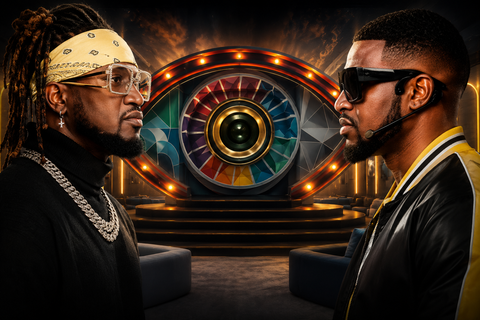
There is something about the P-Square story that keeps making me stop and say, “Wait. So what exactly happened here?”
And I know I am not the only one.
Because every time I think I have finally understood the whole story, another person speaks, another allegation comes out, another old event suddenly becomes relevant, and I find myself going back to the beginning again.
Peter has said his part.
Paul has responded over the years.
Jude has had his own position.
Now other members of the Okoye family are speaking.
There are court proceedings.
There are old interviews resurfacing.
There are social media posts.
There are people who have been following this family for decades, and there are younger Nigerians who are discovering P-Square for the first time and wondering why everybody is talking about two brothers who seem to have been famous since forever.
And honestly, I think that is what makes this particular story so fascinating.
It isn't just a celebrity quarrel.
It is a story about two brothers who became one of Africa's biggest music acts, an older brother who was deeply involved in the business, a family that built an entertainment empire together, and the complicated relationship between family, money, trust and ownership.
And before I go any further, let me say this because I think it is important.
I am not writing this to decide who is right and who is wrong.
I wasn't there when these conversations happened.
I wasn't sitting in the room when business decisions were made.
I didn't see the financial documents myself.
And some of the things being discussed publicly are allegations that are either disputed or are part of ongoing legal proceedings.
So I am going to tell you what I can establish from the public record, explain what each side has said, and leave the court to do what courts are supposed to do.
But before we get to the drama, we need to remember who P-Square actually were.
Because I sometimes wonder whether younger Nigerians understand just how big these two brothers were.
Peter and Paul Okoye were not simply two brothers who made music together.
They were P-Square.
And for a particular generation of Nigerians, that name brings back an entire era.
“Do Me.”
“No One Like You.”
“E No Easy.”
“Beautiful Onyinye.”
“Chop My Money.”
“Personally.”
“Alingo.”
These weren't songs you casually listened to.
They were everywhere.
At weddings.
At parties.
In clubs.
On television.
On radio.
On those little phones we used to pass music from one person to another.
P-Square had the songs, but they also had the dancing, the videos, the fashion and the showmanship.
And because they were twins, there was something about watching them perform together that was difficult to reproduce.
They looked alike.
They dressed alike.
They danced together.
They moved together.
They seemed to understand each other without saying anything.
That image became part of the brand.
And behind the two performers was their older brother, Jude Okoye, who became closely associated with the management and business side of P-Square.
This is where the story begins to become complicated.
Because family businesses can be beautiful when everybody is working towards the same goal.
But family businesses can also become extremely complicated when people stop agreeing about money, responsibility, ownership and who gets to make decisions.
And that is not a P-Square problem alone.
It happens in ordinary Nigerian families every day.
The difference is that when it happens in an ordinary family, perhaps five people know about it.
When it happens in the Okoye family, millions of people are watching.
The cracks in the P-Square relationship became increasingly visible around 2016.
Peter publicly objected to Jude's role as manager, and the disagreements eventually became serious enough that the twins went their separate ways professionally. Peter became Mr P. Paul continued as Rudeboy.
For fans, it was painful.
Because nobody likes seeing a successful family partnership fall apart.
But I think there was something else that made the P-Square breakup particularly painful.
People had invested emotionally in the idea of these brothers.
They had grown up watching them succeed together.
So when they separated, Nigerians didn't see it as simply a music group breaking up.
It felt like a family had broken apart in public.
Then, in 2021, something happened that many people had almost stopped believing was possible.
Peter and Paul reunited.
The twins embraced.
P-Square was back.
And Nigerians celebrated.
I remember the feeling around that reunion. It was almost as if everybody had collectively decided, “Okay, enough. Let these two people be brothers again.”
And for a while, it looked as though the story had found its happy ending.
Unfortunately, it didn't last.
The relationship deteriorated again, and this time the issues being discussed were much more serious.
Money became central to the conversation.
Business arrangements became central.
And the dispute eventually moved beyond social media into the legal system.
Jude Okoye was arraigned by the Economic and Financial Crimes Commission over allegations involving large sums of money, including approximately ₦1.38 billion, $1 million and £34,537.59. He pleaded not guilty to the charges.
That is an important distinction.
He has been accused. He has not been convicted.
I keep coming back to that because social media has a way of turning allegations into facts within five minutes.
Somebody makes a claim.
Someone screenshots it.
Another person adds their own interpretation.
By the time the story gets to the tenth person, the original allegation has somehow become a confirmed fact.
That is not how truth works.
And the P-Square story is a perfect example of why we need to slow down.
Peter has publicly made serious allegations about the management of the P-Square business and has described what he believes was a long period of financial betrayal.
Paul has disagreed with his twin and has publicly defended Jude.
And as the legal proceedings have developed, some of the financial and company arrangements have become more complicated than the simple version of the story circulating online.
At one point, Peter acknowledged in court that he was a co-signatory to a Northside Entertainment account after defence counsel presented bank mandates showing that Peter and Paul were also signatories.
That doesn't automatically tell us who is right about every other aspect of the dispute.
But it does tell me something important.
The real story is probably much more complicated than the version we consume on Instagram.
And that is why I have become particularly interested in what has happened in the last few days.
Because just when you think the story has reached its limit, another family member enters the conversation.
Tony Okoye, one of the older Okoye brothers, has now publicly challenged some of the narratives surrounding Jude's role in P-Square's management.
Henry Okoye has also spoken publicly about the family history and Jude's influence.
Jude's wife has responded to allegations involving her name.
Paul's wife has also found herself being discussed by social-media users simply because she is connected to the family.
This is where I start feeling uncomfortable.
Because there is a point where public interest can become public intrusion.
Just because someone is married to one of the people involved doesn't mean they automatically know every detail of the dispute.
Just because someone is a sibling doesn't mean they have every piece of information.
And just because someone is famous doesn't mean every private pain automatically belongs to us.
I understand why people are interested.
I am interested too.
But there is a difference between wanting to understand a story and turning somebody else's family crisis into a spectator sport.
Still, I cannot ignore the fact that Nigerians are watching.
And watching very closely.
The latest wave of Peter's revelations has almost taken on the structure of a television series.
Part one.
Part two.
Part three.
And somehow we got to Part 8b.
Part 8b!
At that point, I had to laugh.
Because only on Nigerian social media can somebody's family dispute become an episodic production, with the audience demanding the next instalment.
People are literally asking other people to summarise the story for them because there are now so many pieces that they cannot keep up.
That reaction itself tells us something.
The story is no longer simply about P-Square.
It has become a story about curiosity.
People want to know what happened.
They want to know who knew what.
They want to know when things went wrong.
They want to know whether the twins can ever reconcile.
They want to know what Jude's role really was.
They want to know whether the financial allegations will be established in court.
And, perhaps most importantly, people want to know whether the picture they had of P-Square all these years was ever the complete picture.
That is a very human curiosity.
We are naturally drawn to stories where the people involved appear to have everything and yet something underneath the surface is falling apart.
But there is another part of this story that I find even more interesting.
The music.
Because while Peter, Paul, Jude and other members of the family are having this very public dispute, something rather beautiful is happening to P-Square's old catalogue.
People are going back to the music.
P-Square's older albums and songs have been receiving renewed attention, with Best of P-Square recently climbing Nigeria's Apple Music album chart amid the renewed family controversy. Their catalogue is being rediscovered and replayed by people who remember the group and by younger listeners who are only now discovering them.
And I think that is one of the most interesting things about the entire story.
Because it reminds me that good work can outlive the person who created it.
Think about that.
Years after those songs were released, people are still listening.
Years after the videos were made, people are still watching.
Years after the group stopped functioning as it once did, the brand still has power.
That is what happens when you build an asset.
And this is the point where, whenever I write stories like this, my mind naturally goes somewhere else.
I start thinking about the rest of us.
Because while we are watching famous people argue about money, business and ownership, how many of us are building anything that can actually belong to us?
How many of us are creating something today that people can still find five years from now?
Maybe it is a website.
Maybe it is a blog.
Maybe it is a YouTube channel.
Maybe it is a course.
Maybe it is a digital product.
Maybe it is a collection of articles.
Maybe it is a personal brand.
Maybe it is a business.
Maybe it is simply a skill that we can keep selling.
The smartphone in your hand is capable of far more than entertainment.
It can be your classroom.
It can be your office.
It can be your publishing platform.
It can be your design studio.
It can be your sales desk.
It can be the place where you find your first client.
And I say this often because I genuinely believe it: one of the biggest differences between people who will make money in the digital economy and people who will remain spectators is what they choose to do with the technology already available to them.
You don't have to become P-Square.
You don't need millions of followers.
You don't even need a big office.
You can start by learning one useful skill.
For example, there are courses around Entrepreneurship 101, Personal Branding, Digital Marketing, Freelancing Foundations, AI Literacy, Prompt Engineering, Content Creation and Video, Graphic Design and other skills that can help someone move from simply consuming digital content to actually creating value with technology at Happy Face Academy.
And when you are ready to build, there are practical digital business services that can help with things like websites, SEO, lead generation, social media, AI automation, blogging automation and WhatsApp automation.
I am not saying this because I want to turn a P-Square article into an advert.
That would completely miss the point.
I am saying it because every time I see a story about somebody who built something valuable, I find myself asking what the rest of us can learn from it.
P-Square built music.
They built a catalogue.
They built a brand.
They built memories.
And those things are still working for them years later.
That is what I want more people to understand about the internet.
Don't just post.
Build.
Don't just go viral.
Create an asset.
Don't just chase today's attention.
Create something that tomorrow can still find.
And perhaps there is another lesson hidden inside the P-Square story that is even more important.
If you are going into business with your family, document things.
Please.
Document things.
Have agreements.
Know who owns what.
Know who does what.
Know how money comes in.
Know how money goes out.
Keep records.
Separate roles.
Create systems.
It is not because you don't love your family.
In fact, sometimes you put systems in place precisely because you do love your family.
Good systems don't necessarily mean you don't trust people.
Sometimes they are what protect relationships when money becomes complicated.
We may never know every private conversation that happened between Peter, Paul, Jude, and the rest of the family.
Maybe some of the things we are hearing now will eventually be confirmed.
Maybe some will be disproved.
Maybe there will be another reconciliation.
Maybe there won't.
The courts will deal with the matters before them.
The people involved will have to live with whatever decisions they make.
But there is one thing I know.
P-Square created something powerful.
And whatever happens between Peter and Paul, their music has already travelled beyond their personal disagreements.
Their songs are now being rediscovered by younger Nigerians.
Their old work is finding new listeners.
Their story has become a subject of national conversation.
And perhaps that is the part I want us to remember.
Build something that is bigger than the moment.
Because trends disappear.
Arguments end.
People move on.
But a valuable thing you create can keep speaking long after the conversation that created it has ended.
So yes, I will probably continue following the P-Square saga because, frankly, at this point, I also want to know how this story ends.
But I hope that somewhere between watching Part 8b and waiting for Part 9, we remember to look at our own lives too.
What are we building?
What skill are we learning?
What business are we creating?
What digital asset are we leaving behind?
Because it is very easy to spend three hours watching somebody else's story unfold and then realise that you have spent another day doing nothing with your own.
And I don't want that for you.
If you have an opinion, a story, an analysis or a perspective that deserves to be heard, don't keep it in your phone. Write it. Send it to us. There is room for more voices, more perspectives and more meaningful conversations on Global News Arena.
And if what this story has made you realise is that you need to stop being only a consumer of the internet and start building something with it, then start small. Learn a skill. Pick an idea. Use the phone you already have. Find a problem you can solve. And begin.
You don't have to know everything.
Nobody begins at the top.
If you are ready to advertise with us, or you have an article, opinion piece, or news story you'd like published on Global News Arena, I'd love to hear from you. Send me an email.
Read more at Global News Arena.