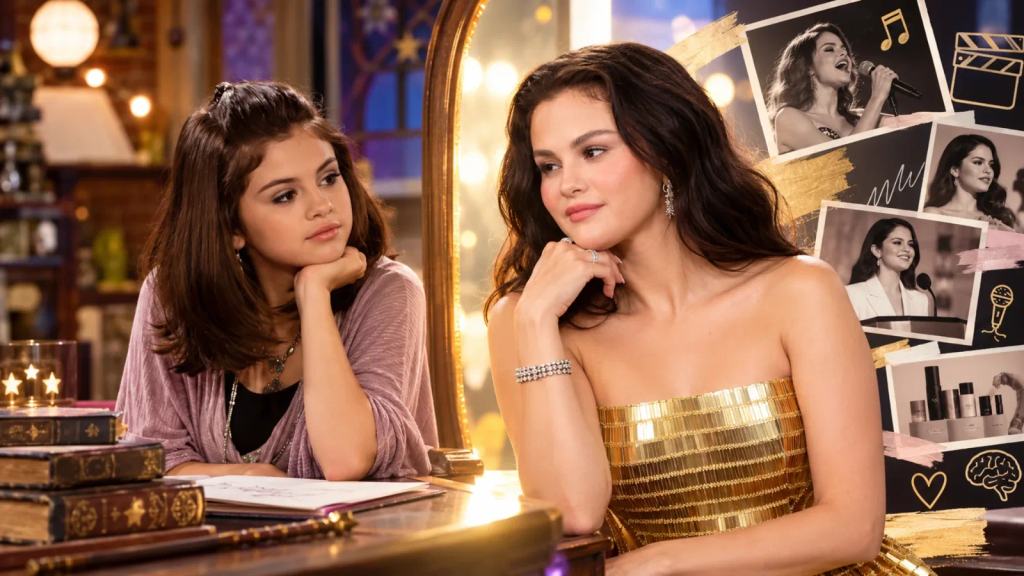
Before Selena Gomez became one of the most recognisable women in entertainment, she was a little girl from Texas watching her mother pursue acting and discovering that she, too, wanted to be part of that world. Before millions of people knew her face, she was learning lines, standing in front of cameras and taking her first uncertain steps into an industry that can turn childhood dreams into adult expectations long before a person is ready for them.
Today, I look at Selena Gomez and see a career that refuses to sit neatly inside one label. She is an actress who became a pop star, a singer who returned to acting, a businesswoman who built a beauty company around self-acceptance, and a public figure who has spoken openly about experiences many celebrities would prefer to keep private. She has also become part of an extraordinary musical bridge between American pop and Nigerian Afrobeats thanks to her collaboration with Rema on the remix of “Calm Down.”
But if we reduce Selena's story to the Disney years, her relationships, her health challenges or even the enormous success of Calm Down, we miss the most interesting part. Her career is not simply a succession of celebrity milestones. It is a story about what happens when a person grows up in front of the world and then tries to decide, as an adult, who she wants to become.
Selena Marie Gomez was born on July 22, 1992, in Grand Prairie, Texas. Her parents, Amanda “Mandy” Cornett and Ricardo “Rick” Gomez, were young when they had her. Her mother was a teenager, and Selena was named after the late Tejano music icon Selena Quintanilla. That name would become part of a very different musical story, although the two singers would ultimately share a connection through their place in the wider world of Latin American and American popular culture.
Selena's parents separated when she was five. Her mother raised her through a period when money was tight and work was not always easy to find. Selena has spoken about how her mother worked multiple jobs and made sacrifices to give her a good childhood. The family did not have much, but she remembered her mother finding ways to make ordinary experiences feel special.
That detail matters to me because it offers a glimpse of the life behind the polished photographs. Long before Selena had stylists, professional makeup artists and a global audience, she was a child whose mother was working to create opportunities for her. Her early life was not the glamorous Hollywood story people might imagine when they see the celebrity she eventually became.
The entertainment industry entered her world partly through her mother, who had aspirations of becoming an actress. Selena accompanied her to rehearsals and became interested in what happened on set. The camera, the performance and the process of creating a character began to feel familiar. It was not yet a global career or a carefully planned brand. It was a young girl discovering that performing could be exciting.
Her first major television opportunity came through Barney & Friends, the children's programme that introduced her to professional acting. She appeared on the show in the early 2000s, where she also crossed paths with another young performer who would later become famous in her own right: Demi Lovato. At the time, neither girl could have known how much their lives would change as they moved through the machinery of children's entertainment.
For Selena, Barney & Friends was an early training ground. It taught her how to work on a set, deliver lines and perform for an audience. Yet children's television is rarely the final destination for a young actor. Many performers disappear from public view when their early roles end. Others spend years trying to escape the image created by the programmes that first made them famous.
Selena's next breakthrough came when she joined the Disney Channel generation that would shape a significant part of late-2000s youth culture.
In 2007, she became the star of Wizards of Waverly Place, playing Alex Russo, a clever, mischievous teenager from a family of wizards. Alex was not the perfect, obedient heroine. She was witty, sometimes selfish, occasionally irresponsible and usually confident that she could talk her way out of trouble. That combination made her entertaining, and Selena's performance helped turn the series into one of Disney Channel's most recognisable shows of its era.
The series ran until 2012, and its success established Selena as a household name among young audiences. She was no longer just a child actor with a handful of appearances. She was the face of a popular television franchise, and her image was becoming familiar to millions of viewers.
But childhood fame comes with a complicated bargain. Adults make decisions about contracts, publicity and career direction while young performers are still learning who they are. Fans may feel that they know the person behind the character, even though they have only seen a carefully edited version of that person. And when a young actor grows older, the audience that once adored them may struggle to accept the changes that come with adulthood.
Selena eventually had to navigate that transition herself. The challenge was not simply to stop being Alex Russo. It was to build a career that could survive after the character became part of television history.
She did not abandon music while acting. In fact, music had been growing alongside her screen career. She recorded songs for film and television projects before becoming the lead singer of Selena Gomez & the Scene, the pop band that released Kiss & Tell in 2009. The group followed with A Year Without Rain in 2010 and When the Sun Goes Down in 2011.
Songs such as “Naturally,” “Who Says” and “Love You Like a Love Song” helped establish Selena as a pop performer beyond her acting work. The band format gave her a way to build a music audience while still benefiting from the recognition she had gained through Disney. It also introduced an important question that would follow her throughout her career: was she primarily an actress who sang, or a singer who acted?
Perhaps the answer was never going to be simple.
When Selena Gomez & the Scene ended its run, Selena moved into a solo career. Her debut solo studio album, Stars Dance, arrived in 2013. It marked a change in presentation, with a more dance-driven pop sound and songs such as “Come & Get It” and “Slow Down.” She was beginning to move away from the image of the teenage television star and towards a more mature musical identity.
That shift became more pronounced with Revival in 2015. The album presented a more self-assured Selena, with songs including “Good for You,” “Same Old Love” and “Hands to Myself.” The project was an important point in her evolution because it allowed her to approach pop music with a stronger sense of personal identity. She was no longer simply extending the reach of her Disney fame. She was trying to define what her own adult career could sound like.
There is a difference between growing older in private and growing older while millions of people have opinions about your appearance, relationships, choices and personality. For Selena, the transition was intensified by the public's interest in her private life. Her relationships, especially her on-and-off relationship with Justin Bieber, became subjects of relentless attention. Headlines and online discussions frequently treated her romantic life as though it were the main plot of her career.
I think this is one of the more revealing tensions in Selena's story. She was building a body of work, exploring new sounds and taking on acting projects, yet public conversation often returned to whom she was dating or what her relationships might mean. That is a familiar problem for women in entertainment: the work can be substantial, but the personal life is often treated as the more marketable story.
Selena continued to release music and take on film and television roles, but her path was not uninterrupted. She also faced health challenges that would eventually change how she spoke about her life and what she wanted to do with her public platform.
In 2015, Selena publicly confirmed that she had been diagnosed with lupus, an autoimmune disease. Lupus can affect different parts of the body and can involve symptoms such as fatigue, pain and inflammation. In Selena's case, the illness became serious enough that she needed a kidney transplant in 2017.
Her friend Francia Raísa donated a kidney, an extraordinary act that Selena later discussed publicly. The surgery and recovery were not simple. Selena subsequently spoke about complications during the operation, including a frightening moment when doctors had to address an unexpected issue. The experience made clear that her health struggles were not abstract details in a celebrity profile. They were real medical challenges with consequences for her daily life and future.
It would be easy to turn this part of the story into a neat narrative about adversity making someone stronger, but I am not convinced that human suffering needs to be packaged so neatly. Illness does not automatically produce wisdom, and recovery does not mean every difficult day disappears. What Selena's openness did, however, was make an often misunderstood illness more visible to an audience that might otherwise have known very little about it.
She also spoke about anxiety and depression, and in 2020 she publicly discussed her bipolar disorder diagnosis. Her willingness to share parts of that experience helped shift the conversation around mental health, particularly for fans who had grown up watching her and now found themselves dealing with their own challenges.
The 2022 documentary Selena Gomez: My Mind & Me offered a particularly personal look at her life and mental health journey. Rather than presenting a flawless celebrity portrait, the documentary explored difficult periods, uncertainty and the effort involved in finding a way forward. Selena has spoken about how hard the film was to watch and how vulnerable she felt about allowing the public to see so much of her life.
I think that decision reveals something important about the difference between celebrity exposure and genuine openness. A famous person can share hundreds of photographs and still reveal very little about themselves. To discuss mental health, illness and the limits of one's own control is a different kind of disclosure. It risks misunderstanding, criticism and the possibility that people will reduce an entire person to the hardest chapter of their life.
Selena's story did not end with those experiences. She continued working, making music and acting, while also building a business that would become a significant part of her identity.
In January 2020, she released Rare, her third solo studio album. The record included “Lose You to Love Me,” a reflective song that became her first number-one single on the Billboard Hot 100. It was an important moment because the song's emotional restraint and directness differed from the more playful pop that had defined parts of her earlier career. It gave listeners a sense of an artist processing change rather than simply performing confidence.
The album's title would also become connected to another major chapter of Selena's life. Later in 2020, she launched Rare Beauty, a cosmetics brand built around a message of individuality and self-acceptance. The company's philosophy pushes back against the idea that beauty should mean achieving a single, perfect appearance. Its products and public messaging encourage people to feel comfortable with their own features rather than treating makeup as a way to hide everything that makes them different.
That message is particularly interesting coming from someone who has spent much of her life being photographed, judged and discussed. Selena knows what it means to have strangers comment on a person's face, body and appearance as though they are public property. Rare Beauty gave her a way to participate in the beauty industry while challenging some of the pressures that industry can reinforce.
The business also has a philanthropic dimension. Selena established the Rare Impact Fund to support mental health services and programmes, particularly for young people. Rare Beauty says that one per cent of its sales is donated to the fund, which also receives support from philanthropic foundations, corporate partners and individual donors. Its stated ambition has been to mobilise $100 million in philanthropic funding for mental health services and education.
This is where Selena's career becomes especially difficult to fit into a single category. She is not only selling makeup; she is using a business platform to support a cause connected to her own experience. That does not mean a commercial company and a charitable mission are the same thing, nor does it remove the need to evaluate a business on its products and performance. But it does show how she has attempted to connect her public identity, her personal experiences and her entrepreneurial work.
While Rare Beauty was growing, Selena was also returning to acting in a way that allowed her to move beyond the expectations attached to her early career. She took on roles that placed her in different kinds of stories, including the animated Hotel Transylvania films, where she voiced Mavis, and projects that required a more complicated performance than her Disney audience might have expected.
Her role as Mabel Mora in Only Murders in the Building, alongside Steve Martin and Martin Short, was particularly important. The comedy-mystery series brought together three characters fascinated by a murder in their apartment building, each with a different personality and relationship to the truth. Selena's understated delivery and dry humour worked well beside the veteran comic timing of her co-stars. The series also earned her renewed recognition as an actor, including major awards attention.
Then came Emilia Pérez, the musical crime film that brought Selena into another demanding creative environment. The film generated substantial international discussion and awards-season attention, and her performance as Jessi Del Monte introduced her to audiences in a very different role from the television characters with which many people associated her. The project also placed her in a Spanish-language film, an area that connected with her Mexican-American heritage and her longstanding interest in Spanish-language music.
In 2021, Selena released Revelación, her Spanish-language EP. It included songs such as “De Una Vez” and “Baila Conmigo,” featuring Rauw Alejandro. The project was significant because it allowed her to explore Latin pop and reconnect with a language and cultural heritage that had long been part of her identity, even though she has explained that she is not fully fluent in Spanish. Revelación received a Grammy nomination for Best Latin Pop Album, marking a major milestone in her music career.
There is something compelling about an artist returning to a cultural or linguistic space that is part of her background while also acknowledging that the relationship may be complicated. Identity is not always a perfectly preserved inheritance. It can involve learning, relearning, asking questions and finding new ways to connect with a part of yourself. Selena's Spanish-language project offered another example of her willingness to explore rather than pretend that every part of her story had always been straightforward.
But perhaps the most unexpected musical connection in her career came through a Nigerian artist whose rise was already drawing international attention.
In 2022, Rema released “Calm Down,” a track from his debut studio album Rave & Roses. The original song had a distinctive, laid-back rhythm, a melodic hook and a playful account of attraction. It was a song that could travel across borders without requiring listeners to share the same first language or cultural background. Its sound made it accessible, while Rema's delivery gave it a personality of its own.
Then Selena Gomez joined him for a remix.
Released on August 25, 2022, the “Calm Down” remix added Selena's vocals to the song, creating a collaboration between the Nigerian Afrobeats star and the American singer whose career had developed through Disney, pop music and Hollywood. The remix did not erase the original song's identity. Instead, it introduced another voice and widened the conversation around a track that was already finding listeners beyond Nigeria.
This is why I think the collaboration deserves more attention than simply being described as a successful feature. It represents a meeting between two artists who came from very different entertainment systems. Rema had built his career within Nigeria's fast-moving music scene and the international expansion of Afrobeats. Selena had spent years working inside American television and pop culture, moving from child stardom to solo music and acting. Their paths met through a song that could accommodate both without forcing either artist to become someone else.
The remix became a major global success. In September 2023, Spotify announced that “Calm Down” had entered its Billions Club, becoming the first track led by an African artist to reach one billion streams on Spotify. That milestone reflected the song's extraordinary international reach and the growing visibility of African artists in the global music industry.
The collaboration also reached major chart positions in markets beyond Africa. In the United Kingdom, the song peaked at No. 3 on the Official Singles Chart.
For Rema, the remix opened the song to additional audiences. For Selena, it connected her with the Afrobeats movement and the listeners who had followed Rema's rise. For many fans, it became a first introduction to one artist through the other. That is one of the great strengths of collaboration: it can build a bridge between audiences that might otherwise remain separate.
And the bridge goes both ways. International collaborations are often discussed in terms of the larger star introducing a smaller artist to a new market. But that explanation can be too simple, especially when it comes to African music. Rema brought a song, a sound and a musical identity that already had its own momentum. Selena's contribution expanded the conversation, but the original creative force of “Calm Down” remained central to its success.
That distinction matters because the global story of Afrobeats is not merely a story of African musicians receiving approval from international stars. It is a story of African artists building records that travel, attracting collaborators and creating musical moments in which different markets meet on more equal creative ground.
Selena's own career has also continued to evolve. In 2025, she released I Said I Love You First, a collaborative album with music producer Benny Blanco, who became her husband in September of that year. The album offered another look at her musical life, this time through a project created with someone who was also her partner. Their relationship and creative collaboration attracted considerable public attention, but the music itself belongs within the longer story of an artist who has repeatedly returned to recording even while acting and business have demanded so much of her time.
By 2026, Selena remained active in entertainment and mental health advocacy. At the Rare Impact Fund's fourth annual benefit in October 2026, she continued to draw attention to youth mental health support and the work of the fund. Reporting at the time said the fund had generated more than $30 million and supported organisations across five continents, reaching approximately 3.5 million young people annually.
Those figures are not just another item on a celebrity achievement list. They show how a personal experience can become the foundation for a wider public effort. Selena has spoken about mental health not as a subject that exists separately from her life, but as something that has shaped how she understands herself, her work and the people who follow her.
It would be tempting to conclude that Selena Gomez's story is about overcoming every obstacle and emerging stronger, but I think that would miss the point. A person does not have to turn every difficult experience into an inspiring lesson for their life to matter. The more honest story is that she has continued to work, create, change direction and make decisions while dealing with challenges that are not always visible to the public.
She has been a child actor, a Disney star, a band singer, a solo pop artist, a film performer, a producer, a business founder and a mental health advocate. She has worked in English and Spanish, collaborated with artists across genres and helped bring a Nigerian Afrobeats record to an even wider global audience. She has also been a person who has had to take her health seriously, seek support and reconsider what success should look like.
That is what makes her career interesting to me. Selena Gomez has not followed one straight line from childhood fame to adult achievement. She has moved between industries, taken on new roles, stepped back when necessary and returned with different priorities. Her success is not simply measured by songs, chart positions, television appearances or the value of a beauty brand. It is also reflected in the range of ways she has chosen to use her platform.
And perhaps that is why the story of Selena Gomez and Rema's “Calm Down” remains such a useful part of her biography. It captures a moment when two very different journeys met through music. One began in Texas, passed through children's television and Disney, and grew into a career spanning pop, acting and business. The other began in Nigeria and became part of the international rise of Afrobeats. Their collaboration showed how music can bring those journeys together without making them identical.
I do not think Selena Gomez needs to be reduced to a symbol of resilience, a business success story or a former child star who made it. She is all of those things in part, but she is also an artist whose story is still developing. The most interesting thing about her may be that, after years of being introduced to the world through other people's expectations, she has continued to create new ways of defining herself.
For me, that is the real story behind the fame: not a perfect rise, not a life without setbacks, but a long process of becoming, and the willingness to keep becoming something more.
If you have an article, opinion piece, or news story you'd like published on Global News Arena, or you're ready to begin your journey toward building a profitable digital business from your phone, I'd love to hear from you.
Read more at https://globalnewsarena.com/