I have always believed that elections tell us much more than who won and who lost. Sometimes, they reveal what people value, what they have become tired of, what they are willing to forgive and, most importantly, who they are willing to trust with another opportunity.
That is why Ademola Adeleke’s victory in the Osun State governorship election caught my attention.
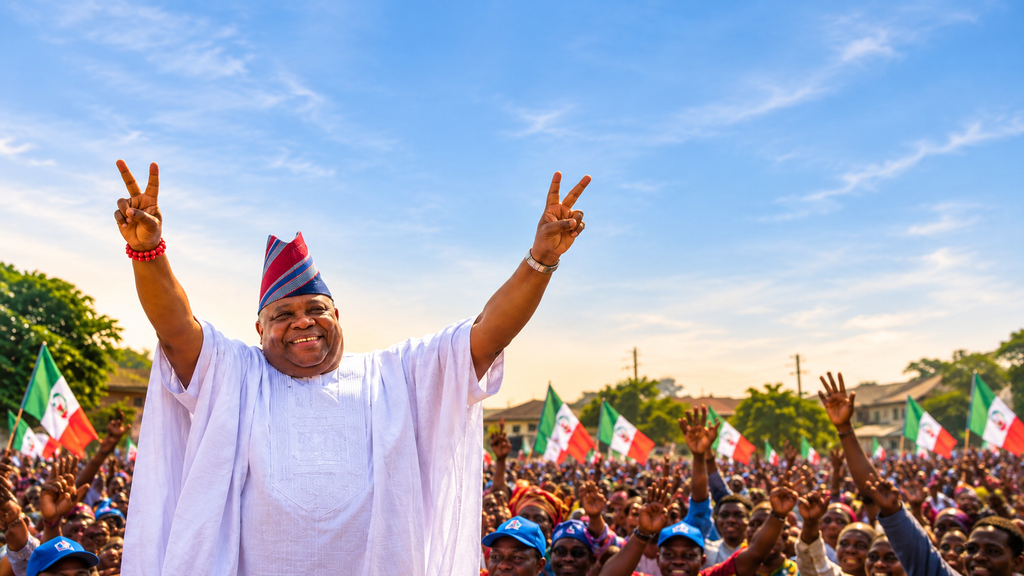
For all the jokes, dancing videos, political arguments and social media debates that have surrounded the governor over the years, one thing is now impossible to ignore: Adeleke has secured another term in office.
The result means the governor will continue to lead Osun State for another four years, giving him the opportunity to build on his first administration and, perhaps more importantly, prove that the confidence placed in him by voters was justified.
For me, however, the interesting part is not simply that Adeleke won.
It is why he won, what the victory says about Nigerian politics, and what ordinary people like you and me can learn from the way public attention, personal branding and grassroots connection can influence outcomes.
Adeleke first became governor in 2022 after defeating the then-incumbent, Gboyega Oyetola, in a closely contested election. That victory was significant because Adeleke was not simply walking into an easy political environment. He had spent years trying to establish himself as a serious political contender, while also carrying the baggage of being one of Nigeria’s most recognisable political personalities.
Four years later, the circumstances were different.
This time, Adeleke was not asking voters to give him a chance as an outsider. He was asking them to judge him based on what they had seen during his first term.
That distinction matters.
When you are an incumbent, the conversation changes. You cannot simply tell people what you intend to do. People can point to what you have already done, what you failed to do and what they believe you should have done differently.
That is why I see Adeleke’s re-election as more than another political victory.
It is also a referendum of sorts on the relationship he has built with the people of Osun.
Of course, no election is ever that simple. Political parties matter. Campaign structures matter. Alliances matter. Candidates matter. Money, mobilisation and grassroots organisation can all influence an election.
And Osun politics has never been short of competition.
Adeleke also entered this election under a different political arrangement after leaving the Peoples Democratic Party and contesting under the Accord Party. That alone was enough to create questions about whether he could maintain the political structure that helped him win in 2022.
There were also opposition candidates and political forces determined to stop him from returning to office.
Yet, despite all of these complications, Adeleke emerged victorious.
And that is where I think we should pause for a moment.
Because it is easy to look at an election result, celebrate or criticise it, and immediately move on to the next trending story. But elections deserve a little more reflection.
What makes voters stay with a politician?
Is it party loyalty?
Is it performance?
Is it personality?
Is it the candidate’s ability to connect with ordinary people?
Or is it a combination of all these things?
In Adeleke’s case, I believe his personality has played a major role in shaping how Nigerians perceive him.
Whether people like his dancing or dislike it, whether they consider his public style entertaining or unusual, Adeleke has achieved something many politicians struggle to achieve: he has become memorable.
And in an age where people are constantly bombarded with information, being memorable is powerful.
Think about it.
There are thousands of politicians in Nigeria, but mention "the dancing governor" and many Nigerians immediately know who you are talking about.
That is branding.
It may not be conventional political branding, but it is branding nonetheless.
And this is where the story becomes much bigger than Adeleke.
Because the same principle applies to ordinary people trying to build something for themselves.
In today's world, attention is currency.
A politician needs attention to communicate with voters. A business owner needs attention to attract customers. A content creator needs attention to build an audience. A writer needs attention to get people to read their work.
The person who understands how to attract and retain attention has an advantage.
But there is an important difference between getting attention and doing something meaningful with that attention.
That is something I believe Adeleke’s story demonstrates very clearly.
His dancing may have made him more recognisable, but recognition alone cannot govern a state.
At some point, personality must meet performance.
The same thing happens online.
You can go viral today and be forgotten tomorrow.
You can get thousands of views on one video and still have no sustainable income.
You can have 10,000 followers and still struggle financially if you have not figured out how to turn your audience, skills or knowledge into something valuable.
That is why I increasingly believe that people should stop looking at social media only as a place for entertainment.
There is an opportunity hiding inside all that attention.
And you do not necessarily need a large office, expensive equipment or huge capital to begin.
For many Nigerians, the first business tool is already sitting in their hands: a smartphone.
With a smartphone and an internet connection, someone can begin learning content writing, social media management, graphic design, video editing, affiliate marketing, blogging or other digital skills.
Someone who enjoys entertainment can create entertainment content.
Someone who understands fashion can build a fashion page.
Someone who knows about travel can create travel guides.
Someone who understands technology can review apps and digital tools.
Someone who writes well can offer content-writing services to businesses and websites.
The possibilities are not limited to becoming an influencer.
In fact, I think that is where many people misunderstand the digital economy.
You do not have to become famous before you can make money online.
You need to become useful.
That is a completely different mindset.
Instead of asking, "How can I become viral?", ask, "What problem can I solve?"
Instead of asking, "How many followers do I have?", ask, "What value am I giving the people following me?"
Instead of simply consuming other people's content every day, ask yourself whether you can use that same smartphone to create something of your own.
That shift can change everything.
And perhaps that is one of the biggest lessons I take from Adeleke's political journey.
He has remained visible.
He has remained recognisable.
He has continued to communicate his personality.
But ultimately, voters still had to decide whether that visibility deserved another four years.
The same thing happens in business.
Visibility can open the door, but value keeps the door open.
That is why I would not advise anyone who wants to build an online income stream to focus only on trends.
Trends come and go.
Skills remain.
Learn how to write.
Learn how to communicate.
Learn how to market.
Learn how to use digital tools and artificial intelligence responsibly.
Learn how to create videos.
Learn how to build an audience.
Learn how to turn information into useful products or services.
These are skills that can continue working for you long after today's trending story has disappeared from social media.
And there is another lesson here that I think deserves attention.
Winning a second term is not the same thing as finishing the job.
In fact, the second term can be more demanding because expectations are now higher.
Adeleke has already been given an opportunity.
The people of Osun will now want to see what he does with it.
They will want infrastructure.
They will want better opportunities.
They will want jobs and economic growth.
They will want improvements in education and healthcare.
They will want effective governance.
And they will ultimately judge the administration by what they experience in their everyday lives.
That is how leadership should work.
The campaign eventually ends.
The posters come down.
The rallies stop.
The music fades.
But ordinary people remain.
That is why I believe Adeleke's second term should not simply be viewed as a celebration for his supporters. It should be viewed as another responsibility placed on his shoulders.
The people have spoken.
Now the government has to listen.
I also think Nigerians should pay attention to what this election means beyond Osun.
Nigeria is already moving toward another major electoral cycle, and political parties will undoubtedly study what happened in Osun. They will study voter behaviour, campaign strategies, grassroots mobilisation, candidate popularity and the issues that influenced the electorate.
But I would caution against assuming that one governorship election automatically predicts what will happen in the 2027 presidential election.
It does not.
Osun is Osun.
Governorship elections are different from presidential elections.
Candidates are different.
Political structures are different.
Local issues are different.
What we can do, however, is learn from the behaviour of voters.
And perhaps the most important lesson is that people are constantly evaluating the people they give their trust to.
That applies to politics.
It applies to business.
It applies to relationships.
It applies to personal brands.
Trust is built gradually.
Reputation is built over time.
And once people believe in what you represent, they are more likely to give you another opportunity.
That is why I keep returning to the issue of consistency.
Adeleke did not become politically relevant overnight.
Whatever one's opinion of him may be, his political journey has been years in the making.
And that reminds me of something I often tell people who want to start making money online: do not expect the first week to look like the fifth year.
You may publish your first article and get only a handful of readers.
You may create your first video and receive very few views.
You may offer your first digital service and struggle to find a client.
That does not necessarily mean you are failing.
Sometimes you are simply at the beginning.
The person who keeps learning, improving and showing up consistently has a much better chance of eventually building something meaningful.
That is why I do not want people to read Adeleke's victory simply as a political headline.
I want us to look at the bigger picture.
A man who was once an opposition candidate is now returning to the Osun State Government House for another term.
His political journey has been filled with criticism, controversy, unexpected moments and plenty of attention.
Yet he has managed to remain relevant enough for voters to give him another opportunity.
Whether you support him or oppose him, that is something worth studying.
And for those of us trying to build our own lives, careers and businesses, the question is even more personal.
What are we doing with the opportunities available to us?
Are we using our phones only to consume other people's success?
Are we constantly watching people make money online without learning how the system works?
Are we waiting until we have enough money before starting?
Or are we taking the small resources we already have and turning them into something valuable?
Because sometimes, the biggest difference between two people is not what they own.
It is what they do with what they have.
Your smartphone may look like a simple device.
But it can also be your classroom.
It can be your office.
It can be your camera.
It can be your publishing platform.
It can be your marketing tool.
It can be the place where you learn a skill that eventually changes your income.
The goal should not simply be to become another person who goes viral.
The goal should be to build something that survives after the attention disappears.
That, to me, is the deeper lesson in Adeleke's second-term victory.
Attention can introduce you to people.
Personality can make you memorable.
Consistency can keep you relevant.
But ultimately, value is what gives people a reason to keep choosing you.
Adeleke now has another four years to demonstrate what he can do with the mandate Osun voters have given him.
For the people of Osun, the real story begins after the celebration.
And for the rest of us, perhaps our own story should begin with a simple question:
What can I start building today with what I already have?
If you have an article, opinion piece, event or news story you would like published, Global News Arena would love to hear from you. And if you are ready to begin your journey toward building a profitable online content-writing business from your phone or laptop, this may be the right time to stop waiting for the perfect opportunity and start developing the skills that can create one.
Send your article, opinion piece, event or publishing enquiry to advertise@globalnewsarena.com.