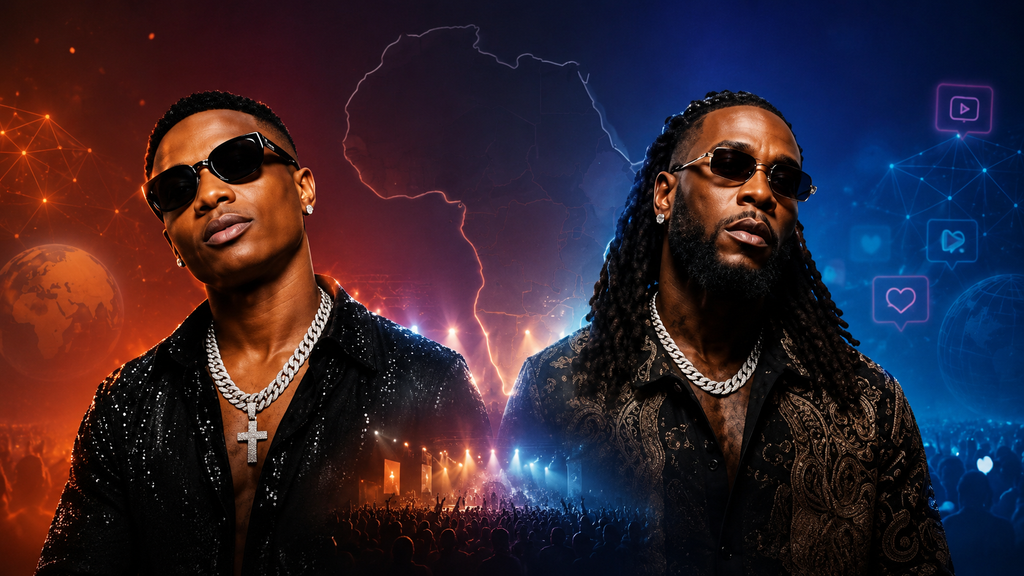
Burna Boy and Wizkid remain two of the biggest names in Nigerian music, and in 2026, the conversation surrounding both artists continues to attract enormous attention from fans across Nigeria, Africa and the wider world.
Whenever their names appear in the same conversation, the debate almost starts by itself. Some fans believe Burna Boy has taken African music to another level through his international performances, collaborations and unmistakable African Giant identity. Others believe Wizkid's longevity, influence and ability to move effortlessly between Afrobeats, R&B and international pop have made him one of the most important Nigerian artists of his generation.
But for me, the more interesting question is not simply who is better.
It is what Burna Boy and Wizkid have done to the conversation around Nigerian music.
Because when we look beyond the fan arguments, the awards, the social-media battles and the endless comparisons, something much bigger has happened. Nigerian music has moved from being a sound that international audiences occasionally discovered to becoming a permanent part of the global music conversation.
And both Burna Boy and Wizkid have played important roles in that transformation.
Burna Boy's career has increasingly been built around the idea of the African Giant. His music brings together Afrobeats with elements of dancehall, reggae, hip-hop and other sounds, while his live performances have helped establish him as an artist capable of commanding major international stages.
His international recognition has also continued. At the 2026 Grammy Awards, his album No Sign of Weakness received a nomination for Best Global Music Album, while "Love" was nominated for Best African Music Performance.
Wizkid, meanwhile, has taken a different but equally significant path.
His ability to blend Afrobeats with R&B and international pop has helped him connect with audiences far beyond Nigeria. His Made in Lagos era, particularly the global success of "Essence," demonstrated how a Nigerian song could become a major international record without losing its Nigerian identity.
The Recording Academy has credited Wizkid's work, including "Made in Lagos" and "Essence," with contributing to Afrobeats' growing international reach. He was also nominated for Best African Music Performance at the 2026 Grammy Awards for "Gimme Dat" with Ayra Starr.
That is why I find the comparison between both artists so fascinating.
They have not necessarily followed the same road to global recognition.
Burna Boy has built an image around scale, performance, cultural identity and a sound that constantly reminds listeners of his African roots. Wizkid has built his influence through musical versatility, collaborations, longevity and an ability to move between different sounds without losing his identity.
In other words, they have demonstrated that there is more than one way for an African artist to become global.
And that is perhaps one of the most important developments in Nigerian music.
There was a time when African artists often had to convince international audiences to pay attention. Today, the situation is changing. Nigerian artists are performing around the world, collaborating with major international stars, appearing at some of the biggest award ceremonies and competing for global recognition.
That shift did not happen overnight.
It came through years of work from artists, producers, songwriters, managers, promoters and fans who continued pushing Nigerian music beyond the country's borders.
Burna Boy and Wizkid became major symbols of that movement, but they are certainly not the only artists responsible for it.
The conversation has now expanded to include names such as Davido, Tems, Rema, Ayra Starr and many other African artists who are reaching audiences outside their home countries.
In fact, the 2026 American Music Awards demonstrated just how competitive the African music space has become. Burna Boy, Wizkid, Rema, Tyla and Moliy were nominated in the Best Afrobeats Artist category, with Tyla ultimately taking the award.
For me, that development is more encouraging than disappointing.
It means African music is growing.
It means the conversation is no longer dependent on one or two artists.
It means new voices are entering the market, new sounds are being discovered and audiences are becoming more interested in African music as a whole.
Yet despite that growth, Burna Boy and Wizkid continue to attract an unusual level of attention.
Part of the reason is their longevity.
Another reason is the strength of their personal brands.
And then there is the Nigerian culture of competition.
Nigerians love a good debate.
Put two successful people in the same industry and someone will immediately ask who is richer, who has more hits, who has the better albums, who has more awards, who has the bigger international audience and, eventually, who is the greatest.
Social media makes that competition even louder.
A single post can turn a simple discussion about music into thousands of comments, arguments and counterarguments.
But somewhere inside all of that noise is a lesson that I believe is much more valuable than determining which artist should sit at number one.
Both Burna Boy and Wizkid have built recognisable identities.
You hear a Burna Boy record and there is usually something about the sound, delivery or subject matter that makes it identifiable.
You hear Wizkid and, in many cases, you can also recognise the musical world he has created.
That kind of identity is powerful.
And it is not only useful in music.
It applies to almost everything people are trying to build today.
A content creator needs an identifiable voice.
A writer needs a recognisable style.
A business needs a clear identity.
A social-media personality needs something that makes people want to come back.
Even someone starting a small online business from a smartphone needs to understand what they are offering and why another person should pay attention.
This is where I think the story of Burna Boy and Wizkid becomes relevant to ordinary Nigerians who may never step onto a concert stage.
You do not have to become a global superstar to learn from global superstars.
You can simply study the principles behind their journeys.
They developed their skills.
They built audiences.
They created identities.
They continued evolving.
And they understood that attention becomes valuable when it is connected to something people actually care about.
That last point is especially important in today's digital economy.
Many people have access to smartphones and social-media platforms, but having access is not the same as knowing how to create value.
Someone can spend five hours scrolling through social media without building anything.
Another person can spend those same five hours learning how to write articles, edit videos, design graphics, manage social-media pages or create useful digital content.
The difference is not necessarily the device.
It is what the person decides to do with it.
That is why the growth of Nigerian music can serve as inspiration for people who want to start small digital businesses.
A person who loves entertainment can learn entertainment writing.
Someone who understands trends can build a content page.
Someone who enjoys storytelling can learn content writing and offer services to businesses and websites.
Someone who is good at explaining things can create educational content.
Someone with knowledge in a particular area can eventually package that knowledge into a digital product.
And many of these journeys can begin with a smartphone.
Of course, none of this means people should expect instant income.
That would miss the entire lesson.
The careers of Burna Boy and Wizkid were not built overnight, and neither is a sustainable digital business.
Behind every major success story are years of practice, mistakes, experimentation, learning and consistency that the public rarely sees.
Social media often shows us the result without showing us the process.
We see the sold-out arena but not the small performances that came before it.
We see the international collaboration but not the years spent developing the artist's craft.
We see the successful entrepreneur but not the countless failed ideas that may have happened before the successful one.
That is why I believe the smartest way to look at the Burna Boy versus Wizkid debate is not simply through the question of who is winning.
The better question is what their journeys can teach us about building something that lasts.
And their journeys also show why competition can be healthy.
African music is becoming increasingly competitive because more artists are finding international audiences.
At the 2026 BET Awards, Burna Boy, Wizkid, Tems and Asake were among the African artists nominated, although none of them ultimately won an award that night.
That does not make their careers less successful.
If anything, it shows how crowded the global African music conversation has become.
There are more artists competing for attention, more countries producing internationally recognised talent and more listeners discovering African music.
That should push everyone to improve.
It should push established artists to keep evolving.
It should encourage upcoming artists to take their craft seriously.
And it should remind ordinary people that there are opportunities beyond simply consuming what other people create.
Because while millions of people are arguing online about whether Burna Boy or Wizkid is better, both artists have already accomplished something that goes beyond winning a fan argument.
They have helped prove that something created in Nigeria can travel across borders and connect with people who may not even understand the language.
That is powerful.
It tells a young Nigerian that the place where you start does not necessarily have to determine the size of the audience you eventually reach.
Maybe your talent is music.
Maybe it is writing.
Maybe it is photography.
Maybe it is video editing.
Maybe it is storytelling.
Maybe it is teaching.
Maybe it is something you have not even discovered yet.
The important thing is to start developing it.
Because the next major Nigerian success story may not look exactly like Burna Boy's story or Wizkid's story.
It may look completely different.
It may happen on YouTube.
It may happen through a blog.
It may happen on social media.
It may happen through a digital product.
It may happen through an online service created by someone sitting in a bedroom with nothing more than a smartphone and an internet connection.
That possibility is what makes this moment so exciting.
Nigerian music has shown the world that African creativity can command global attention. Burna Boy and Wizkid have both contributed significantly to that story, even though their approaches, sounds and career paths are different.
So yes, fans can continue debating who is better.
They can compare the albums, the awards, the collaborations, the performances and the influence.
That debate will probably continue for years.
But while the debate continues, there is another question worth asking ourselves: what are we building with our own talents?
Because the greatest lesson from Burna Boy and Wizkid may not be about becoming the biggest artist in Africa.
It may simply be about understanding your talent, developing your identity, building your audience and refusing to believe that your starting point has to be your finishing point.
And if Nigerian music can travel from Lagos to London, New York, Los Angeles and countless other cities around the world, there is no reason to believe that other Nigerian talents cannot travel just as far.
The next global Nigerian success story could be yours.
If you have an article, opinion piece, event or news story you would like published, or you are ready to begin your journey toward building a profitable online content-writing business from your phone or laptop, Global News Arena would love to hear from you. Send an email to advertise@globalnewsarena.com.