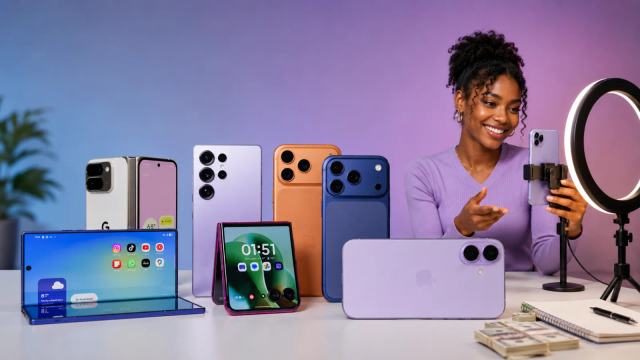
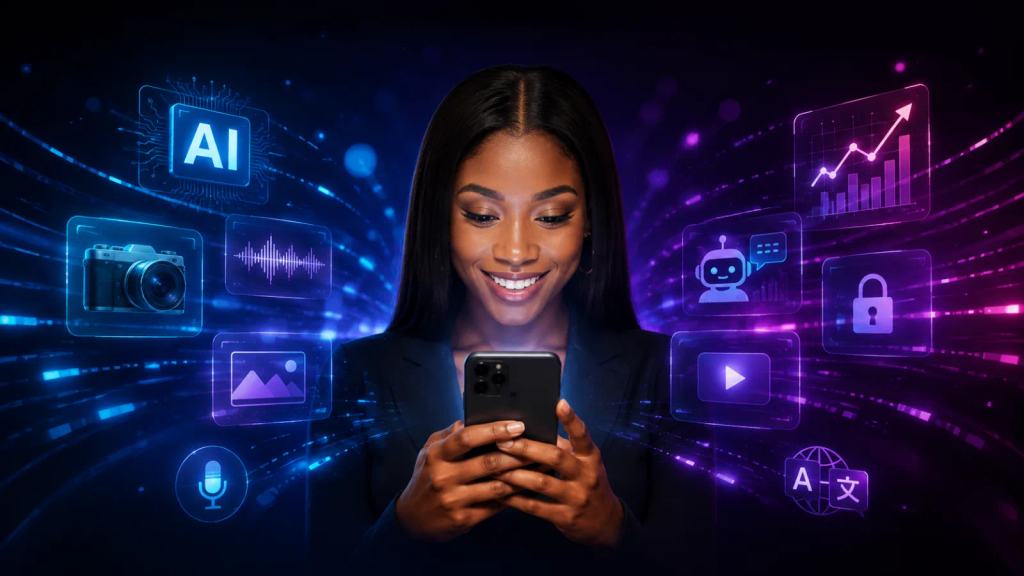
Artificial intelligence is changing the smartphone faster than many people realise. What was once simply a device for making calls, sending messages, taking pictures and browsing social media is gradually becoming a much smarter digital tool capable of understanding language, recognising images, assisting with everyday tasks and helping users create content.
That is why the conversation around smartphones in 2026 is no longer only about how many cameras a phone has, how much RAM it offers or how large its display is. Increasingly, people are asking another important question: how intelligent is the phone?
The answer can make a real difference because AI is being built into more parts of the smartphone experience. Instead of requiring users to manually perform every little task, artificial intelligence can now assist with writing, photography, translation, organisation, research, communication and productivity.
One of the easiest places to see this change is the smartphone camera. Modern phones can already recognise different scenes and automatically adjust settings to produce better photographs, but AI is taking this much further. Depending on the device and software, AI can help improve lighting, reduce unwanted noise, enhance details, remove distractions from photographs and make intelligent edits after a picture has been taken.
This means taking a photograph is becoming less about simply pressing the shutter button and more about allowing the phone to understand what is in front of the camera.
For people who depend on their phones to create content, this can be particularly useful. A small business owner can take product photographs without having to become a professional photographer. A content creator can make social media images more quickly. Someone running an online business can produce visual content without needing a complicated editing setup.
And the same idea is now moving into writing and communication.
AI writing features can help users rewrite sentences, correct grammar, summarize long information or turn rough thoughts into clearer messages. Instead of spending several minutes trying to find the right words, a user can provide an idea and allow an AI tool to help organize it.
This does not mean people should stop learning how to write. In fact, I believe good writing becomes even more important when AI is everywhere because readers can easily notice when content feels generic, repetitive or completely machine-generated.
The strongest approach is to allow AI to assist with the work while keeping human judgment, personality and original ideas at the centre.
That becomes even clearer when we look at voice technology. Smartphones have had voice assistants for years, but artificial intelligence is making these systems better at understanding ordinary human language.
Rather than memorising complicated commands, people can increasingly speak to AI in a conversational way. You can explain what you need, ask a follow-up question and continue the conversation instead of treating the phone like a machine that only understands rigid instructions.
From there, another major development becomes obvious: smartphones are becoming better at understanding context.
Translation is a good example. AI-powered translation tools can help convert text and speech between languages, making communication easier for travellers, businesses, students and people working with international audiences. The quality and availability of these features can vary, but the direction of the technology is clear.
The same thing is happening with search.
Traditional search requires users to think about keywords, type them into a search engine and go through different results. AI-powered search allows people to ask questions in a more natural way and receive a response designed around the meaning of the question.
But this convenience comes with a responsibility.
AI can be wrong.
It can misunderstand a question, produce an inaccurate answer or present information confidently when the facts do not support it. That is why I would never recommend treating an AI-generated answer as automatically correct, particularly when the information involves money, law, health or other important decisions.
Instead, AI should be treated as an assistant that helps us work faster while we remain responsible for checking important information.
Interestingly, some of the biggest changes are happening behind the scenes.
You may hear the phrase “on-device AI” more often as smartphone manufacturers continue developing dedicated chips and models that can handle certain AI tasks directly on the phone.
Traditionally, many AI services depended heavily on cloud computing. Information would be sent from the smartphone to a remote server, processed there and returned to the device.
On-device AI changes part of that process by allowing supported AI functions to happen directly on the smartphone.
Google has been investing heavily in this area through its Tensor processors and Gemini models. Its Android ecosystem includes on-device AI capabilities designed to support certain experiences without relying entirely on cloud processing.
That can have important benefits, including potentially faster responses for supported tasks and better control over certain types of personal information.
However, it is important not to assume that every AI feature on a smartphone works offline. Different features can require different levels of internet connectivity and cloud processing, so buyers should always check the specifications and privacy information for the particular device they are considering.
Samsung is also pushing AI deeper into its Galaxy smartphone ecosystem, with features designed around communication, photography, productivity, search and security.
And that brings us to an area that I think deserves much more attention: smartphone security.
As people increasingly use their phones for banking, shopping, business and private communication, smartphones have become extremely valuable targets for scammers and cybercriminals. AI is therefore being used not only to make phones more entertaining and productive but also to identify potentially suspicious activity.
Some newer AI-powered features can analyse communications or calls and provide warnings about potential scams. The exact functionality depends on the manufacturer, software and market, but the broader idea is important.
The smartphone is becoming capable of helping users identify certain digital risks instead of simply waiting for the user to notice them.
At the same time, AI is changing the way people create.
This is where I believe the smartphone revolution becomes particularly interesting for young entrepreneurs, creators, freelancers and anyone interested in building something online.
A modern smartphone can already serve as a camera, video editor, writing device, research tool, communication platform and business management system. Adding AI capabilities means some of those tasks can become faster and easier.
Someone can research an idea, write a draft, edit an image, create a video, communicate with customers and publish content using a device that fits inside a pocket.
That creates an opportunity that did not exist at the same scale for previous generations.
You do not necessarily need an expensive office or a huge collection of equipment to begin learning digital skills. With a capable smartphone and internet connection, you can start developing skills in content writing, social media management, digital marketing, video editing, graphic design and other online services.
AI can help with brainstorming, organisation, editing and research, but the human being still has to bring the ideas and make the final decisions.
This is why I think the most important question about AI smartphones is not simply, “What can this phone do?”
The better question is, “What can I do with this phone?”
That small change in thinking can completely alter how someone views technology.
A person can use an AI smartphone simply to watch videos and scroll through social media all day. Another person can use the same technology to learn a skill, build an audience, create content, promote a small business or develop a digital product.
The device is the same.
The difference is how it is being used.
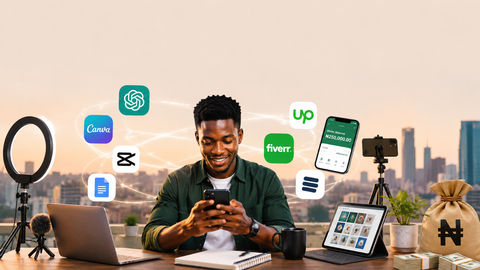
For someone in Nigeria, this matters because a smartphone can be one of the most accessible digital tools available. Rather than seeing the phone only as something for entertainment and communication, it can also become a practical tool for learning and earning.
A small business owner can use AI to help draft promotional content. A creator can use AI-assisted editing tools to improve videos. A writer can use AI to organise ideas before developing an original article. A freelancer can use digital tools to communicate with clients and manage projects.
The possibilities will continue to grow as smartphone manufacturers integrate more AI capabilities into their devices.
However, this does not mean everyone needs to immediately replace their current phone.
If your existing smartphone works well and meets your needs, there may be no reason to rush into buying a new device simply because the word “AI” appears on the advertisement.
When it eventually becomes time to upgrade, though, AI capabilities should be considered alongside the things buyers already look at.
Think about the camera if you create visual content. Think about processing power if you edit videos. Consider storage if you work with large files. Look at battery life if you spend many hours working from your phone. Check software support because an AI smartphone that receives regular updates can potentially become more useful over time.
Most importantly, investigate the actual AI features rather than being impressed by the label alone.
A phone may advertise dozens of AI features, but if none of them solve a problem you actually have, they may not be worth paying extra for.
Privacy should also remain part of the buying decision.
AI features can sometimes require access to information on your device, so users should understand what permissions they are granting and how their information is processed. Some features may process information locally, while others may rely on cloud services.
Reading the manufacturer's privacy information may not be the most exciting part of buying a smartphone, but it is becoming increasingly important.
And as AI becomes more deeply integrated into smartphones, another transformation is beginning to emerge.
The future smartphone may not simply be a collection of separate applications that users open one after another. Instead, AI could increasingly act as a layer connecting different functions and helping users complete tasks based on what they are trying to achieve.
Rather than asking yourself which application you need to open, you may increasingly be able to tell the phone what you want to accomplish and allow its AI system to help organise the steps.
That could fundamentally change the way people interact with smartphones.
We are moving from phones that respond mainly to commands toward phones that can understand more context and assist with more complicated tasks.
But even as smartphones become more intelligent, one thing will remain unchanged: technology is only as useful as the person using it.
AI cannot decide what business you should build. It cannot replace curiosity. It cannot automatically give you a unique voice. It cannot guarantee that every piece of information it produces is correct.
What it can do is reduce some of the barriers between an idea and the finished product.
That is why I see AI smartphones as more than another upgrade cycle.
They represent a shift in what a smartphone can be.
The phone in your pocket can increasingly become a learning tool, creative studio, communication assistant and digital workplace all at once.
The real opportunity is therefore not simply owning an AI smartphone. It is learning how to use artificial intelligence responsibly and creatively to accomplish things that once required much more time, equipment or technical knowledge.
And perhaps that is the biggest change happening right now.
The smartphone is becoming smarter, but the real advantage will belong to the people who become smarter about how they use it.
Instead of using powerful technology only to consume what other people create, we can use it to develop our own ideas, build useful skills, reach audiences and create opportunities.
That is the part of the AI smartphone revolution I believe deserves the most attention.
If you have an article, opinion piece, event or news story you would like published, or you are ready to begin your journey toward building a profitable online content-writing business from your phone or laptop, Global News Arena would love to hear from you. Send an email to advertise@globalnewsarena.com.