What if the photograph everyone is sharing is real enough to convince you, but the event it appears to show never happened?
Imagine opening your phone and seeing what looks like a photograph of a violent protest. There are crowds in the street, police officers confronting demonstrators and smoke rising above the buildings. The caption tells you that a particular community has attacked another, or that a government has lost control of its capital. Within minutes, the image is being reposted, discussed and used as evidence in arguments about politics, security and immigration.
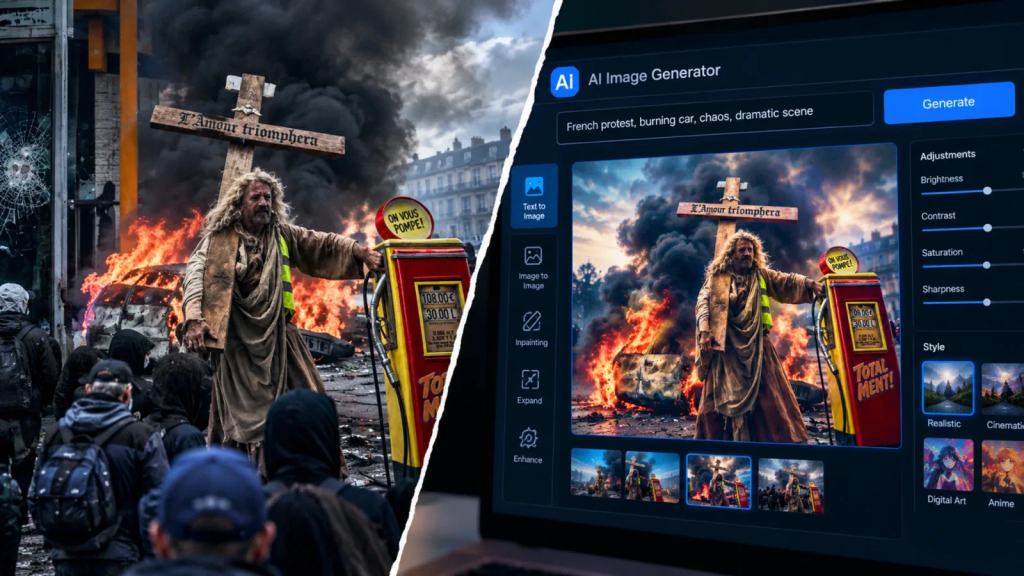
But there is a problem: the image was generated or manipulated using artificial intelligence. It may depict a scene that never happened, place real people in a false context or make an old event look like breaking news.
By the time someone discovers the truth, thousands, or millions, of people may already have seen it.
This is the danger behind the growing circulation of synthetic images, and it is why I believe the latest controversy involving French President Emmanuel Macron deserves attention beyond the immediate political dispute.
On October 21, reporting by the Associated Press described Macron's criticism of foreign leaders who, he argued, were exploiting unrest in France for political purposes. The controversy involved claims about protests linked to the cost of living, allegations blaming Muslim migrants for violence and the circulation of misleading material, including AI-generated images. Macron called some of the claims “stupid” and “unacceptable.”
The political arguments are important, and the claims made by different leaders should be examined on their evidence. But the broader issue is one that reaches far beyond France: when fabricated or misleading images become part of public debate, how can people tell what is real, what is altered and what has been taken out of context?
I think this is now one of the most important questions facing journalism and digital communication.
For a long time, photographs carried a special kind of authority. A written claim could be challenged, but a picture often appeared to offer direct evidence. People would say, “I saw it with my own eyes,” even when what they had actually seen was a photograph on a screen. Images felt immediate, concrete and difficult to argue with.
That trust has always had limitations. Photographs can be cropped, edited, staged or taken years before the event they are claimed to document. A real image can be paired with a false caption. A picture from one country can be presented as evidence of an event in another. A photograph of a peaceful gathering can be used to illustrate a report about violence that occurred somewhere else.
Artificial intelligence has made the problem more complicated because it can generate realistic-looking images from text prompts and alter existing pictures with increasing sophistication. A fabricated image may contain convincing details, appropriate lighting and an apparently plausible setting. It can be created in minutes and distributed without any visible indication that it is synthetic.
The result is not simply a technical challenge. It is a problem of public trust.
Images influence how we feel about events before we have time to analyse them. A photograph of a child in danger can trigger compassion. A picture of a crowd confronting police can create fear or anger. An image that appears to show a politician behaving dishonestly can reinforce an existing suspicion. If the image is false, the emotion it produces may still be real and that emotion can shape what people believe and how they behave.
This is especially dangerous during political disputes, elections, protests, conflicts and public emergencies. In those moments, people are already searching for explanations. They may be worried about security, frustrated with the government or convinced that a particular group is responsible for a problem. A fabricated image can appear to confirm what they already believe.
Once that happens, the image may travel through a network of friends, influencers, political commentators and group chats before anyone checks its origin. The people sharing it may not even know it is false. Some may believe they are warning others about a genuine threat.
That is why I do not think misinformation should always be approached as a problem caused by people who knowingly lie. Deliberate deception is real, but so is accidental amplification. A person can share false information because it looks convincing, because it comes from someone they trust or because they are emotionally invested in the claim.
The solution must therefore include both accountability for people who deliberately manufacture deception and better habits for everyone who consumes or distributes information.
For journalists, the responsibility is particularly serious. A newsroom cannot treat a viral image as verified evidence simply because thousands of people have shared it. Popularity does not establish authenticity. A photograph may be trending because it is shocking, not because it is true.
Before publishing an image tied to a major claim, a journalist should ask some basic questions. Who created it? Where did it first appear? When was it captured or generated? Is the location identifiable? Does the image match the details of the event being reported? Can an independent source confirm that the scene happened as described?
These questions sound simple, but they can prevent serious mistakes.
One useful starting point is reverse image search. Tools such as Google Lens and TinEye can help locate earlier appearances of an image online. If a photograph supposedly taken during today's protest appears on websites from several years ago, that is a strong reason to investigate further. It may be an old photograph being recirculated with a new caption.
Reverse image search is not a complete solution, however. A newly generated image may have no earlier online version. An edited image may have been cropped or altered enough to evade a straightforward match. The absence of a match does not prove that an image is authentic.
The next step is to inspect the context. Does the weather in the photograph match reports from the location? Do signs, road markings, building shapes or landmarks fit the claimed place? Are there independent photographs or videos of the same event from other angles? Has a credible news organisation or local witness documented what happened?
Geolocation can help when a scene contains recognisable landmarks, but it requires care. A familiar building may appear in multiple locations, and visual similarities can mislead even experienced investigators. Verification should combine several clues rather than depend on one apparently convincing detail.
Metadata can sometimes provide information about a file's creation or editing history, but it is not a guarantee of authenticity. Social platforms often strip metadata when images are uploaded, and file details can be altered. Similarly, AI image detectors may offer useful clues, but their results are not definitive. They can produce false positives and false negatives, especially as image-generation technology improves.
There is also a distinction between identifying an AI-generated image and establishing whether a claim is true. An image might be genuine but used in a misleading context. Another might be AI-generated as an obvious illustration, with no intention to deceive. The question is not only whether AI was involved; it is how the image is being presented and what viewers are being asked to believe.
For journalists, the strongest approach is to establish provenance wherever possible. Provenance means understanding where a piece of media came from and how it has been handled. Original files, information from the photographer, corroborating footage and reliable eyewitness accounts can all help. Where verification is incomplete, the article should say so rather than imply certainty.
The public can adopt a similar routine before sharing a shocking image.
Pause before reacting. Read beyond the caption. Look for the original source. Search for earlier versions of the picture. Check whether trusted news organisations or official sources have independently reported the event. Be cautious when an image appears only in anonymous accounts or is accompanied by an emotionally charged claim with no supporting details.
If the image is being used to accuse a person or community of a crime, the need for verification becomes even greater. A false image can damage reputations, increase hostility and place vulnerable people at risk. Even after a correction is published, the original claim may continue circulating because it has already reached audiences who never see the update.
This is one reason corrections should be clear, visible and easy to share. When an organisation discovers that it has published an inaccurate image, it should explain what was wrong, correct the record and preserve enough transparency for readers to understand the change. Quietly replacing an image without acknowledging the mistake can undermine trust.
AI itself is not the enemy of journalism. It can help creators produce illustrations, visualise complex ideas, translate material and develop creative projects. It can also support verification work when used responsibly. The problem arises when synthetic material is presented as documentary evidence or used to mislead people about events in the real world.
That distinction matters for businesses and content creators too. An AI-generated image may be appropriate for a clearly labelled concept illustration, a fictional scene or an advertising creative. It is not appropriate to pass off an invented photograph as proof that a public event occurred, that a product has achieved results it has not achieved, or that a real person was present in a situation they never experienced.
For Global News Arena and other publishers, the principle should be straightforward: use AI creatively, but do not allow a generated image to masquerade as verified reporting. If an image is illustrative, label it. If it represents a real event, verify it. If the origin cannot be established and the image could materially mislead readers, do not publish it as fact.
This is also a useful opportunity for readers who want to understand the tools themselves. AI image generators can be valuable for creating original editorial illustrations, campaign artwork and social media graphics, but the best tool depends on the task, budget, licensing needs and level of control required. A separate guide to the best AI image-generation software can help creators compare options without confusing image creation with image verification.
That distinction is important: an image generator creates or modifies visuals; a verification workflow investigates whether a particular image accurately represents reality. One does not replace the other.
Ultimately, the Macron controversy is a reminder that the battle over public opinion is not fought only through speeches, policy documents and news reports. It is also fought through the pictures people see, the captions attached to them and the emotions those pictures provoke.
A convincing image can make a false story feel true. A misleading caption can turn a real photograph into false evidence. And a viral post can travel much faster than the careful work required to establish what actually happened.
I do not believe the answer is to distrust every image or assume that everything online is fabricated. That would leave us paralysed and would unfairly discredit genuine reporting. The answer is to develop better habits of verification, demand transparency from publishers and recognise that visual evidence needs context.
For journalists, that means authenticating images before publication, documenting uncertainty and correcting errors openly. For readers, it means resisting the urge to share a picture simply because it confirms what they already suspect. For platforms and public figures, it means understanding that the circulation of false visual claims can have consequences beyond online arguments.
The next time a shocking photograph appears on your screen, ask one question before you believe it: what evidence do I have that this image shows what the caption says it shows?
In an era when images can be created in seconds, that small pause may be one of the most valuable acts of media literacy we have.
If you have an article, opinion piece, or news story you'd like published on Global News Arena, or you're ready to begin your journey toward building a profitable digital business from your phone, I'd love to hear from you.
Read more at Global News Arena and Advertise with us