A New Kind of Exploration Beneath the Lunar Surface with GIMLI lunar cave mission
READ: UNILORIN Science and Technology Park Woos Chinese Investors
There is something particularly fascinating about the possibility that the Moon may be hiding an entire world beneath its familiar, dusty surface. For generations, our understanding of Earth's natural satellite has been shaped by what telescopes, orbiters, landers and astronauts could observe from above or directly on the ground. Yet the next important chapter of lunar exploration may depend on what scientists can discover underground.
Read: Do you need a professional writer in 72 hours? Contact Auxi Chat
That is why the GIMLI lunar cave mission deserves attention.
READ: The Science of Drifting Off: Why Your Brain Thinks Up Its Best Ideas Right Before You Sleep.
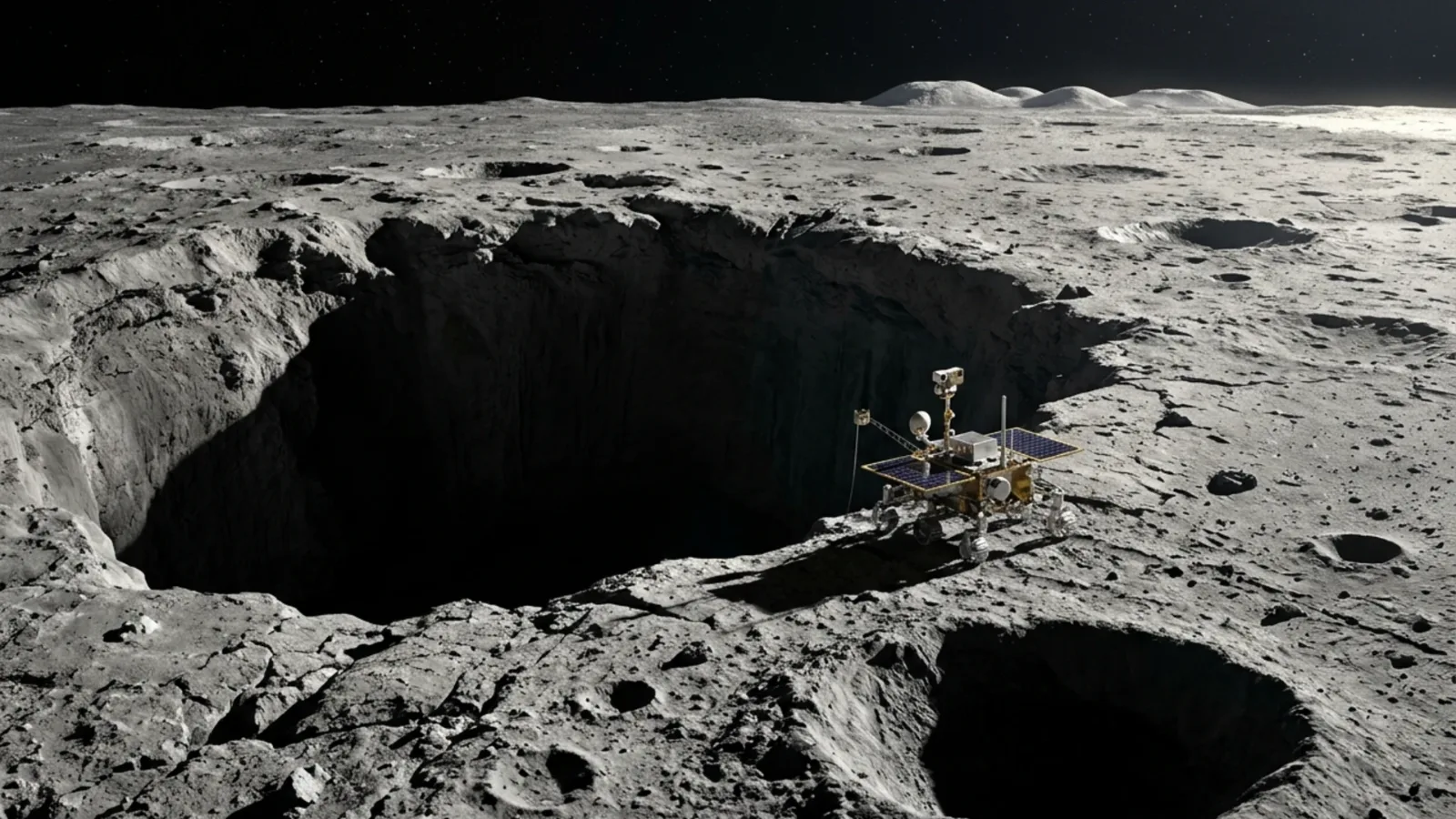
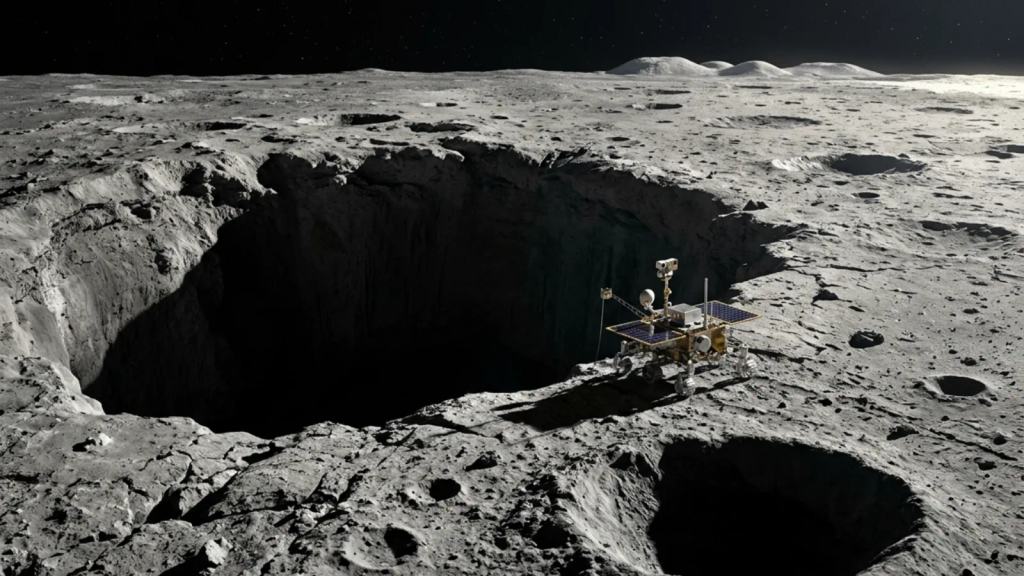
NASA has selected an investigation known as Geophysical Instruments for Marius Lunar pit Investigation, or GIMLI, to examine the Marius Hills Pit, a large opening on the lunar surface that could connect to an underground lava tube. The project is intended to investigate whether a substantial underground space exists and, if one is detected, help researchers estimate its dimensions.
I find the scientific question particularly compelling because it moves lunar exploration beyond the familiar ambition of reaching the Moon and landing astronauts on its surface. It asks a more practical question: what might already exist there that could make future human exploration safer?
Read: Need a professional website in 72 hours? Contact Auxi Chat
The distinction matters. Scientists have not yet confirmed that the Marius Hills Pit opens into a large, accessible cave. GIMLI is being prepared to investigate that possibility, not to announce a discovery that has already been made.
NASA announced the selection on September 30, 2026, as part of its Payloads and Research Investigations on the Surface of the Moon programme. The agency says the selected investigations are intended to improve knowledge of the lunar environment and support preparations for a sustained human presence on the Moon.
What Exactly Is GIMLI?
The name GIMLI may sound like that of a fictional space explorer, but it represents a serious scientific investigation.
Its full name, Geophysical Instruments for Marius Lunar pit Investigation, describes its purpose. Rather than simply sending a conventional rover to take photographs, the project will use scientific instruments to investigate the structure beneath the lunar surface.
The investigation is led by the Planetary Science Institute, with Than Putzig identified as its project lead. Honeybee Robotics is working with the institute to develop and integrate important parts of the equipment. The Norwegian Space Agency is also involved, including the provision of ground-penetrating radar.
The instruments are expected to travel to the Moon aboard a lander and rover delivered through NASA's Commercial Lunar Payload Services initiative.
This is an important detail because the GIMLI lunar cave mission is not simply a story about a robot driving into a dark tunnel. It is a coordinated scientific effort involving instruments, spacecraft delivery systems and researchers who want to understand what lies beneath a particular lunar geological feature.
The planned investigation combines ground-penetrating radar, seismic sensors, gravity measurements and cameras. Each instrument has a different role, and together they should provide a more complete picture of the underground environment.
Why Scientists Are Interested in the Marius Hills Pit
The Marius Hills Pit is located in a region of the Moon associated with extensive volcanic activity. Its importance comes from the possibility that it may provide an opening into a larger underground structure.
To understand why that matters, it helps to consider how lava tubes form.
On Earth, flowing lava can develop a solid outer crust while molten material continues moving underneath. When the flow eventually stops or drains away, it can leave behind a hollow passage. Similar processes may have created underground channels on the Moon during periods of ancient volcanic activity.
If such structures exist and remain sufficiently intact, they could preserve valuable evidence about the Moon's geological past.
The Marius Hills Pit is therefore more than an unusual hole in the lunar landscape. It may provide researchers with an opportunity to investigate material and structures that have remained hidden from ordinary surface observations.
The GIMLI lunar cave mission will examine whether the opening connects to an underground lava tube and whether the available evidence supports the existence of a substantial subterranean space.
I believe this is one of the most interesting aspects of the project. Space exploration is often presented through dramatic images of rockets, astronauts and distant landscapes. But some of the most important discoveries may come from patiently investigating features that appear unremarkable until scientists understand what they could reveal.
How the Instruments Will Investigate the Hidden Structure
The scientific strength of GIMLI lies in its combination of measurement techniques.
Ground-penetrating radar will help researchers investigate structures beneath the lunar surface. By sending signals into the ground and examining their reflections, scientists can identify changes in underground material and search for features that may indicate a buried void.
Seismic instruments will provide another source of information. By examining how vibrations travel through the ground, researchers can learn more about the physical structure beneath the surface. The project includes active-source seismic measurements, an approach intended to help scientists investigate underground properties.
A gravimeter will measure variations in the local gravitational field. Such measurements can provide clues about differences in underground density. A large empty space, for example, could produce a different gravitational signature from the surrounding solid rock.
Cameras will also be important. They will capture images of the lunar surface and the exposed walls of the pit, giving researchers visual information about the geological layers and materials around the opening.
The value comes from combining the results. Radar, seismic measurements and gravity data can each provide useful clues, but interpreting them together may give scientists a much stronger understanding of what lies below.
The project is not simply looking for a dramatic photograph of a cave entrance. It is attempting to establish whether a hidden structure exists, what its physical characteristics may be and how it relates to the geological history of the region.
Why a Lunar Cave Could Matter to Future Astronauts
The possibility of underground lunar shelters has implications that extend well beyond scientific curiosity.
The Moon presents a difficult environment for human beings. Its surface experiences extreme temperature changes, while astronauts and equipment are exposed to radiation and the threat of micrometeoroid impacts.
A sufficiently large and stable underground lava tube could offer some natural protection from these hazards. The surrounding rock might help reduce exposure to harmful radiation, while the underground environment could provide more stable temperatures than the exposed surface.
That does not mean every lunar cave would automatically be suitable for human habitation. Scientists and engineers would still need to establish its dimensions, structural stability, accessibility and other safety characteristics.
A cave could have unstable sections, difficult entrances or conditions that make human access impractical. Finding an underground void would therefore represent an important scientific result, but it would not immediately make that location ready for astronauts.
Nevertheless, the possibility is significant.
If researchers can identify and characterise a suitable natural shelter, future mission planners may have another option when considering where astronauts could operate for extended periods.
I see this as a shift in the way humanity could approach the Moon. Instead of assuming that every future base must be constructed entirely from materials brought from Earth, scientists are investigating whether the lunar environment itself contains features that could support human activity.
That possibility deserves careful attention, even though much more research would be required before any underground habitat could become a reality.
What Happens if the GIMLI lunar cave mission Finds No Cave?
One of the most important points about this investigation is that it could still deliver meaningful scientific results even if the expected underground lava tube is not detected.
NASA and the research team are interested in understanding how the Marius Hills Pit formed and what its geological structure can reveal about the Moon's volcanic past.
The exposed walls of the pit may contain layers of lunar soil, known as regolith, and evidence of ancient lava flows. These materials can provide clues about the processes that shaped the region.
Researchers may also gain a better understanding of how volcanic activity unfolded on the Moon, how lava moved across the landscape and whether separate eruptions occurred over long periods.
This means the project does not depend entirely on discovering a massive underground cavern to justify its scientific value.
That is an important lesson in research. A mission should not be judged only by whether it confirms the most exciting possibility. Sometimes, evidence that challenges an existing assumption can be just as valuable.
If GIMLI finds no substantial lava tube extending from the pit, the measurements could still help scientists refine their understanding of lunar geology and improve future investigations.
The Bigger Picture for Robotic Space Exploration
READ: Explainer: The Orbital Traffic Problem Nobody Owns
The GIMLI lunar cave mission also reflects a broader development in space exploration: the increasing importance of robotic systems in places where sending humans would be too risky or expensive.
Robotic instruments can gather information in environments that would be difficult for astronauts to enter without extensive preparation. They can measure conditions, collect images and provide evidence that helps mission planners make better decisions.
For lunar caves in particular, this approach is especially sensible. An underground environment may contain steep slopes, loose material, unexpected obstacles and limited communication opportunities.
A robotic investigation can help establish what scientists are dealing with before human explorers are asked to approach the same environment.
There is also a wider technological dimension. NASA's use of commercial lunar delivery services demonstrates how scientific instruments can be sent to the lunar surface through partnerships with private companies.
Such arrangements are becoming an important part of the agency's approach to delivering scientific and technological payloads to the Moon.
The GIMLI project brings together scientific research, commercial engineering and international collaboration. Its partners include the Planetary Science Institute, Honeybee Robotics and the Norwegian Space Agency, alongside researchers from other participating institutions.
I consider this combination important because the future of space exploration will depend on more than the achievements of one agency or one country. Scientific progress increasingly requires different areas of expertise to work together.
The Moon May Still Have More Secrets to Reveal
The renewed interest in lunar caves reminds us that the Moon is not simply a lifeless landscape to be photographed and visited. It is a geological world with a long history, much of which remains incompletely understood.
The GIMLI lunar cave mission could help scientists answer questions about ancient volcanic activity, underground structures and the possibility of natural shelters for future astronauts.
However, expectations should remain grounded in the evidence. The existence of a large, accessible lava tube connected to the Marius Hills Pit has not yet been established. The investigation is designed to determine whether the evidence supports that possibility.
For me, that uncertainty is part of what makes the project worth following. The most meaningful scientific discoveries often begin with a question that cannot be answered from a distance.
If GIMLI identifies a substantial underground structure, it could influence how scientists think about lunar geology and how future planners approach the challenge of establishing a sustained human presence beyond Earth.
If it does not, the information gathered could still help explain how one of the Moon's unusual geological features developed.
Either way, the investigation represents another step towards understanding the lunar environment in greater detail.
Humanity has spent decades learning how to reach the Moon. The next challenge may be learning how to understand its hidden spaces, use its natural features responsibly and prepare for exploration that lasts longer than a brief visit.
And somewhere beneath the surface of the Marius Hills region, GIMLI may help scientists discover whether the Moon has been keeping a remarkable geological secret.
The writer of this article does not claim to know the individuals named personally. The information regarding their backgrounds as published on Global News Arena is based on independent online research.
If you have an article, opinion piece, event or news story you would like published, Global News Arena would love to hear from you.