There are few things more frustrating than looking at your phone and seeing 5% battery when you still have a long day ahead of you. I have been in that situation before, and in Nigeria, it can become even more stressful when you know the electricity may not return anytime soon.
Your phone is no longer just a device for making calls. It is where you receive messages, make payments, communicate with customers, attend meetings, create content, work, learn, navigate unfamiliar places and, for many people, make money. So when the battery dies at the wrong time, it can feel like much more than a minor inconvenience.
That is why I have come to see a good power bank as one of those simple gadgets that can quietly make everyday life easier.
Whether I am travelling, attending a long event, spending the day outside the house or dealing with an unexpected power cut, having a reliable backup battery gives me one less thing to worry about. But that does not mean every power bank advertised online is worth buying.
This is where I think many people make mistakes.
It is easy to see a huge number such as 30,000mAh and immediately assume that the product must be better than a 10,000mAh or 20,000mAh model. But capacity is only one part of the story. Charging speed, USB ports, Power Delivery support, size, weight, build quality, warranty and the reputation of the seller can matter just as much.
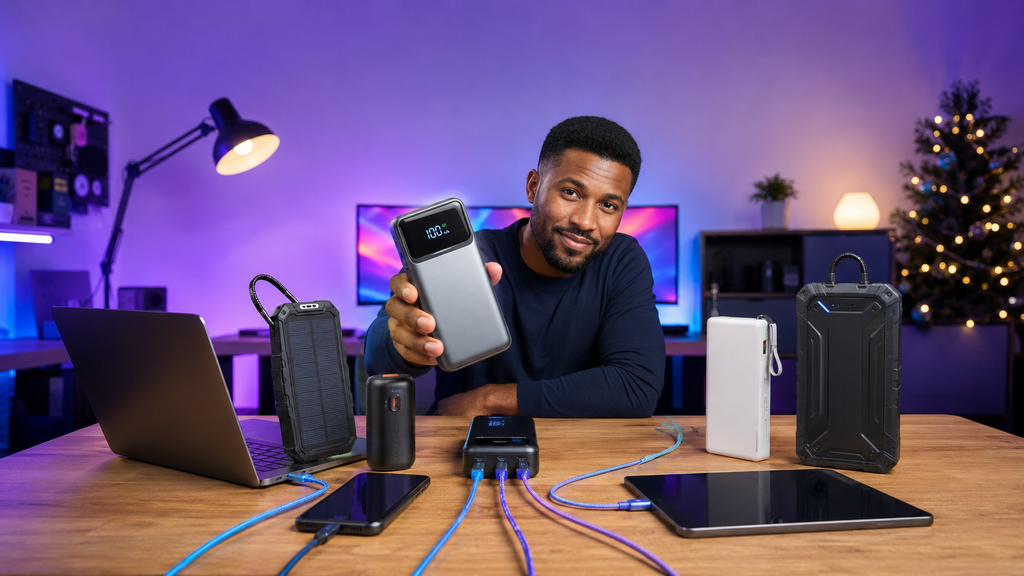
So, after looking at what different users actually need, I would narrow the search down to seven power banks that are worth considering in 2026.
For someone who wants a power bank for everyday Nigerian life, the Oraimo Traveler 3 Lit 27,000mAh immediately stands out to me. It combines a large stated capacity with 22.5W fast charging and multiple charging options, while its built-in flashlight is the kind of practical feature that can become surprisingly useful when the lights go off at night.
That flashlight may not sound like the reason to buy a power bank, but anyone who has experienced a blackout while searching for something in a dark room knows how useful a little extra light can be.
The Traveler 3 Lit is also the kind of option I would consider for students, workers, travellers and people who spend long periods away from a wall socket. Nigerian buying guides have included it among the stronger everyday power-bank options because of its combination of capacity and practical features.
However, I would not automatically recommend a 27,000mAh power bank to everybody. The more capacity a power bank has, the more likely it is to become heavier and less convenient to carry. If you only need enough power to rescue your phone during an afternoon event, carrying a large battery in your bag may not make much sense.
And that brings me to a completely different type of user.
If I wanted something premium and powerful enough to charge more than just my phone, the Anker Prime 20,000mAh 200W would get my attention. Anker lists the model with two USB-C ports and one USB-A port, with up to 200W total output. Each USB-C port can deliver up to 100W, while the USB-A port can provide up to 65W.
What makes that interesting is that this is no longer simply a phone accessory. Depending on the device and its charging requirements, a power bank in this category can also support tablets, gaming devices and compatible laptops.
There is, however, a reason I would not tell everyone to rush out and buy it. It is a premium product, and its weight is around 545g. If all you want is to keep your phone alive for another few hours, paying extra for 200W charging may be unnecessary.
But if you work from your laptop, create content, travel frequently or depend on several electronic devices, that additional power can be much more valuable.
That same thinking is why I would also put the UGREEN Nexode 20,000mAh 145W on the radar of serious smartphone and laptop users. UGREEN says the model supports up to 145W total output and can deliver up to 100W through its built-in USB-C cable.
For me, this is where a power bank starts becoming more interesting than an emergency phone charger.
Imagine spending an entire day outside while your phone, tablet and laptop are all competing for battery. If your work depends on those devices, losing power is not simply annoying. It can mean missing a customer, delaying an assignment, losing the opportunity to publish something or failing to respond to an important message.
And that is something I think Nigerians who work online should take seriously.
The smartphone economy is growing, and more people are using their devices to work, create and sell. So a reliable power source is becoming part of the infrastructure of that lifestyle.
Still, not everybody needs a 145W or 200W power bank. Sometimes convenience matters more than raw power, and that is why I find the Baseus Free2Pull 20,000mAh 65W particularly interesting.
Its biggest attraction is the built-in retractable USB-C cable.
I know this sounds like a small thing, but small conveniences can make a big difference. How many times have we carried a power bank only to discover that the charging cable is sitting at home? With a built-in cable, there is one less accessory to remember.
The Baseus Free2Pull is therefore the sort of product I would consider for someone who travels frequently, moves around with a backpack or handbag, attends events or simply has a habit of forgetting cables.
And if you are looking for something more straightforward without paying for extremely high laptop-level output, the Baseus Bipow 20,000mAh is another option worth considering.
With a stated 20,000mAh capacity and up to 22.5W output, it sits closer to what I would describe as the practical middle ground. You get more capacity than a small pocket power bank without necessarily paying for performance you may never use.
I also like the idea of having a digital battery display because it gives you a clearer idea of how much power is left. Instead of looking at a few small indicator lights and guessing whether you have enough battery for the journey home, you can see the remaining percentage more clearly.
But then again, there are people who would rather sacrifice capacity for portability.
If I were attending an event, going out for a few hours or carrying a small bag, I would not necessarily want to carry a large power bank weighing down my belongings. In that situation, a 10,000mAh option such as the Anker Nano can make much more sense.
The advantage is simple: you get a smaller and easier-to-carry backup that can help prevent your phone from dying when you need it most.
This is particularly useful for people who already have regular access to electricity and only want something for emergencies, short trips, commuting, events or unexpected delays.
Then there is the other end of the scale.
For someone who spends long periods away from electricity and wants maximum capacity without immediately entering the most expensive premium category, a 30,000mAh Romoss model is worth investigating.
The attraction is obvious. Thirty thousand milliamp-hours sounds reassuring when you know you could be away from a wall socket for an extended period.
I can imagine this being particularly useful for long-distance travellers, outdoor workers and heavy smartphone users who do not want to worry about charging their phones several times during the day.
But once again, I would not choose it simply because 30,000 is bigger than 20,000.
That is because a power bank is only useful when it fits the way you live.
If your phone is mainly used for WhatsApp, calls, social media and occasional browsing, a good 10,000mAh or 20,000mAh power bank may be more than enough. If you travel frequently or spend entire days outside, 20,000mAh gives you more breathing room. And if you are a heavy user with several devices, a larger capacity becomes more attractive.
If you need to charge a laptop, however, I would pay close attention to USB-C Power Delivery and wattage rather than looking only at the mAh number.
This is one of the most important things I would want anyone buying a power bank to understand.
Capacity and charging speed are not the same thing.
A 30,000mAh power bank can store more energy than a 20,000mAh model while still charging your phone more slowly. On the other hand, a 20,000mAh power bank with strong USB-C Power Delivery can be much more useful to someone who wants to charge a laptop.
And there is another issue I would never ignore, especially when buying electronics in Nigeria: where the product comes from.
There are plenty of cheap and unbranded power banks available, and some products can make impressive claims on their packaging without delivering anything close to the advertised performance. That is why I would rather buy from a trusted retailer, verified brand store or authorised seller than simply choose the cheapest option I can find.
A few naira saved at the point of purchase may not feel like a bargain if the battery starts performing badly after a short period.
I would also keep an eye on the condition in which I store the power bank. Nigeria can get extremely hot, and I would not make a habit of leaving a battery-powered device inside a hot car for hours. Heat is not something I would casually expose any rechargeable battery to.
More importantly, I think the conversation around power banks points to something much bigger about how we live and work today.
For years, many of us thought of smartphones mainly as entertainment devices. We use them to watch videos, scroll through social media, chat with friends and follow celebrities.
But that picture has changed.
For many Nigerians, a smartphone is now a workplace.
It is where a small business owner communicates with customers. It is where a freelancer finds clients. It is where a content creator records and edits videos. It is where an online seller manages orders. It is where a student learns a new skill. It is where someone can start building a business without owning an office.
And that is why I believe something as simple as keeping your phone charged can have a bigger impact than we sometimes realise.
A power bank gives you more hours of battery life, but what you do with those extra hours is entirely up to you.
Instead of using every additional hour to scroll endlessly, someone could use that same smartphone to learn content writing, build a social media management skill, create digital products, research affiliate marketing, start a small online service or build an audience around something they genuinely understand.
I am not saying everybody who buys a power bank needs to become an entrepreneur.
My point is simply that the device in our hands has become much more powerful than many of us realise.
If we are going to invest in keeping our smartphones alive, it is worth thinking about what those smartphones can help us build.
For me, that is the real lesson behind choosing a power bank in 2026.
The best option is not necessarily the one with the biggest battery or the highest number printed on the box. It is the one that matches your lifestyle, your devices and the work you expect it to do.
For everyday Nigerian use, I would look closely at the Oraimo Traveler 3 Lit 27,000mAh. If I wanted premium high-performance charging, the Anker Prime 20,000mAh 200W would be one of my strongest considerations. For someone who needs to keep both a phone and laptop running, the UGREEN Nexode 20,000mAh 145W deserves attention.
If convenience is the priority, I would look at the Baseus Free2Pull. For a more balanced mid-range option, the Baseus Bipow 20,000mAh is worth considering. If portability matters most, an Anker Nano 10,000mAh could be the better fit, while someone who prioritises high capacity may want to investigate a 30,000mAh Romoss model.
Prices, stock and exact specifications can change, particularly in the Nigerian market, so I would always check the current specifications, seller reputation, warranty and price before making a purchase.
Most importantly, I would not buy a power bank simply because the number on the box is bigger.
I would buy it because it solves a real problem in my life.
Because when the electricity goes off, when the journey takes longer than expected, when an event runs late or when I suddenly need my phone for something important, the last thing I want to see is a red battery icon.
And perhaps that is why a good power bank is more than an accessory.
It is a small investment in staying connected, productive and prepared.
The bigger question is what we choose to do with that connection once we have it.
If you have an article, opinion piece, event or news story you would like published, or you are ready to begin your journey toward building a profitable online content-writing business from your phone or laptop, Global News Arena would love to hear from you. Send an email to advertise@globalnewsarena.com.