
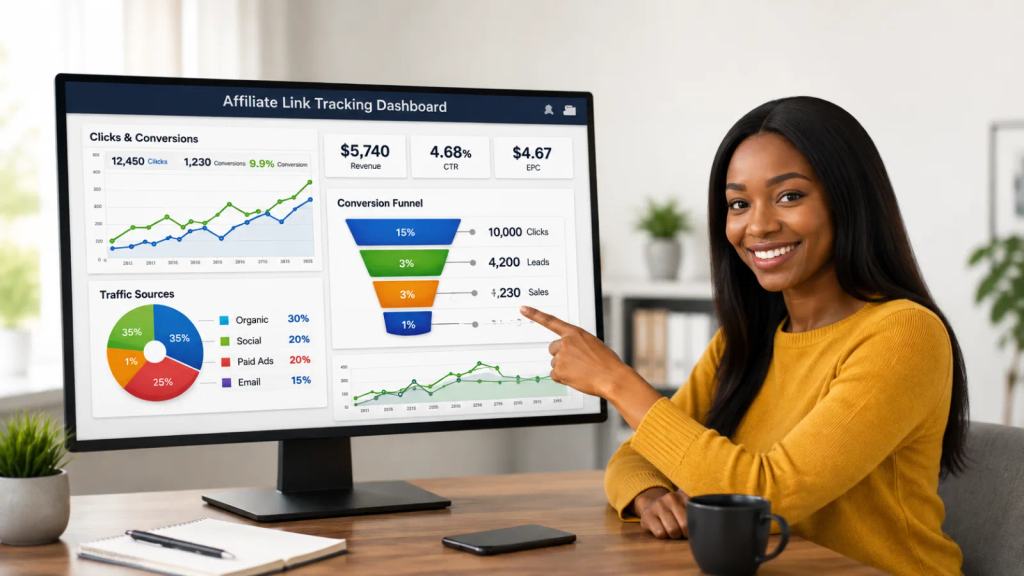
Affiliate marketing becomes much easier to understand when you stop looking at it as simply posting a link and waiting for someone to buy. The real work begins when you start paying attention to what happens after that link goes live.
You need to know where your visitors are coming from, how many people are clicking your affiliate links, which content is generating those clicks, how many people are actually converting and, ultimately, whether the effort is producing income.
Without that information, you may be creating content every day without knowing what is working.
That is why learning how to track affiliate marketing traffic, clicks and conversions is one of the most important skills anyone entering affiliate marketing should develop.
The good thing is that the basic idea is not complicated.
Traffic simply means the people coming to your content. If 2,000 people visit your article, social media page or video because they are interested in what you published, you have generated 2,000 visitors.
Clicks are what happen when some of those visitors interact with your affiliate link. If 2,000 people visit your article and 100 click your affiliate link, you have generated 100 affiliate clicks.
Then comes the number that matters even more: conversions.
A conversion happens when the person who clicked your affiliate link completes the action required by the affiliate program. Depending on the program, that could be buying a product, signing up for a service, starting a subscription, registering for an offer or completing another qualifying action.
So, if I were explaining affiliate tracking to someone just starting out, I would put it this way: traffic tells you who arrived, clicks tell you who showed interest, and conversions tell you who actually took the next step.
But there is another number that makes these figures even more useful, and that is your click-through rate, commonly known as CTR.
You can calculate your affiliate CTR by dividing your affiliate clicks by the number of visitors and multiplying the result by 100.
For example, if 2,000 people visit your article and 100 people click your affiliate link, your affiliate CTR is 5%.
That simple calculation can already tell you something about your content.
If you are receiving thousands of visitors but hardly anyone is clicking your affiliate links, you have a reason to investigate. Maybe the product is not relevant to your readers. Maybe your recommendation is buried somewhere in the article. Perhaps your call to action is unclear, or the people arriving on your page are simply looking for information and are not ready to buy.
And this is exactly why I believe affiliate marketing should never be treated as a numbers game where the biggest traffic automatically wins.
Imagine that one article receives 10,000 visitors but generates only 50 affiliate clicks and two sales, while another receives 2,000 visitors but generates 300 clicks and 30 sales.
The first article has five times more visitors, but the second article may be much more valuable to the business.
That difference is important because it changes the question we should be asking.
Instead of asking, “How many people saw my content?” we should also be asking, “How many people were interested enough to take action?”
Once you start thinking that way, your affiliate dashboard becomes much more useful.
Most affiliate programs and networks provide some form of reporting that can help you monitor activity such as clicks, conversions, orders and commissions. The exact information available depends on the affiliate program, but the principle remains the same: your dashboard gives you evidence about what is happening after people interact with your links.
However, there is a mistake I would avoid, especially as a beginner.
Do not check your affiliate dashboard only when you receive a commission notification.
A commission tells you that something worked, but your other numbers can help you understand why it worked.
Maybe you published an article about a particular software tool and it generated 200 clicks but only one sale. Then you published a comparison article about the same type of software and received only 80 clicks, but 15 people converted.
That should make you curious.
What was different about the second article?
Maybe the people reading it had stronger buying intent. Maybe the comparison answered questions they had before making a decision. Maybe the product was presented more clearly. Or perhaps the audience was simply more relevant.
The numbers will not always give you the complete answer, but they give you clues about where to look.
This is where tracking individual campaigns becomes extremely useful.
Suppose you are promoting the same affiliate product on Facebook, TikTok, YouTube, your website and WhatsApp. If you simply paste the same link everywhere without a tracking structure, it can become difficult to determine which platform is producing the results.
You may know that people are clicking, but you may not know whether those clicks came from your website article, Facebook post or short video.
Using campaign tracking information can help separate those sources.
Google Analytics, for example, supports campaign parameters that can be added to URLs to help identify where website traffic came from and which campaigns generated it. Google says these parameters can be used to identify specific campaigns, sources and other information in Analytics reports.
That means you can create different tracked links for different campaigns and then compare the results.
Imagine that your Facebook campaign generates 500 clicks, your website article generates 150 clicks, your YouTube video generates 100 clicks and your WhatsApp campaign generates 50 clicks.
At first, Facebook appears to be the winner.
But what happens if those 500 Facebook clicks generate only two sales while the 150 website clicks generate 20?
Suddenly, the platform with fewer clicks is producing much stronger results.
That is the kind of information that can save you from making poor business decisions.
You might have spent hours trying to increase Facebook traffic simply because it produced the most clicks, when your website was quietly sending you customers who were much more likely to buy.
And that is why I would rather have 100 highly interested people than thousands of people who have no intention of taking action.
Traffic is valuable, but relevant traffic is even more valuable.
The same principle applies to conversion rates.
If 200 people click your affiliate link and 10 complete the required action, your conversion rate is 5%.
But a conversion rate should never be viewed in isolation. Different products, industries, prices, audiences and affiliate programs can produce very different results.
If people are clicking but not buying, there could be several reasons.
The product might be too expensive. The landing page might not convince them. They might be comparing alternatives. The offer might not match what your content promised. Or your audience might simply not be the right audience for that particular product.
So rather than immediately concluding that your affiliate strategy has failed, look at the journey from beginning to end.
Where did the visitor come from?
What content did they see?
What made them click?
What happened after they clicked?
Did they convert?
If they did not convert, what could have stopped them?
Those questions are much more useful than simply looking at the final commission figure.
It also helps to keep a simple record of your campaigns.
You do not need an expensive analytics system to begin. A spreadsheet on your smartphone can be enough.
You could record the date, content title, platform, product being promoted, clicks, conversions and commissions.
After several weeks, you can compare the numbers.
You might discover that product comparison articles consistently generate more clicks than ordinary reviews.
You might find that short videos generate huge amounts of traffic but very few conversions.
You might discover that your website attracts fewer people but produces more sales.
You might even discover that one particular product continues to outperform everything else you promote.
Those discoveries can influence your future content.
Instead of creating content simply because you think a topic sounds interesting, you can begin creating content based on evidence.
And this is where affiliate marketing starts becoming more than simply sharing links.
You are learning how your audience behaves.
You are learning which problems people are trying to solve.
You are learning which products attract attention and which ones actually lead to action.
Most importantly, you are learning how to turn content into a measurable business activity.
But while we are talking about tracking clicks and conversions, there is another part of affiliate marketing that should never be ignored: transparency.
If you earn a commission when someone buys through your affiliate link, your audience should understand that relationship.
The U.S. Federal Trade Commission says affiliate relationships should be disclosed clearly and conspicuously so consumers understand the connection and can decide how much weight to give the recommendation. The FTC specifically addresses affiliate marketing and says disclosures should be close to the recommendation or affiliate link rather than hidden somewhere difficult to find.
For example, a simple statement explaining that you may earn a commission from purchases made through links in the article can make the relationship much clearer.
This matters not only because of advertising rules in markets such as the United States, but also because trust is incredibly important when you are building an online audience.
People are more likely to listen to your recommendations when they believe you are being honest with them.
And I think this is where some affiliate marketers get it wrong.
They see a product with a high commission and immediately start promoting it, even when the product has little connection to their audience.
But earning a commission today is not worth destroying the trust you have spent months or years building.
If you are creating content about smartphones, for example, recommending useful phone accessories may make sense.
If your audience is interested in small businesses, software for managing customers, websites, payments or productivity may be relevant.
If your audience is interested in online learning, useful educational platforms or digital tools may make more sense.
The connection between the audience, the problem and the product should feel natural.
That is also why I believe the strongest affiliate marketers are not necessarily the people who post the most links. They are often the people who understand their audience the best.
They know what their readers are searching for.
They understand the questions people ask before buying.
They create content that answers those questions.
Then, when there is a relevant product that genuinely helps solve the problem, the affiliate recommendation becomes part of the solution rather than an interruption.
And this brings me to the bigger opportunity I see for people who want to build an income online.
Affiliate marketing can be started on a small scale, and many of the activities involved can be done from a smartphone.
You can research products from your phone.
You can write articles from your phone.
You can create short videos from your phone.
You can publish to social media from your phone.
You can monitor analytics from your phone.
You can check your affiliate dashboard from your phone.
You can even keep track of your campaigns using a spreadsheet on your phone.
That does not mean making money online is automatic, because it is not.
There are no guarantees that posting an affiliate link will produce sales, and anyone promising instant wealth simply because you joined an affiliate program deserves to be approached carefully.
What you can build, however, is a skill.
You can learn how to create useful content.
You can learn how to attract the right audience.
You can learn how to analyse traffic.
You can learn how to improve your click-through rate.
You can learn how to understand conversions.
And as those skills develop, you may discover opportunities beyond affiliate marketing.
The same ability to write useful content can lead to content writing.
The same knowledge of social media can lead to social media management.
The same audience you build around a topic could eventually support a digital product, online course, newsletter, consulting service or another digital business.
That is why I do not see affiliate marketing simply as a way to earn commissions.
I see it as one possible entry point into the wider digital economy.
But the starting point is still the same: learn to measure what you are doing.
If nobody is clicking, find out why.
If people are clicking but not converting, investigate what happens after the click.
If one article consistently produces sales, understand what makes that article different.
If one platform sends valuable visitors, invest more time in learning how to use that platform effectively.
If a product repeatedly disappoints your audience, stop promoting it.
In other words, let the data guide your decisions rather than allowing assumptions to control your strategy.
You do not need to become a professional data analyst to do this.
Start with a few numbers.
Track your visitors.
Track your affiliate clicks.
Track your conversions.
Track your commissions.
Track where your traffic comes from.
Then compare those numbers over time.
Eventually, you begin to see patterns.
And those patterns can tell you what your audience wants, what they trust and what they are willing to spend money on.
For me, that is the real value of affiliate marketing tracking.
It takes you from simply saying, “I posted a link,” to being able to say, “I know which content brought people in, I know what they clicked, I know what converted and I know what I should improve next.”
That is a completely different way of approaching an online business.
You are no longer relying entirely on luck.
You are testing.
You are learning.
You are improving.
And because you can start with a smartphone, the barrier to learning these skills is lower than it has ever been.
You do not need to begin with thousands of followers or a large website. You can start with one topic, one audience, one useful product and one piece of helpful content.
Then measure the result.
Improve it.
Try again.
Over time, those small experiments can become a system.
And once you understand that system, affiliate marketing becomes much more than putting links on the internet and hoping somebody buys.
It becomes an exercise in understanding people, creating useful content and building trust while using data to make smarter decisions.
That is the part I believe aspiring digital entrepreneurs should pay attention to, because the biggest opportunity may not be the first commission you earn. It may be the knowledge you gain about how attention, content and online buying behaviour work.
Once you understand that, you have learned something that can be applied far beyond affiliate marketing.
And if you are willing to start small, learn consistently and allow your results to teach you what to do next, your smartphone can become more than a device for consuming content. It can become a tool for building something of your own.
If you have an article, opinion piece, event or news story you would like published, or you are ready to begin your journey toward building a profitable online content writing business from your phone or laptop, Global News Arena would love to hear from you. Send an email to advertise@globalnewsarena.com.