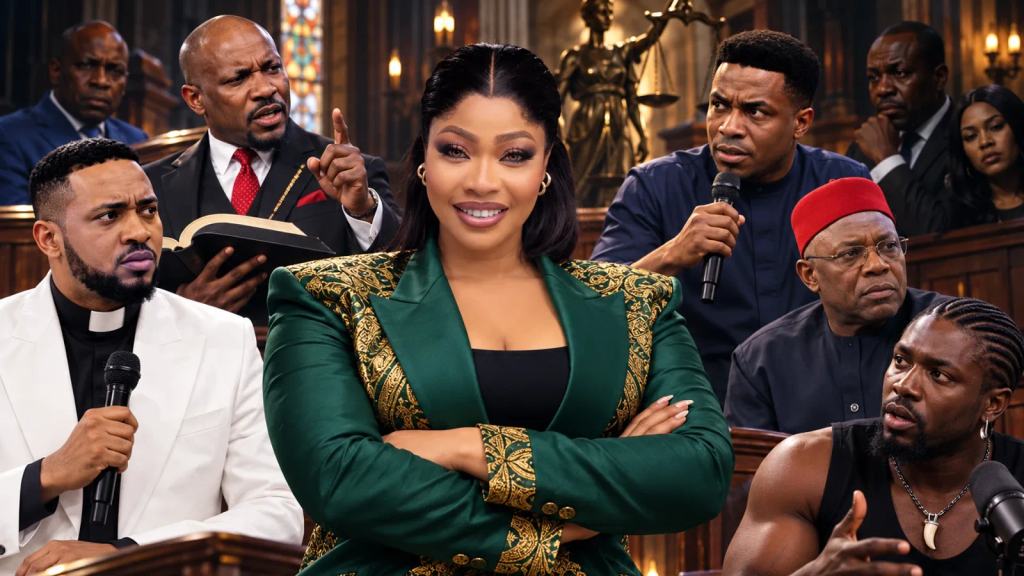
There is something deeply surreal about watching Nollywood melodrama, megachurch power, romantic disappointment and Nigerian electoral politics collide in a courtroom.
If you spent five minutes on Nigerian social media on Wednesday, October 28, 2026, you probably encountered the video that stopped timelines in their tracks.
It was not a polished political address. It was not a cinematic film teaser. It was actress and African Action Congress (AAC) Abia State governorship candidate Doris Ogala, handbag perched on her head, speaking defiantly as prison officials prepared to take her into custody.
Her words were raw and unmistakably emotional.
"Oh, na love dey carry me go prison... They don’t know the law, using the law against a common man. I no fear prison, I fear Jesus. Prison, I go there. I no dey fear Chris Okafor, I go go prison, and I will come out!"
The video quickly attracted reactions across Nigerian social media. Some joked about an "incoming governor in cell 2." Others questioned the justice system, while many wondered how a dispute involving alleged romantic promises had escalated into criminal proceedings.
The Federal High Court proceedings were more than a celebrity spectacle. Ogala pleaded not guilty to the charges reported against her. The court ordered her remand pending the hearing of her bail application, according to reports published on October 28 and 29.
The case had become another chapter in a dispute that had already involved public accusations, a proposed marriage controversy, financial claims, online recordings and civil court proceedings.
But how did the story reach this point?
To understand the events of October 2026, it is necessary to revisit the relationships, public confrontations and legal disputes that preceded the latest court appearance.
The Marriage, the Miscarriages and the Questions That Followed
Before the controversies involving prominent pastors became a recurring feature of her public life, Doris Ogala was married to businessman Kingsley Anyanwuagwu.
The couple married in 2019. For a time, their relationship appeared to offer a quieter chapter away from the pressures of the entertainment industry.
Then came January 2022.
Ogala published an emotional message suggesting that her marriage had ended.
"Marriage is bitter kola. If I end mine and anyone mocks me, I swear I’ll curse that person... The way people are being mocked on social media after divorce made a lot to stick in marriage suffering and smiling... Breaking News! I’m officially single. Don’t ask for details."
The post generated questions about the state of her marriage. Days later, however, she shared photographs with her husband and said she was still in her matrimonial home.
The mixed messages left observers wondering what was happening behind the scenes.
The situation became clearer in August 2026, when Ogala appeared on Nedu Wazobia's podcast, The Clarity Zone. During the interview, she discussed the end of her marriage and revealed that she had experienced more than ten miscarriages.
According to reporting by Pulse Nigeria on August 20, 2026, Ogala said the pregnancy losses contributed to the collapse of her marriage in 2022.
The disclosure added a deeply personal dimension to a relationship that had previously attracted attention through social media posts and public speculation.
It also reminded audiences that the breakdown of a marriage can involve private experiences that outsiders may never fully understand.
During the same interview, Ogala discussed her earlier relationship with Pastor Chris Okafor. She said they had dated between 2017 and 2019, before she married Kingsley.
That disclosure brought the earlier relationship into the centre of the public conversation.
Commentators began examining the chronology and questioning how the relationship had influenced subsequent events. However, the precise circumstances of private relationships cannot be established simply by comparing social media posts.
What became clear was that Ogala's personal history with Okafor would become a central part of the controversy that followed.
Chris Okafor, the Money Dispute and the ₦1 Billion Claim
Dr. Chris Okafor, the founder of Grace Nation International, popularly known as Liberation City, became the central figure in Ogala's most consequential public dispute.
The conflict had several stages. It involved a financial allegation in 2024, a public dispute over an alleged romantic relationship in December 2025, and subsequent court proceedings.
Each stage introduced new claims and attracted a wider audience.
The April 2024 financial dispute
The public confrontation did not begin with the December 2025 wedding controversy.
In April 2024, Ogala accused Okafor of failing to deliver money that she said had been entrusted to him for her.
In posts reported by Nigerian entertainment publications, she alleged that an associate had given the pastor ₦35 million to deliver to her. She claimed that she received only ₦10 million and that the amount delivered to her did not account for the full sum.
The exact breakdown in her public account varied in the reports, so the original transaction records would be needed to establish the amount paid, the amount received and any outstanding balance.
Okafor's legal representatives later offered a different account of the wider financial relationship. In January 2026, his lawyer, Ife Ajayi, said the dispute originated in a business arrangement from which the cleric had withdrawn after concluding that its objectives could not be achieved. His legal team rejected allegations of wrongdoing.
These are competing accounts, not a settled finding about what happened to the money.
The dispute nevertheless marked an important stage in the relationship between the two public figures. A disagreement involving money had become a public confrontation involving accusations, denials and questions about the conduct of a prominent religious leader.
The reported detention in 2024
Ogala also spoke publicly about being detained following an earlier confrontation.
Some reports described her detention in connection with the dispute, but the full official record of the incident was not available for independent verification during this review.
Her account of the experience added another layer to the public disagreement. For her supporters, the situation raised questions about how disputes involving powerful public figures should be handled. Critics, meanwhile, questioned the allegations made on social media.
The appropriate way to assess such a dispute is to examine the available records and the responses from those involved, rather than assume that either party's public statements settle the matter.
The December 2025 wedding controversy
The dispute intensified in December 2025 after a video of Okafor's engagement to another woman circulated online.
Ogala claimed that she and the pastor had maintained a romantic relationship since 2017. She alleged that he had made promises of marriage and that his decision to marry another woman left her deeply hurt.
"Somebody should go and tell Chris Okafor that he will not marry! Who are you leaving me for? Forget shame here."
Her comments attracted widespread attention because the alleged relationship involved a prominent cleric and a public figure who was openly challenging his decision to marry someone else.
The issue soon moved beyond social media.
On December 18, 2025, Premium Times reported that Ogala had issued a formal legal demand seeking ₦1 billion from Okafor. The demand followed his wedding to another woman and concerned what Ogala described as a broken promise to marry.
The claim involved alleged emotional, reputational and psychological harm. It was a demand for compensation, not a court finding that the pastor owed the money.
The distinction matters. A legal demand states what one party is seeking. A court must determine the legal merits of a disputed claim through the applicable process.
The wedding controversy nevertheless became one of the defining episodes in the dispute.
A public celebration had become entangled with an earlier relationship, a substantial financial demand and competing accounts of what had happened between the people involved.
The livestream arrest and VeryDarkMan's involvement
The controversy soon expanded to include social media activist Martins Vincent Otse, popularly known as VeryDarkMan, or VDM.
In December 2025, Ogala's public statements included threats to release private material concerning the cleric. Reports subsequently described her arrest and detention, followed by her release.
VDM entered the dispute by publishing recordings of conversations involving Ogala and making claims about evidence connected to the allegations.
The controversy also involved a woman identified as Miss Chi, who reportedly claimed on VDM's platform to be Okafor's biological daughter. Okafor denied the paternity allegation, and the reported DNA claims would require examination of the underlying evidence before any conclusion could be reached.
As more people joined the public conversation, the dispute became harder to separate from the wider machinery of online commentary.
Recordings circulated. Old statements resurfaced. People offered competing interpretations of events they had not necessarily witnessed.
The result was a dispute that extended beyond the original relationship and into questions about privacy, reputational harm, the publication of private material and the limits of online speech.
The January 2026 court order
On January 22, 2026, The Guardian reported that Justice Akintunde Savage of the Lagos State High Court in Ikeja had issued an interim order restricting Ogala, VDM and Kelvin Chimaobi Emmanuel from mentioning or referring to Okafor, his church or ministry on social media or other platforms, pending further proceedings.
The order also addressed the publication of alleged private communications and other material.
An interim order is a court direction made while proceedings remain unresolved. Its precise terms and subsequent legal status should be checked against the relevant court documents.
The development marked another turning point. The disagreement was no longer being conducted solely through public statements and online broadcasts. It had become the subject of formal civil proceedings.
The next major development came in October 2026, when federal criminal charges brought the controversy back into the headlines.
The October 2026 Arraignment: What the Court Reports Say.
On October 28, 2026, the Federal High Court in Lagos heard proceedings involving Ogala and allegations connected to her dispute with Okafor.
Reports by Punch Newspapers, Premium Times, Tribune Online and QED.NG described her arraignment and subsequent remand.
The Office of the Attorney-General of the Federation brought the prosecution. Justice Akintayo Aluko presided over the proceedings.
The allegations concerned electronic communications, the publication of intimate material without consent, and alleged threats to publish further material unless the cleric provided compensation or bought a house.
According to the prosecution's account reported by Nigerian news outlets, the alleged conduct occurred between September 2024 and March 2026.
Ogala pleaded not guilty.
That plea is important. It means she denied the charges when they were read to her. The allegations have not been established by a criminal conviction.
Why was she remanded?
According to Punch Newspapers, the prosecution asked the court to remand Ogala while it reviewed her bail application. The prosecutor said he had received the application that day and needed time to respond.
Her defence counsel opposed the request. He argued that bail was within the court's discretion and said Ogala would attend subsequent hearings if released.
The defence also drew attention to her status as a governorship candidate in Abia State.
The court ordered an accelerated hearing of the bail application and remanded her pending its determination.
The reports available for this article contain two discrepancies that require caution.
First, some reports described the charges as three counts, while others described four. Second, reports differed over whether the correctional facility was Ikoyi or Kirikiri.
The charge sheet and remand warrant were not independently available for this review. The exact count and facility should therefore be confirmed against primary court records before the article is published.
The reports available on October 29 stated that the bail application was scheduled for October 30, 2026. No outcome should be assumed without a subsequent verified report.
What does remand mean?
Remand means that a court has ordered a person to remain in custody while a legal matter proceeds or a particular application is determined.
It does not, by itself, establish guilt.
The court must consider the relevant legal questions, and the prosecution must prove the criminal allegations through the judicial process.
That distinction is especially important when a case has already attracted intense public attention. Social media commentary can quickly turn an accusation into an apparent verdict, even when the legal process remains incomplete.
The video of Doris Ogala speaking defiantly as officials prepared to take her into custody became a powerful image. It attracted sympathy, criticism and political interpretations.
But the image cannot answer the legal questions before the court.
Those questions must be resolved through evidence and due process.
Apostle Johnson Suleman and the Abia Political Clash
Okafor was not the only prominent religious leader with whom Ogala had a public confrontation.
In September 2026, she challenged Apostle Johnson Suleman of Omega Fire Ministries over comments about Abia State and Governor Alex Otti.
The dispute was political rather than romantic.
Suleman had reportedly praised the governor's performance, including remarks about governance and purported 24-hour electricity. Doris Ogala, who was positioning herself as an opposition candidate for the Abia governorship, challenged the praise.
She accused the cleric of using his pulpit as an indirect political campaign platform.
She also warned other prominent religious leaders, including Pastor Jerry Eze of Streams of Joy, against becoming involved in Abia State's electoral politics.
The argument raised an important question about religious influence in public life.
When a prominent cleric praises a governor, is the statement simply an expression of personal opinion, or can it influence political perceptions among followers?
Religious leaders have a right to express their views. Political candidates also have a right to challenge those views. The important task is to examine the actual statements and their context.
Ogala then made the confrontation personal.
She claimed to possess information about an alleged incident involving Suleman at the Protea Hotel in Lagos. She said she knew details, including room numbers, that she believed would shock the public.
Those claims were made by Ogala. They should not be treated as independently established facts without corroborating evidence and a response from the person concerned.
Her challenge included the words, "Bring your police and judiciary. I will face you head-on."
The episode attracted attention because it combined religious authority, political competition and personal allegations.
But attention is not the same as political credibility.
A candidate seeking public office must also explain how they intend to address jobs, infrastructure, education, healthcare, security and the daily concerns of voters.
The question for Ogala is whether the attention generated by public confrontations will translate into political trust, or distract from the policy discussions voters need.
That remains a separate question from the allegations involved in her legal disputes.
Tonto Dikeh, Benedict Johnson and Uche Elendu: The Nollywood Fallouts
Ogala's public controversies have not been limited to romantic relationships or religious figures.
Over the years, she has also been involved in public disagreements with Nollywood colleagues. These episodes have included accusations, expressions of loyalty, apologies and renewed disputes.
They reveal how quickly a disagreement between public figures can become a matter of public entertainment.
Tonto Dikeh and the Bentley dispute
Ogala was a vocal defender of Tonto Dikeh during the actress's public conflict with Delta politician Prince Kpokpogri in 2021.
Ogala criticised Kpokpogri and accused him of blackmail and owing Dikeh money. Her intervention presented her as a friend willing to defend someone she supported.
By 2025, however, the relationship between Ogala and Dikeh had become strained.
The dispute included claims about an alleged Bentley gift. Ogala denied receiving the vehicle and objected to allegations that she had been ungrateful.
She also accused people associated with Dikeh of bullying her online.
In June 2025, Ogala publicly apologised to Dikeh, Angela Okorie and Actors Guild of Nigeria president Emeka Rollas. She referred to grief, personal trauma and disappointment in explaining her actions.
The apology did not permanently settle the matter. Reports in July 2025 described a renewed disagreement between Ogala and Dikeh.
The episode illustrates how public friendships can move through several stages: support, disappointment, confrontation, apology and further disagreement.
It also shows how a dispute over an alleged gift can become a larger argument about loyalty and expectations.
The Benedict Johnson feud
In July 2023, during a public disagreement involving Angela Okorie and Uche Elendu, Ogala criticised actor Benedict Johnson.
She accused him of taking opposing sides and contributing to discord behind the scenes. She also claimed that he had betrayed her despite her previous support.
Those statements represented Ogala's account of the relationship. They do not independently establish Johnson's motives or conduct.
The episode nevertheless became part of the wider public record of her disagreements with entertainment colleagues.
The late Dr Iyke Lawson Kanu's estate
In November 2023, Ogala criticised Uche Elendu over a dispute involving the estate of the late Dr Iyke Lawson Kanu.
Reports described Ogala publishing court documents and questioning why Elendu was contesting properties in a dispute involving the deceased's wife and five children.
Estate disputes can involve complex questions about ownership, wills, inheritance and the rights of surviving family members.
Documents shared online may provide useful context, but their significance depends on the full record and applicable law.
A public accusation should not be treated as a final legal determination.
Taken together, these episodes show why Ogala has remained a subject of public discussion. She has frequently entered disputes involving other personalities, sometimes defending people she considered friends and sometimes criticising them.
That history does not establish the merits of the current criminal case. It does, however, help explain why each new development attracts attention from people already familiar with her public life.
The same audience that followed earlier disagreements is now watching a legal dispute with potentially more serious consequences.
Why the Doris Ogala Story Captures Attention
There is a reason people keep following stories involving romance, money, religious authority, celebrity friendships and courtroom drama.
Such stories contain questions that people naturally want answered.
Why did the relationship end? Were promises made? What evidence exists? Why did the disagreement escalate? What will happen next?
Each answer can introduce another question.
That is the structure of a compelling narrative.
Ogala's story combines several subjects that regularly attract public interest. It includes a marriage, reported personal loss, an alleged romantic relationship, financial claims, a wedding controversy, legal proceedings and political ambition.
Each development changes how readers interpret the events that came before it.
But there is an important distinction between a compelling story and a proven case.
A writer should not present allegations as established facts simply because they generate attention. Nor should a writer exploit private suffering or publish unverified claims about identifiable people.
The strongest reporting gives readers a clear chronology, identifies who made each claim, includes relevant responses and explains what remains unresolved.
That is how a publication can attract readers without sacrificing credibility.
It also reveals something important about online writing.
People are more likely to stay with a story when they understand the people involved, recognise the conflict and have a reason to care about the outcome.
That skill has value beyond celebrity journalism. It can be applied to fictional stories, blogs, newsletters, digital books, scripts and content-writing services.
Which raises an important question: what if you could learn to use storytelling to build your own online income?
Make Money Online by Writing Stories People Love to Talk About.
You do not need to be a famous author. You do not need a literature degree or complicated English.
You need an idea, a willingness to learn and a practical way to turn that idea into a story people want to read.
Have you ever told someone a story and watched them lean forward and ask, "Really? What happened next?"
That is the power of curiosity.
Now imagine learning how to use that instinct in your writing and turning it into an opportunity to earn money online.
What if your stories could make you money?
Think about situations that immediately make readers curious.
A woman discovers that her closest friend has been hiding a devastating secret. A wealthy man disguises himself as an ordinary worker to discover who genuinely loves him. A spouse uncovers a revelation that changes everything they thought they knew about their marriage.
Readers want answers. They discuss the characters, share the stories and may return for the next instalment.
That is how an engaging story can attract attention.
You can learn to write fictional stories, publish them online, build an audience and explore legitimate ways to earn from your work.
What is a controversial story?
A controversial story explores a situation people may disagree about, find surprising or feel strongly enough to discuss.
It does not have to involve a real celebrity or an actual scandal. Some of the most engaging stories are entirely fictional.
Consider these examples:
Should a woman forgive someone who betrayed her trust?
Is it wrong to protect your family by keeping a serious secret?
What happens when the person everyone mocked becomes more successful than all of them?
When forced to choose, would you pick love or financial freedom?
Should loyalty to a friend have limits when that friend does something wrong?
Can a relationship survive a serious betrayal?
You can explore these questions using simple language.
The important thing is to make readers care about the characters, understand what is at stake and want to discover what happens next.
Controversial storytelling should not become an excuse to defame real people or publish unverified allegations. Fiction allows you to explore difficult situations without presenting invented events as real news.
From story idea to online income
Start by choosing an idea that creates curiosity. It might involve a secret, a difficult choice, an unexpected discovery or a betrayal.
Develop the idea into a story with clear characters, a problem and a meaningful ending. Use simple words and reveal information at a pace that keeps readers interested.
Next, choose where to publish. You might explore storytelling platforms, blogs, newsletters, digital publishing services, freelance writing marketplaces or social media.
Each option has different rules and earning opportunities. Check whether you retain ownership of your work, whether paid publishing is available and what conditions apply to receiving payments.
Then work on building an audience. Publish consistently, improve your writing and pay attention to genuine feedback.
Finally, explore suitable ways to earn. These may include commissioned writing, freelance content services, digital books, paid newsletters, subscriptions or eligible advertising programmes.
Income is not guaranteed. Your results will depend on writing quality, demand, audience development, consistency and the monetisation method you choose.
But you can begin by learning the craft and developing a practical plan.
Do you need to be a professional writer?
No.
You do not need complicated English. You do not need to write a whole book in one day. You do not need thousands of followers before you begin.
You need an idea, a willingness to learn and a process you can follow.
Today, you have an idea in your head. Tomorrow, you can learn how to develop it into a story. Next, you can learn how to edit it, publish it and introduce it to potential readers.
With practice, you can build a collection of stories, develop a portfolio, grow an audience and explore different earning opportunities.
Your first story may not make money immediately. It may not attract thousands of readers. That is normal.
Every story you write gives you another opportunity to improve.
The goal is not to become an overnight success. It is to acquire a useful skill and learn how to put it to work.
Ready to Turn Your Ideas Into Stories That Pay?
You do not have to wait until you feel like a seasoned author.
You can begin learning how to transform simple ideas into engaging narratives that people want to read, discuss and share.
Imagine having a clear process for developing a story instead of staring at a blank page and wondering where to begin.
Imagine understanding how to introduce a character, create a problem, build suspense and bring the story to a satisfying conclusion.
Imagine knowing how to choose a publishing method, reach potential readers and explore ways to earn from your work.
These are practical skills you can develop one step at a time.
Book a 1-on-1 Consultation and Story Strategy Session
If you want personalised guidance, a one-on-one consultation can help you move from scattered ideas to a more organised writing and publishing plan.
During the session, we can explore how to identify your storytelling niche, develop engaging story openings, create meaningful conflicts, choose suitable publishing platforms and evaluate monetisation options.
We can also discuss whether freelance writing, commissioned stories, digital books, paid publications or another approach best suits your goals.
The aim is to help you understand what to do, why it matters and how to take the next step with greater confidence.
There are no promises of guaranteed earnings or overnight success. The focus is on learning a skill, understanding your options and building a practical strategy.
Book your 1-on-1 consultation today.
Your next big story could begin with one simple idea. Let us bring it to life.
SEO Tags
Doris Ogala, Chris Okafor, Nigerian Celebrity News, Nollywood, Celebrity Controversies, Nigerian Entertainment, Online Storytelling
Men Doris Ogala Has Mentioned or Been Publicly Linked To
Romantic Relationships and Marriage
Kingsley Anyanwuagwu: Her former husband, whom she married in 2019 and separated from in 2022.
Pastor Chris Okafor: General Overseer of Grace Nation/Liberation City, with whom she claimed an eight-year past relationship and broken marriage promise, and who is the complainant in her federal cybercrime and extortion trial.
Pastors and Religious Figures
Apostle Johnson Suleman: Head of Omega Fire Ministries, whom she initially defended politically and later accused of being among those behind her October 2026 prison remand.
Pastor Jerry Eze: Convener of NSPPD/Streams of Joy International, whom she called out in October 2026, alleging he played a role in her remand because of secrets she holds.
Pastor Olumide Emmanuel: Linked through public commentary surrounding the broader Chris Okafor church controversy; not confirmed to have been directly named by Doris.
Pastors Sylvester, Kelvin, Oliver, and Shedrack: Junior pastors at Liberation City named in news reports regarding leadership and service arrangements during the crisis; unconfirmed as personal targets of Doris.
Politics and Governance
Alex Otti: Current Governor of Abia State, whom she accused in October 2026 of colluding with pastors to orchestrate her remand to derail her 2027 AAC governorship bid.
Dr. Okezie Ikpeazu: Former Governor of Abia State, whom she publicly defended in August 2026 by asserting he achieved more than Alex Otti but was betrayed by his media team.
Omoyele Sowore: AAC national leader and activist who publicly backed her, secured support following her arrests, and condemned her 2026 prison remand.
Nollywood, Feuds, and Social Circles
Benedict Johnson: Nollywood actor she publicly called out, accusing him of a multi-year land fraud, backbiting, and spreading rumors about her and her friends.
Chief Emeka Rollas: Actors Guild of Nigeria (AGN) president whom she accused of shielding producer Adanma Luke after Junior Pope's death, later apologized to in 2025, and who endorsed her 2027 political campaign in 2026.
Prince Walter Ogochukwu Igweanyiba: Uche Elendu’s ex-husband, whom Doris brought into the public spotlight in 2020 by leaking messages alleging he had an affair with Oge Okoye.
Prince Joseph Kpokpogri: Politician and businessman whom Doris attacked online and released leaked audio recordings against while defending Tonto Dikeh.
Olakunle Churchill: Tonto Dikeh's ex-husband, whom Doris publicly dragged on multiple occasions during his custody and child-support feuds with Tonto.
Junior Pope Odonwodo: Late Nollywood actor whose fatal boat accident prompted her to lead fierce online call-outs against industry leadership.
Media, Activism, and Commentary
Martins Vincent Otse (VeryDarkMan / VDM): Social media activist who intervened in her dispute with Pastor Chris Okafor, published commentary and recordings, and campaigned for her release.
Akpororo (Bowoto Jephthah): Stand-up comedian and gospel minister who had public social media exchanges with Doris during the wider clergy controversies.
Chinedu Ani Emmanuel (Nedu Wazobia): Broadcaster who hosted her on The Clarity Zone podcast in August 2026, where she made viral revelations about her marriage, miscarriages, and past relationship with Chris Okafor.
The writer of this article does not claim to know the individuals named personally. The information regarding their backgrounds and the allegations in their cases, as published on Global News Arena, is based on independent online research. All criminal allegations should be distinguished from convictions, and the individuals are presumed innocent unless proven guilty in court.
If you have an article, opinion piece, event or news story you would like published, Global News Arena would love to hear from you.