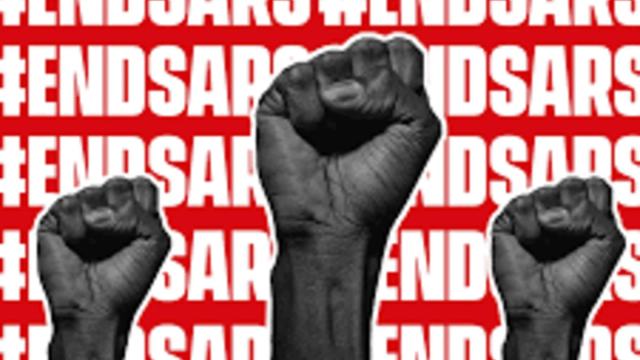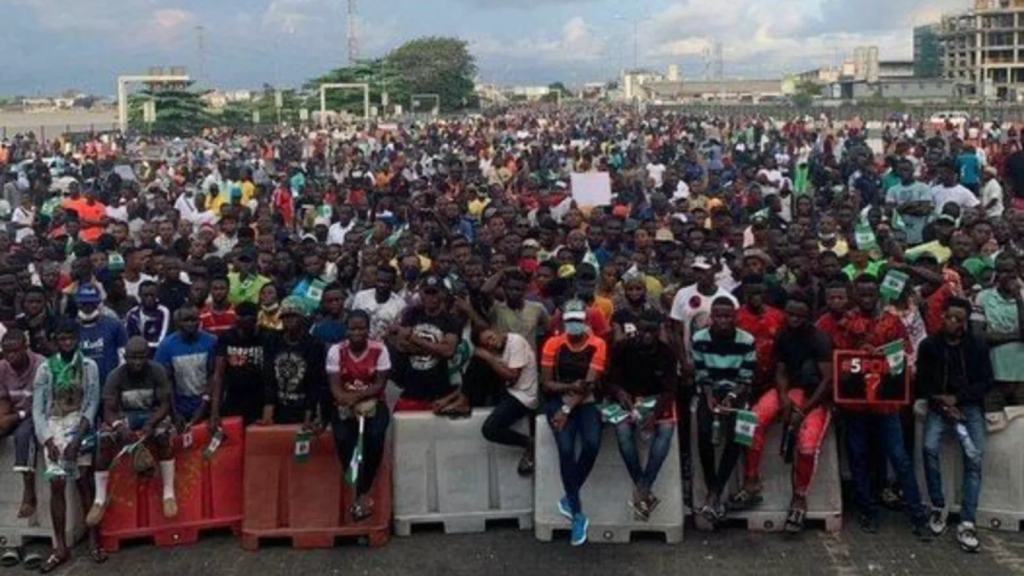
Police on Tuesday fired tear gas at Nigerians who gathered at the Lekki Toll Gate in Lagos to mark six years since soldiers opened fire on protesters there.
The gathering was organised by Enough is Enough. Wreaths were laid, and the crowd came to honour those who died and to renew the call for justice and police reform.
It did not last long. Canisters landed, the crowd scattered, and the wide road in front of the toll gate emptied.
Two people were arrested, including a man who said he was a journalist. A placard was also taken from one participant.
About 30 police trucks and armed officers were in place before the gathering began. The command had said only indoor and virtual events would be allowed, citing reports of possible clashes between opposing groups.
Lagos State governorship candidates Gbadebo Rhodes-Vivour of the African Democratic Congress and Funso Doherty of the Nigeria Democratic Congress were at the toll gate. Both left after the tear gas.
Six years ago, on the night of 20 October 2020, soldiers opened fire on young Nigerians sitting on the road, waving the flag and singing the national anthem.
The country had been on the street for close to two weeks by then. The protests started in early October after a video appeared to show men in uniform shooting a young man in Delta State. Within days, crowds had filled Lagos, Abuja, Port Harcourt and other cities.
SARS was dissolved on 11 October 2020. Nine days later, the soldiers came to Lekki.
The Lagos judicial panel chaired by Justice Doris Okuwobi submitted its report in November 2021. It found that 11 protesters were killed at the toll gate, four others were missing and presumed dead, and 48 people were recorded as casualties.
The panel described the shooting as a massacre.
It said the soldiers fired without provocation, that they refused to let ambulances reach the wounded, and that police officers shot at people running for the lagoon afterwards.
The report made 32 recommendations, among them a public apology, prosecution of the officers involved, compensation for victims and families, and a memorial at the toll gate.
The state government disputed key parts of the report, including its conclusions on casualties.
Amnesty International documented at least 56 deaths nationwide during the protests, about 38 of them on 20 October 2020 alone, protesters and people caught in the violence together.
In July 2024, the ECOWAS Court of Justice found Nigeria responsible for serious human rights violations at the toll gate and ordered the state to investigate and provide redress.
Rights groups say implementation has been slow and uneven.
Six years on, no soldier or police officer has been put on trial for that night, and the public apology the panel asked for has not been made.
Each October since, the same scene has repeated.
In 2021 police fired tear gas at a memorial procession led by young people and celebrities.
In 2024 they fired again at protesters asking that the panel's recommendations be implemented.
This year the police said the gathering was a security risk. The people who came said they came to remember.
With the road closed, much of the remembering moved to the phone.
Through the day, old photographs from the toll gate, tributes to the dead and the green and white flag travelled across X, Instagram, Facebook and TikTok.
The #EndBadGovernance Movement, Lagos chapter, and the Youth Rights Campaign took the anniversary to TikTok Live at 7pm. The session was titled Six Years After EndSARS.
Remembering the Victims, Defending Democratic Rights and Fighting for a New Nigeria, and it was hosted by Cruise Naija. Speakers included Francis Nwapa of the Youth Rights Campaign, the executive director of the Corporate Accountability and Public Participation Africa, Rasheedat Adeshina of the Joint Action Front, the activist Ayoyinka Oni, and Kamsi Ibeh, who survived the night at the toll gate.
Members of the Obidient Movement marked the day with prayers, a condolence register and the release of balloons. Rights groups did the same work in writing.
The Rule of Law and Accountability Advocacy Centre said the real question six years after EndSARS is not whether reforms were announced, but whether policing has become more lawful, professional, humane and accountable.
The Corporate Accountability and Public Participation Africa asked the federal and Lagos State governments for a public apology, for prosecution of those responsible, and for full reparations.
There is a hard logic in that.
A movement born on social media in 2020 now returns there every October, because the road where it began keeps being taken away from the people who remember it.
The crowd at the toll gate was smaller this year. The question they carried is the same one the country asked in 2020, and it still has no answer.
Are you interested in learning how to write professionally and earning money as a writer and content creator? Contact Auxi Sherpa today to start your writing journey immediately.
If you have an article, opinion piece, event or news story you would like published, Global News Arena would love to hear from you.
Send a message to Global News Arena contact to get in touch.