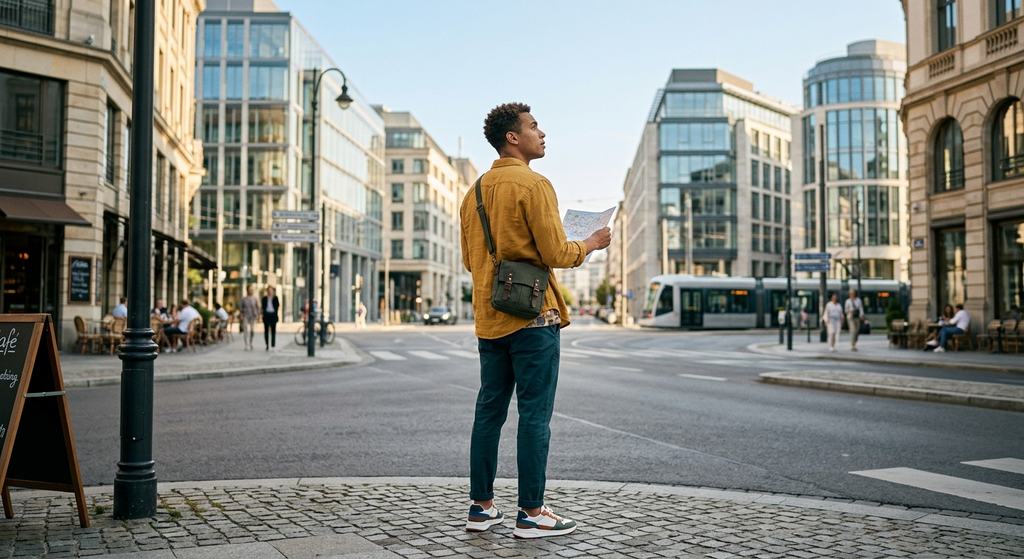
Nothing teaches you how capable you are, quite like getting lost alone in a city where you don't speak the language.
No tour guide to ask.
No travel companion to quietly hand the problem over to.
Just you, a half-working map app, a phone battery that is somehow already at 23 percent, and a problem you now have to solve yourself.
The first time this happened to me, I panicked.
Not dramatically.
Just enough to stand there thinking, "Okay, this was a terrible idea."
Then I figured it out.
I asked someone for directions.
I pieced together what they were saying.
I checked the map.
I took the wrong turn once.
Then I eventually found my way back.
Nothing particularly extraordinary happened.
But I remember that moment because it changed the way I thought about myself.
I'd always assumed being resourceful meant knowing what to do.
Solo travel taught me that being resourceful can also mean being willing to figure out what to do next.
When you're travelling with other people, decisions are shared.
"Where should we eat?"
"Which train do we take?"
"Should we turn left?"
"Is this the right neighbourhood?"
Someone else always has an opinion.
Sometimes it's exactly what makes the trip comfortable.
But when you're alone, there is nobody else to wait for.
You have to make the decision.
And you quickly realise that most decisions aren't as permanent or terrifying as they initially feel.
Take the wrong train?
Get off at the next stop.
Restaurant looks terrible?
Find another one.
Missed the bus?
Figure out the next option.
Completely lost?
Ask someone.
You start collecting tiny examples of yourself solving problems.
Then something interesting happens.
You begin trusting yourself more.
That confidence follows you home.
Because the real benefit of solo travel isn't necessarily the destination.
It's the evidence you collect along the way.
You now know that you can land somewhere unfamiliar and function.
You can make decisions with incomplete information.
You can communicate when you don't have the right words.
You can deal with unexpected problems without immediately calling someone else to fix them.
Those are incredibly transferable skills.
And they're useful far beyond travel.
Especially if you're building something of your own.
Starting a business is basically a long series of tiny moments where you don't know exactly what you're doing.
You don't know which client will say yes.
You don't know whether the website is good enough.
You don't know whether that email will get a reply.
You don't know which marketing strategy will work.
There is rarely a perfect map.
You make the best decision you can with the information you have, then adjust.
That sounds a lot like being lost in a new city.
It's uncomfortable.
But you learn.
I've written before about how your first online business doesn't need to be fancy, and I think the same principle applies here.
Beginners often wait until they feel completely prepared before doing something.
But complete preparation is mostly an illusion.
At some point, you have to go.
You have to try.
You have to make the first decision and deal with whatever happens after it.
That's what solo travel forces you to practise.
It puts you in situations where there is no perfect answer and makes you discover that you can still move forward.
You don't need to become a fearless person.
That's not really the goal.
You can be nervous and still figure things out.
You can be uncertain and still make a decision.
You can get lost and still find your way.
That is a much more useful kind of confidence than believing you'll never have problems.
Because problems are guaranteed.
The valuable part is knowing you can handle them.
You come home from a solo trip with more than photographs and a list of places you've visited.
You come home with a little more evidence that you can trust yourself.
And honestly, that's one of the best souvenirs you can bring back.
Frequently Asked Questions
Is solo travel actually safe for beginners?
With reasonable precautions and planning, many people travel solo safely, though it's worth researching your specific destination in advance.
What makes solo travel different from traveling in a group?
Solo travel removes the safety net of shared decision making, forcing you to problem solve and make choices independently.
Can solo travel really build confidence that transfers to other areas of life?
Yes. Successfully navigating unfamiliar situations alone often builds transferable confidence in handling unexpected problems generally.
Do I need to speak the local language to travel alone?
Not necessarily. Many solo travelers navigate language barriers using translation apps, gestures, and patience.
What's the biggest lesson people take from solo travel?
Often, a clearer sense of their own resourcefulness and ability to handle unfamiliar situations without relying on someone else. No tour guide, no safety net, just you discovering you're far more resourceful than you thought.
If you have an article, opinion piece, event or news story you would like published or you are ready to begin building a profitable online content writing business from your phone or laptop, Global News Arena would love to hear from you.
Send an email to advertise@globalnewsarena.com