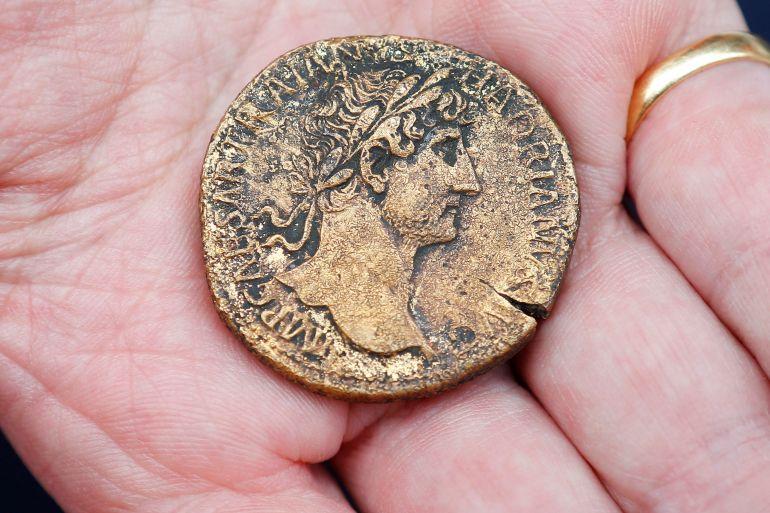
Three schoolchildren in Israel have discovered a 1,900-year-old Roman coin during a school trip to the Jerusalem Hills, creating an unexpected connection between a classroom excursion and the region's ancient history.
READ: Ice Age Cave Engravings Reveal Hidden Ancient Artwork
The children, all aged 10, reportedly found the object while playing with an air blower on an agricultural terrace at Sataf, between Ein Bikura and Ein Sataf.
Read: Do you need a professional writer in 72 hours? Contact Auxi Chat
An initial assessment by the Israel Antiquities Authority raised the possibility that the coin was minted during the reign of Roman Emperor Hadrian, who ruled from 117 to 138 CE.
READ: The Nigerian Independence Struggle: How Nationalists Challenged Colonial Rule
However, experts have not yet confirmed its exact identity or age. The object must undergo further professional examination before its historical origin can be established.
1,900-Year-Old Roman Coin Discovered During School Trip
Read: Need a professional website in 72 hours? Contact Auxi Chat
The discovery happened during an educational visit led by Amit Feinstein, a tour guide and archaeology student at Bar-Ilan University.
According to reports, the students were playing with an air blower on one of the ancient agricultural terraces when they noticed the coin.
They immediately brought the discovery to the attention of their teacher, who informed Feinstein.
Feinstein suspected that the object could belong to the Roman period. Because he was not a specialist in ancient coins, he photographed it and shared the images with university lecturers for an initial assessment.
Their early assessment suggested that it could belong to the Roman or Byzantine period.
A subsequent consultation with the Israel Antiquities Authority raised the possibility that the coin came from Hadrian's reign.
Possible Connection to Emperor Hadrian
Hadrian ruled the Roman Empire between 117 and 138 CE. His reign is particularly significant in the history of the region because of the Bar Kokhba revolt, a major Jewish uprising against Roman rule between 132 and 135 CE.
If the preliminary identification is confirmed, the 1,900-year-old Roman coin would provide a small but interesting material connection to this period.
Coins are important archaeological objects because they can help researchers investigate ancient political authority, economic activity, trade and cultural practices.
Their inscriptions, images, materials and manufacturing techniques can also provide clues about the societies that produced and used them.
However, the coin's exact design and historical significance have not yet been established.
Children Learn About the Importance of Preserving History
The discovery also became an unexpected lesson about protecting archaeological objects.
Feinstein explained to the children that ancient discoveries should not simply be taken home as souvenirs. They need to be reported so that experts can examine, document and preserve them.
One of the boys who initially found the coin reportedly wanted to keep it.
After a discussion about the importance of protecting historical objects, the children agreed to hand it over to their school principal. Feinstein also reported the discovery to the Israel Antiquities Authority.
The school principal subsequently organised a discussion with the wider fourth-grade class about antiquities law and the importance of reporting archaeological finds.
Why the Sataf Discovery Matters
Sataf is known for its ancient agricultural terraces, which show how communities used the hilly landscape for cultivation.
READ: Board of Peace Warns Gaza Ceasefire Could Collapse Without Action
Discoveries in such locations can help researchers understand how people lived, worked and organised their communities in earlier periods.
The 1,900-year-old Roman coin could provide additional information about the region if its preliminary identification is confirmed.
The find also demonstrates how archaeological discoveries can happen outside formal excavations. In this case, a school trip brought students into contact with an object that may have survived for nearly two thousand years.
Global News Arena has previously explored the importance of preserving historical records in its report on Nigeria's independence struggle.
For now, the coin is awaiting professional examination. Its final identification will determine what researchers can confidently say about its age and connection to the Roman period.
Are you interested in learning how to write professionally and earn money as a writer and content creator? Contact us today to start your writing journey immediately.
Need a professional website in 72 hours? Contact us
Do you need a professional writer in 72 hours? Contact us
If you have an article, guest story, event or news tip you would like published, Global News Arena would love to hear from you.