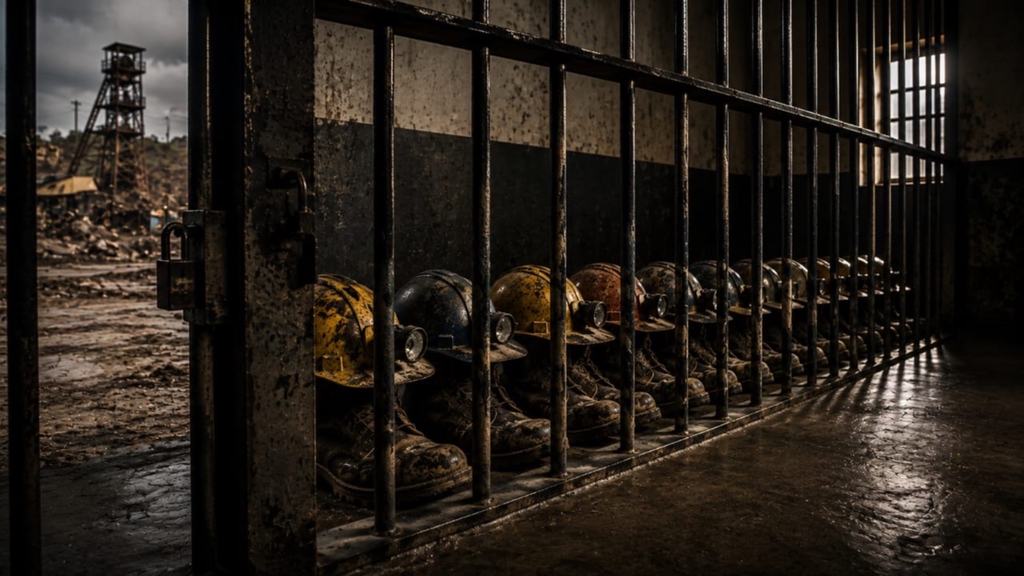
Thirty-seven people are dead after being detained by the Nigeria Security and Civil Defence Corps (NSCDC) during an operation against suspected illegal mining in Niger State.
The detainees were arrested around the M.I. Wushishi/Lukoto area on September 15 and 16. Their deaths were discovered in the early hours of September 17, prompting a police investigation, government intervention and the suspension of the Niger State NSCDC commandant.
But the most important questions are still unanswered.
What happened inside the detention facility?
What condition were the detainees in when they were arrested?
Were there warning signs before the deaths?
Was medical attention available?
Who was monitoring the people in custody?
And if something was going wrong, who was supposed to know first?
Authorities have not established the official cause of death. The NSCDC initially referred to a suspected disease outbreak, while the Niger State government has said forensic examinations and autopsies are necessary before conclusions can be reached. A survivor has separately alleged that detainees were held in an overcrowded, poorly ventilated cell. That account is part of the wider investigation and has not established the official cause of death.
That distinction matters.
When something this serious happens, assumptions can spread faster than facts. One explanation becomes another person’s conclusion. Rumours become public narratives. Families search for information while officials try to establish what actually happened.
This is why information management is not a small administrative issue.
It can become a matter of life, safety, money and public trust.
A functioning system should make it possible to know who has been arrested, where they are, when they were admitted, what condition they were in, what medical attention they received and whether anything unusual has been reported.
If someone becomes sick, the warning should not disappear into a notebook.
If a facility becomes overcrowded, someone should know.
If a person needs urgent attention, the information should reach the person responsible.
And if several warning signs appear at the same time, the system should make the pattern visible.
That is the difference between simply having information and actually using information to prevent problems.
Technology cannot determine what caused the 37 deaths in Niger State. Only a proper investigation and medical examination can establish that.
But organisations can use better systems to make sure important information does not get lost between departments, people or processes.
For businesses, the same principle applies.
A customer complaint can be missed. A payment can remain unresolved. An urgent request can sit unanswered. A lead can disappear because nobody followed up. A manager can receive information too late to act on it.
These may look like ordinary business problems.
But they all have the same root. A system that depends too heavily on people remembering what needs to happen next.
This is where AI-powered automation can become useful.
Instead of relying entirely on manual monitoring, businesses can build workflows that capture information, record interactions, trigger follow-ups and alert the right person when action is required. Auxi Sherpa’s AI Business Automation service is designed around this kind of workflow, including customer responses, notes and follow-ups.
The other side is knowing what the information actually means.
Good decisions require good information. Auxi Sherpa’s Deep Research service focuses on structured research, including market, competitor and business intelligence, with sourced findings.
Together, those ideas point to a simple lesson:
Don’t wait for a problem to become a crisis before building a system for seeing it.
The investigation in Niger State must establish what happened to the 37 people who died in custody. The authorities have said they will investigate the circumstances surrounding the deaths, while rights groups have called for an independent and thorough investigation.
That investigation belongs to the relevant authorities.
But the lesson about systems belongs to everyone.
Whether it is a government agency managing detainees or a small business managing customers, important information should not depend on memory, scattered conversations or delayed communication.
Good systems do not just record what happened. They help people notice what is happening while there is still time to respond.
If you have an article, opinion piece, event or news story you would like published, Global News Arena would love to hear from you.
Send an email to advertise@globalnewsarena.com.