Delhi Air Pollution Ahead of Diwali Raises Health Concerns
READ: Malaysia King Najib House Arrest Dispute Sparks Royal Warning
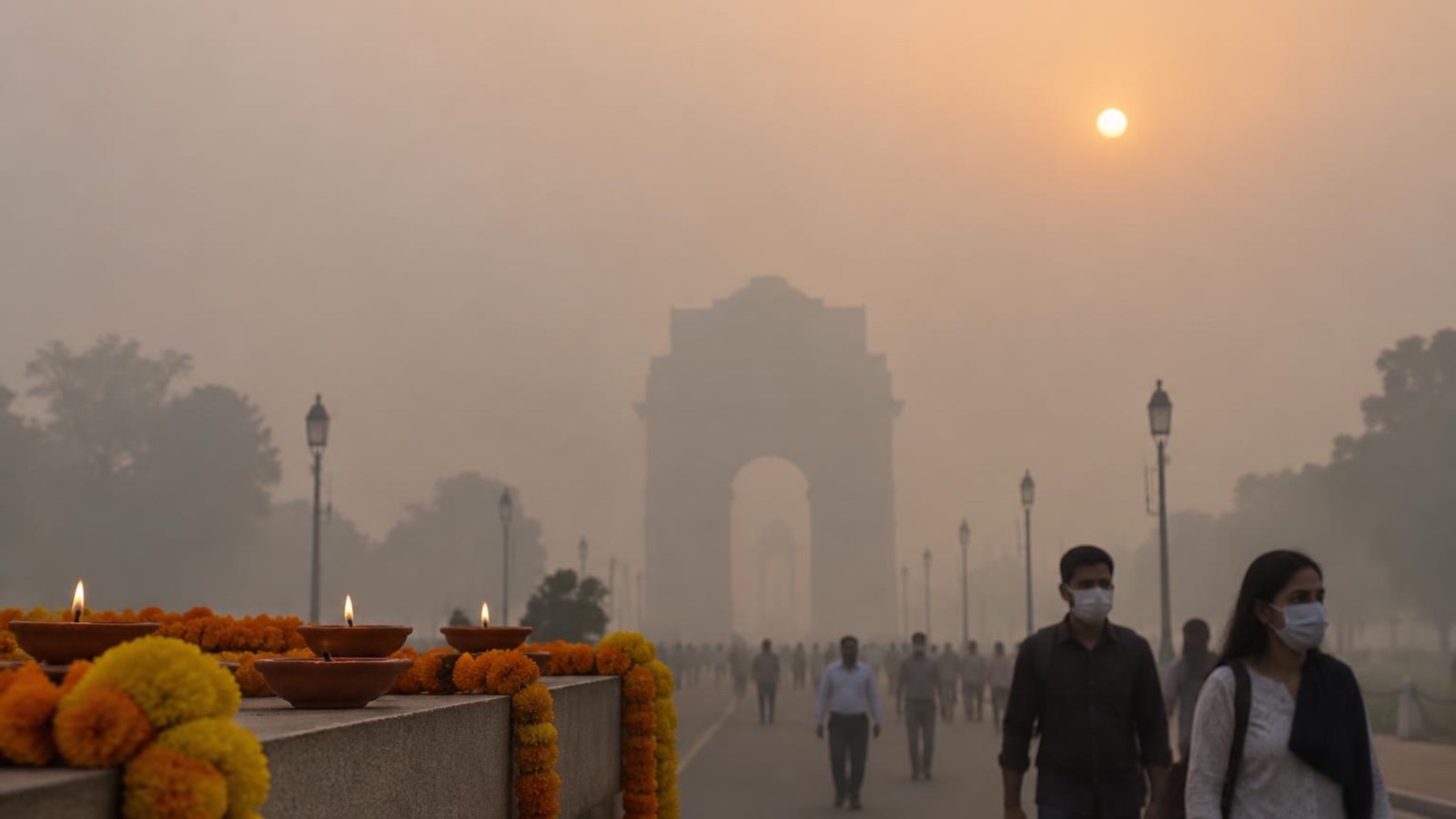
Delhi has once again found itself at the centre of a worsening environmental crisis, with Delhi air pollution ahead of Diwali reaching alarming levels as millions of people prepare to celebrate the Hindu festival of lights. On Saturday, November 7, 2026, Swiss air-quality monitoring group IQAir ranked the Indian capital as the world’s most polluted major city, highlighting the growing challenge of protecting public health during one of the country’s most widely celebrated festivals.
Read: Do you need a professional writer in 72 hours? Contact Auxi Chat
The development comes as residents prepare for Diwali, which falls on Sunday, November 8, according to the report. Although the festival is associated with light, family gatherings, religious observances and fireworks, celebrations involving firecrackers can introduce additional pollutants into an atmosphere already burdened by traffic emissions, construction dust and seasonal smoke.
READ: New Zealand Election Results Show Tight Race Between National and Labour
For people living in Delhi and surrounding communities, the timing presents a familiar but serious dilemma. A festival that brings families together and carries deep cultural significance is approaching at a time when the air itself has become a major public-health concern.
The latest readings underline how quickly seasonal pollution can become a crisis. They also raise questions about whether temporary restrictions and public warnings can adequately protect residents when several sources of pollution combine over a densely populated urban area.
Read: Need a professional website in 72 hours? Contact Auxi Chat
Delhi Records an IQAir US AQI Reading of 581
According to Reuters, IQAir placed Delhi at the top of its live ranking of the world's most polluted major cities on Saturday morning. At approximately 10:35 a.m. local time, the monitoring platform recorded a United States air quality index, or US AQI, reading of 581.
The reading was substantially higher than the corresponding figure for Lahore, Pakistan, which recorded 285 in the same ranking. The comparison placed Delhi at the top of the monitored major-city list during a period of worsening air quality ahead of Diwali.
India’s Central Pollution Control Board, however, reported an AQI of 363 for Delhi at 10 a.m. on Saturday, placing the city in the official Indian index’s “very poor” category.
These numbers require an important distinction. IQAir’s US AQI and India’s official AQI are based on different scales and methodologies. They should therefore not be compared as if they were measurements produced under an identical system.
Nevertheless, both readings point to a serious pollution problem. The difference between the two figures does not mean that one report should automatically be dismissed; instead, each must be interpreted according to the system used to calculate it.
The IQAir ranking is also a snapshot of conditions at a particular time, rather than a permanent designation for Delhi. Live air-quality rankings can change as weather conditions, emissions and pollution concentrations shift throughout the day.
Even with those qualifications, Delhi’s position in the ranking has drawn attention to the environmental pressures facing northern India as winter approaches.
Why Delhi Air Pollution Ahead of Diwali Is Worsening
Delhi’s pollution problem cannot be attributed to a single source. It develops through the interaction of everyday emissions, seasonal conditions and activities that can release additional pollutants into the atmosphere.
Vehicle exhaust remains one important contributor. Delhi is a major metropolitan centre with substantial road traffic, and emissions from cars, buses, motorcycles and commercial vehicles contribute to the mixture of pollutants affecting the city.
Construction activities also generate dust, while industrial emissions and the burning of agricultural waste in parts of northern India can add to the wider regional pollution burden.
Seasonal weather conditions make the problem more difficult to manage. As temperatures fall, colder and heavier air can limit the vertical movement of polluted air under certain atmospheric conditions. When ventilation is poor, emissions from multiple sources can accumulate close to the ground rather than disperse efficiently.
This means that pollution produced across different locations can contribute to poor air quality over a much larger area. Delhi’s experience is consequently connected to environmental conditions and emission sources beyond the boundaries of the capital itself.
Diwali adds another concern. Firecrackers can release particulate matter and other pollutants during celebrations. When fireworks are used in an area already experiencing severe pollution, the additional emissions can worsen exposure, particularly for people who spend time outdoors.
The immediate challenge is therefore not simply to discourage one activity. It is to reduce the combined effect of transport emissions, dust, industrial pollution, agricultural burning and festival-related smoke.
Authorities Introduce Precautionary Measures Before Diwali
Indian authorities have taken precautionary steps as pollution levels deteriorate across Delhi and the surrounding National Capital Region.
Reuters reported that schools in and around Delhi had been ordered to offer online classes, while residents were encouraged to work from home ahead of the festival.
These measures are intended to reduce exposure and limit some of the activities contributing to the city's pollution burden. Online classes can reduce the number of children travelling to school, while working remotely may reduce commuting traffic where employers and workers are able to make the necessary arrangements.
Authorities have also activated Stage III of the Graded Response Action Plan across Delhi-NCR, according to reporting by The Times of India on November 6. The plan introduces additional pollution-control measures when air quality deteriorates, although the effectiveness of any intervention depends on implementation and the conditions prevailing at the time.
Such measures illustrate the difficulty of responding to a pollution emergency that has several causes. Restrictions introduced shortly before a festival may help reduce some emissions, but they cannot immediately eliminate pollution already present in the atmosphere or address every source affecting the region.
The challenge is particularly significant for residents whose work cannot be performed remotely. Delivery workers, street vendors, construction workers, traffic personnel and others who earn their living outdoors may have limited opportunities to avoid polluted conditions.
For these groups, public warnings alone may not be sufficient. Practical protection also depends on access to reliable air-quality information, appropriate respiratory protection and measures that reduce pollution at its source.
What Severe Air Pollution Means for Public Health
The concern surrounding Delhi air pollution ahead of Diwali extends beyond the city's position in an international ranking. Air pollution can affect the respiratory and cardiovascular systems, with the potential consequences depending on the pollutants involved, their concentrations and the duration of exposure.
Fine particulate matter is particularly concerning because small particles can penetrate deep into the lungs. Exposure can aggravate existing respiratory conditions, including asthma, and contribute to other adverse health effects.
Children, older adults and people with existing heart or lung conditions may be especially vulnerable. However, severe pollution is not a problem that affects only people with diagnosed illnesses. Healthy adults can also experience adverse effects when pollution levels become sufficiently high.
Short-term exposure may be associated with coughing, throat irritation, breathing discomfort and worsening respiratory symptoms. More serious effects are possible, particularly for vulnerable individuals or during sustained periods of poor air quality.
Residents should therefore pay attention to current local air-quality readings rather than relying exclusively on a citywide ranking. Conditions can vary between neighbourhoods, and pollution levels may change during the day.
When air quality is severely polluted, reducing strenuous outdoor activity is a sensible precaution. People who must go outside may benefit from a well-fitting N95 or N99 respirator, which can reduce exposure to fine particles when used correctly. Such masks do not eliminate every pollution risk, and their effectiveness depends on fit and proper use.
Indoors, keeping windows closed when outdoor pollution is particularly high, using an appropriately sized HEPA air purifier where available and reducing indoor smoke can help limit exposure. These measures cannot replace broader pollution-control policies, but they may reduce some of the immediate risks.
Anyone experiencing significant difficulty breathing, chest pain or other serious symptoms should seek appropriate medical care.
Diwali Celebrations Could Put Additional Pressure on Delhi’s Air
The approach of Diwali makes the current situation especially sensitive. Fireworks are traditionally associated with celebrations in many communities, but their emissions can add to the pollutants already accumulating over northern India.
The concern is not limited to the moment a firecracker explodes. Pollution levels can fluctuate as emissions spread, weather conditions change and particles remain suspended in the air.
READ: Russian Missile Attack on Kyiv Damages Homes Ahead of Peace Talks
Where the atmosphere is poorly ventilated, additional smoke may worsen an already difficult situation. This is why public-health experts regularly urge people to consider the environmental consequences of fireworks during periods of severe pollution.
Choosing electric lights and other lower-emission ways to celebrate can help avoid the additional smoke associated with firecrackers. Communities can also support cleaner celebrations through public awareness, responsible event planning and compliance with applicable local restrictions.
Such choices do not resolve Delhi’s wider pollution crisis. They can, however, help avoid adding another source of emissions during a period when residents are already facing unhealthy air.
For authorities, the immediate priority is to communicate the risks clearly, enforce applicable restrictions and ensure that residents have access to timely information. Longer-term efforts must also address the everyday activities and regional conditions that contribute to recurring pollution episodes.
Delhi’s Pollution Crisis Demands More Than Seasonal Action
Delhi’s position at the top of IQAir’s pollution ranking is a reminder that the city’s environmental challenges extend beyond the festival calendar. Although Diwali can intensify concerns because of firecracker emissions, the underlying pollution problem develops over weeks, months and years.
The seasonal combination of traffic emissions, construction dust, industrial activity, agricultural burning and unfavourable weather conditions creates a recurring challenge for policymakers. Tackling it requires sustained action across transport, industry, waste management, construction and agriculture, rather than relying solely on emergency measures during periods of severe air quality.
Public communication is equally important. Residents need clear explanations of what air-quality readings mean, how different monitoring systems compare and what precautions are appropriate under different conditions. Confusing or inconsistent information can make it harder for people to respond effectively.
The experience also highlights the unequal burden of environmental emergencies. People who can work remotely, remain indoors and afford air purifiers may have more options for reducing exposure than people who depend on outdoor employment or live in poorly ventilated housing.
That disparity makes pollution control a question of both environmental protection and public health. Effective policies must consider not only the average pollution reading but also who is exposed, for how long and what practical protection is available.
As Diwali approaches, Delhi faces the immediate task of limiting additional pollution while protecting residents from the conditions already recorded. The IQAir reading of 581 and the official Indian AQI of 363 provide different measurements, but both reinforce the urgency of the situation.
The festival should be an occasion for celebration rather than avoidable harm. Cleaner celebrations, better public information and effective enforcement can help reduce immediate risks. Lasting improvement, however, will depend on sustained action against the sources of pollution that return each year.
Delhi’s latest ranking is therefore more than a headline about one polluted morning. It is a warning about the costs of allowing seasonal environmental pressures to become a recurring public-health emergency.
As residents prepare for Diwali, the central question is not simply whether Delhi will remain at the top of a global pollution ranking. It is whether the authorities, businesses and communities involved can turn repeated warnings into meaningful and lasting improvements in the air people breathe.
The writer of this article does not claim to know the individuals named personally. The information about their backgrounds, as published on Global News Arena, is based on independent online research.
Are you interested in learning how to write professionally and earning money as a writer and content creator? Contact Auxi Chat today to start your writing journey immediately.
If you have an article, opinion piece, event or news story you would like published, Global News Arena would love to hear from you.