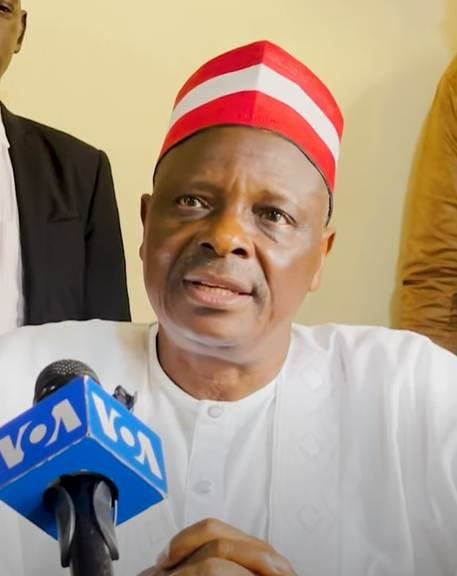
Rabiu Musa Kwankwaso is one of northern Nigeria’s most recognisable political figures. He has served as governor of Kano State, minister of defence and a senator, building a political network whose influence extends beyond the offices he has held.
READ: Babajide Sanwo-Olu: Biography, Career and Public Life
His public identity is closely tied to Kwankwasiyya, a movement associated with red caps, grassroots organising and an emphasis on education. His career also illustrates the shifting alliances that have shaped Nigeria’s multiparty politics.
Early life and professional background
READ: La Liga: Biography, History and Spanish Football Legacy
Kwankwaso was born on 21 October 1956 in Kwankwaso, a community in what is now Madobi Local Government Area of Kano State. He grew up in northern Nigeria and pursued technical education before entering public life.
He trained in engineering, studying in Nigeria and the United Kingdom. His early professional career was with the Kano State Water Resources and Engineering Construction Agency, where he worked before moving into electoral politics.
This technical background became part of his political profile. As a public official, he frequently placed infrastructure, water provision and educational development at the centre of his programme.
From parliament to Kano governor
Kwankwaso entered national politics during Nigeria’s short-lived Third Republic. Elected to the House of Representatives in 1992 on the platform of the Social Democratic Party, he became deputy speaker. Military intervention ended that democratic experiment in 1993.
When civilian rule returned in 1999, he won the Kano governorship as a member of the Peoples Democratic Party. His first term lasted until 2003, when he lost his re-election bid to Ibrahim Shekarau.
He subsequently served as minister of defence under President Olusegun Obasanjo, holding the position from 2003 to 2007. The appointment gave him experience in the federal executive after his first period in state government.
Kwankwaso returned as Kano governor in 2011 and served until 2015. His administrations are associated with road construction, urban development, expanded educational opportunities and scholarship programmes supporting study in Nigeria and abroad.
The establishment of Kano University of Science and Technology at Wudil during his first term was a significant part of that education agenda. His second term further strengthened his reputation as a politician who used visible public projects to build support.
National ambitions and party changes
Kwankwaso’s national career has crossed several major political parties. In 2013, while serving his second term as governor, he left the Peoples Democratic Party for the All Progressives Congress alongside other governors.
He contested the APC presidential primary ahead of the 2015 general election, finishing behind Muhammadu Buhari. He then represented Kano Central in the Senate from 2015 to 2019.
In 2018, he returned to the PDP and again sought a presidential nomination. He later joined the New Nigeria Peoples Party in 2022 and became its presidential candidate for the 2023 election.
He finished fourth in that presidential contest, with his strongest support concentrated in Kano. The result demonstrated both the depth of his home-state base and the challenge of translating regional strength into a nationwide electoral coalition.
Kwankwasiyya and political significance
READ: Taiwo Odukoya: Biography, Career and Ministry Legacy
Kwankwasiyya is central to understanding Kwankwaso’s influence. More than a campaign label, it is a political network built around his leadership, supporters and allies. Its distinctive red caps have become a familiar symbol in Nigerian politics.
Kano’s large electorate makes a durable support base there especially important. Kwankwaso’s ability to mobilise voters helps explain why his name regularly features in discussions about opposition cooperation and political realignment.
His broader significance lies in the combination of administrative experience, personal organisation and regional appeal. His career shows how an influential state-level movement can sustain national ambitions, even as party platforms and alliances change.
Are you interested in learning how to write professionally and earn money as a writer and content creator? Contact Auxi Chat today to start your writing journey immediately.
Need a professional website in 72 hours? Contact Auxi Chat
If you have an article, opinion piece, event or news story you would like published, Global News Arena would love to hear from you.