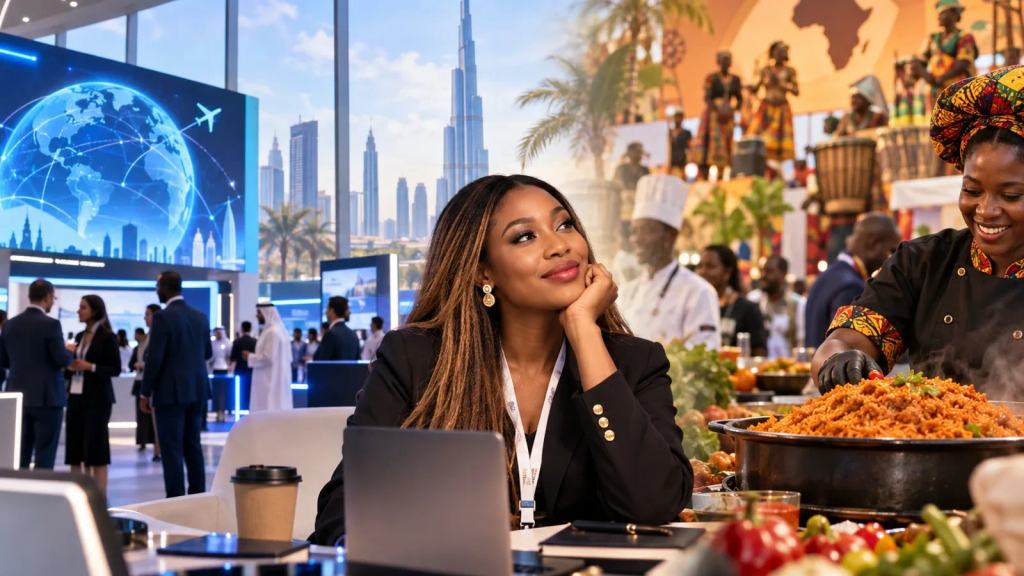
I am currently at the Arabian Travel Market (ATM) 2026 in Dubai.
If you have spent five minutes on the floor of the Dubai World Trade Centre this week, you already know the single word dominating every conversation: AI.
From the Future Stage to private executive lounges, artificial intelligence is the undisputed headliner. Keynotes, like the one delivered by Dr. Marwan Alzarouni, CEO of AI at the Dubai Department of Economy and Tourism, are mapping out how intelligent systems, predictive analytics, and autonomous infrastructure will redefine airlines, mega-resorts, border governance, and the entire traveler journey.
It is ambitious. It is electric. It is a masterclass in where global travel infrastructure is heading.
Yet, walking between state-of-the-art tech demonstrations and immersive virtual pavilions, my mind didn't jump to another tech conference.
It wandered thousands of miles southwest. Straight to Lagos.
Straight to Akwaaba.
The Pan-African Pulse of Akwaaba
For anyone who grew up around the African travel space, the Akwaaba African Travel Market in Lagos is practically woven into our DNA.
For over two decades, Akwaaba hasn’t just been an event on the calendar; it has been the heartbeat of continental tourism. It is where African ministers, global aviation chiefs, hotel brands, and diaspora operators converge under one roof at Eko Hotels to hammer out bilateral routes, open borders, and sign deals that move real millions across the continent.
It is serious business. But it has always understood something fundamental: in Africa, business moves at the speed of relationship.
Which brings me to the Jollof Rice War.
Honestly, I miss the sheer audacity of it.
Anyone who has ever stood in that crowded hall knows that the Jollof Rice War is never just a culinary contest. It is masterclass destination marketing disguised as friendly rivalry. It is national pride, soft diplomacy, entertainment, and tourism identity served on a steaming plate.
Seeing the First Lady of Lagos State, Dr. Ibijoke Sanwo-Olu, flag off the 22nd edition this year and join the tasting across 15 chefs brought an immediate smile to my face.
Ghana can argue their case.
Sierra Leone and Gambia can bring their best recipes.
Senegal can claim historical copyright.
But as far as we are concerned in Lagos, the matter is settled before the pot is even opened.
Culture as an Economic Engine
Behind the laughter, the music, and the after-parties that spill into Lagos nights, Akwaaba has done something profound: it turned cultural celebration into economic mobility.
Tourism isn't just a spreadsheet of arrivals, hotel occupancy rates, and airline yields. It is the young chef discovering that regional cuisine can headline international travel expos. It is the independent tour operator packaging cross-border itineraries from Accra to Kigali. It is the hospitality worker, the event builder, and the creative entrepreneur finding their footing in a global market.
That is why the Jollof Rice War at Akwaaba matters.
It proves that culture isn't a decorative add-on to tourism. Culture is the product. It is people meeting people. It is multi-country partnerships sparked over conversations that started with a shared meal.
Dubai’s Machinery, Lagos’s Soul
Standing back in Dubai, the synergy becomes obvious.
At ATM 2026, the question is: How do we build the smartest, most frictionless systems to move the world?
At Akwaaba, the question is: What is the story, the warmth, and the cultural magic that makes the world want to move in the first place?
ATM shows us the cutting-edge machinery of modern tourism, how automated workflows, smart airports, and connected ecosystems can make travel effortless across continents. Dubai is an undisputed global crossroads, gathering nations to design the logistical future of our planet.
Akwaaba shows us the soul that powers that machinery. It gathers the world’s most culturally vibrant continent to celebrate identity, foster intra-African trade, and showcase the human warmth that no machine learning model can ever replicate.
One builds the runway. The other gives the traveler a reason to fly.
We Never Had to Choose
It is tempting for observers to draw lazy lines, to label one event "high-tech" and the other "cultural," or one "global" and the other "regional."
That completely misses the point.
Both ATM and Akwaaba are premier market platforms operating at the absolute peak of their mandates. They are two essential halves of the same global equation.
Tourism cannot thrive in a vacuum of cold code. Nor can it scale without modern infrastructure.
We need the algorithms, and we need the Jollof.
We need ATM’s visionary blueprint for smart destinations, intelligent aviation, and global investment. And we need Akwaaba’s unmatched ability to turn African heritage, music, culinary diplomacy, and human brotherhood into bankable enterprise.
Technology determines how we will travel tomorrow.
Culture, community, and shared meals will always remind us why we pack our bags today.
So yes, I am here in Dubai, taking notes on the future of AI and watching the travel landscape evolve in real time.
It is brilliant.
But somewhere in my heart, I am still in that crowded hall in Lagos, waiting for the judges to announce what we already know.
Long live the innovation. And long live the Jollof Rice War.
Are you interested in travelling to Qatar from Nigeria? Start Now.
If you have an article, opinion piece, event or news story you would like published, Global News Arena would love to hear from you.
Send a message to Global News Arena contact to get in touch.