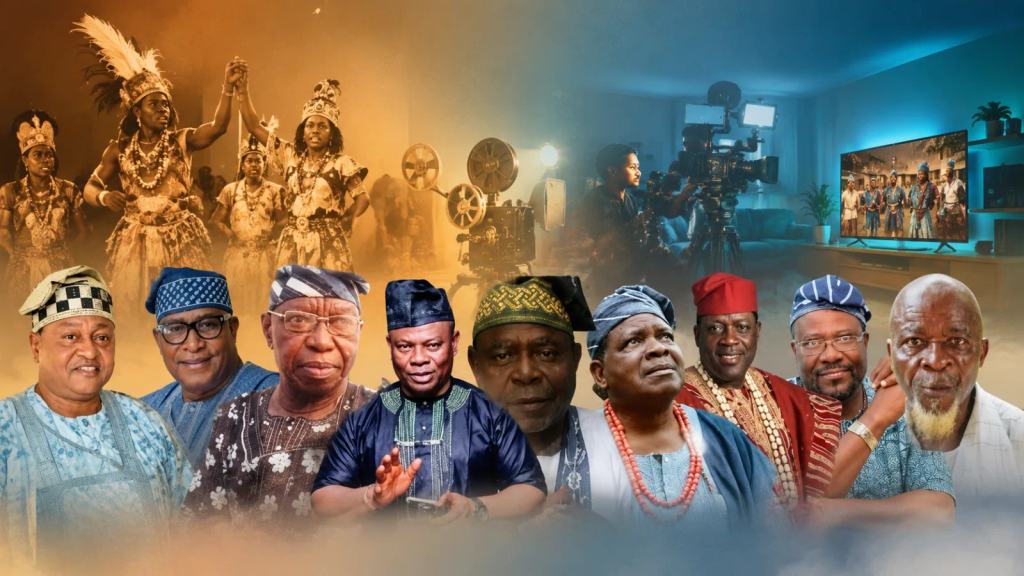
Yoruba Nollywood did not begin with Netflix, YouTube, smartphones or the modern cinema experience we know today. Its roots go much deeper, to a time when actors and performers travelled from one community to another, carrying stories, music, costumes and culture directly to the people.
That history is important because when we watch a Yoruba film today, it is easy to see only the actors, the storyline, the comedy, the drama or the entertainment. Behind all of that, however, is a long tradition of Yoruba storytelling that has survived major changes in technology, audience behaviour and the Nigerian entertainment business.
Before films could be watched in the comfort of our homes, Yoruba performers were already taking entertainment to their audiences through travelling theatre. From the twentieth century, particularly from the 1930s and 1940s, travelling theatre became an important part of Yoruba popular culture. Performers moved between towns and communities with their costumes, musical instruments and other materials, presenting stories that combined acting, music, dance and traditional storytelling.
These performances were much more than a way to pass time. They carried history, language, culture, humour, social commentary and traditional values from one generation to another. The performers were entertaining their audiences, but they were also preserving stories that could easily have disappeared with time.
This is where the story of Yoruba Nollywood becomes particularly interesting to me because some of the things these early performers understood are the same things modern content creators are still trying to master today.
They understood their audience.
They knew the stories people wanted to hear. They understood the humour people enjoyed. They knew how to use music, language and familiar cultural experiences to hold attention. Most importantly, they understood that a good story could bring people together.
One of the biggest names associated with this transformation was Hubert Ogunde.
Ogunde became one of Nigeria's most influential theatre pioneers and established a professional theatrical company in 1945. His productions combined drama, music and dance, while many of his performances also addressed social and political issues.
His work showed that entertainment could be both culturally meaningful and commercially valuable. He did not have to remove Yoruba identity from his productions to attract audiences. Instead, Yoruba language, music, traditions and social realities became part of the reason people wanted to watch.
Other influential figures, including Duro Ladipo and Kola Ogunmola, also helped develop the Yoruba travelling theatre tradition. Their works drew from Yoruba history, mythology, traditional stories and music, demonstrating that indigenous stories could be powerful enough to attract large audiences.
And this is important because those theatre companies were already building something that the film industry would later need: performers who understood storytelling and audiences who wanted to watch Nigerian stories.
As technology developed, some of these theatrical traditions gradually found their way onto the screen. The transition from theatre to cinema was not simply a change from performing on a stage to standing in front of a camera. It represented a major shift in how Nigerian stories could be preserved, reproduced and distributed.
Instead of performing the same story in one town and then travelling to another, filmmakers could record a production and take that story much further.
The 1970s became an important period in this development. Films such as Ajani Ogun demonstrated the growing connection between Yoruba theatre and Nigerian filmmaking. Associated with Duro Ladipo's theatrical tradition and directed by Ola Balogun, the film showed how Yoruba cultural storytelling could be adapted for the screen.
Hubert Ogunde also moved into filmmaking, producing works such as Aiye. His transition from theatre to film was significant because it showed that the skills developed through years of live performance could be transferred into cinema.
The technology was changing, but the heart of the storytelling remained the same.
People still wanted stories about themselves.
They still wanted to see their language, culture, struggles, relationships and traditions represented.
They simply had another way of experiencing those stories.
As Nigerian cinema continued to develop, television and video technology created even more opportunities. Then the 1990s brought one of the most important turning points in the country's film history.
The emergence of the Nigerian home-video industry changed the economics of filmmaking. Living in Bondage, released in 1992, is widely regarded as a landmark in the development of modern Nollywood and demonstrated the commercial possibilities of direct-to-video filmmaking.
However, it would be misleading to look at that moment as though Nigerian filmmaking suddenly appeared from nowhere. There had already been decades of theatre, cinema, acting, production and indigenous storytelling before the video-film boom.
Yoruba theatre was one of the important traditions that helped create the creative environment in which Nigerian video filmmaking could grow.
The video era made Nigerian films more accessible to ordinary audiences. People could buy or rent films and watch Nigerian stories in their homes. Producers could make films more quickly than was possible with some traditional cinema production methods, while marketers and distributors created networks that helped move films across the country.
Yoruba filmmakers embraced the opportunity.
Actors became household names. Producers developed their own audiences. Yoruba-language films created a distinct identity within the wider Nigerian film industry, while stories continued to explore family relationships, traditional institutions, morality, social problems, comedy, romance and everyday Nigerian experiences.
What I find particularly fascinating is that the business structure around these films also demonstrated something important about creative entrepreneurship.
A film was never only a film.
There was a writer behind the story, actors in front of the camera, directors guiding the production, editors putting the pieces together, costume designers creating the visual identity, marketers promoting the work and distributors taking it to audiences.
An entire economic ecosystem was being created around storytelling.
And then technology changed again.
The internet began to transform how Nigerians consumed entertainment. Physical copies became less important as digital distribution grew. YouTube gave filmmakers another platform for reaching audiences, while Facebook, Instagram, TikTok and other social platforms created new ways to promote films, actors and creative projects.
Streaming platforms pushed that transformation even further.
A Yoruba film no longer had to depend entirely on a cinema in Nigeria or a physical video copy to find an audience. With the right digital distribution strategy, a story produced in Nigeria could reach viewers in other parts of Africa and across the world.
That is an extraordinary change when we compare it with the travelling theatre era.
The early performers had to travel to the audience.
Today, the audience can travel to the content.
A Yoruba film can be uploaded in Lagos and watched by someone thousands of kilometres away. An actor can build an international following without personally visiting every country where their audience lives. A filmmaker can promote a production through social media before the first scene even reaches viewers.
In many ways, the travelling theatre has become digital.
Yet the principle remains the same.
Find your audience.
Tell them a story they care about.
Give them a reason to return.
That principle is not only relevant to filmmakers. It is relevant to almost anyone trying to build something online today.
When I look at the history of Yoruba Nollywood, I see a powerful lesson about adaptation. The people who built the travelling theatre tradition did not have the technology available to today's creators, but they still found ways to create, distribute and monetise their talent.
When cinema became available, filmmakers adapted.
When video became popular, they adapted again.
When television expanded, Nigerian stories moved to television.
When the internet became powerful, filmmakers moved online.
Now, creators are exploring streaming platforms, social media and artificial intelligence.
The tools keep changing, but the ability to adapt remains one of the most valuable skills a creator can have.
That is why I believe the story of Yoruba Nollywood is bigger than entertainment.
It is also a story about entrepreneurship.
Those early performers were not simply artists. They were organisers, marketers, business people and content creators in a different form. They had to decide where to perform, how to attract audiences, how to manage their productions and how to keep people interested enough to return.
In today's language, we might call some of what they were doing audience building, content marketing and creative entrepreneurship.
The platforms are different, but the thinking is surprisingly similar.
And this is where the history becomes relevant to someone who has never acted in a film or stepped onto a theatre stage.
You do not have to be an actor to participate in today's digital economy.
You could be a writer.
You could create educational videos.
You could explain Nigerian history.
You could review films.
You could document local culture.
You could manage social-media pages for businesses.
You could create digital guides.
You could provide content-writing services.
You could build a niche website.
You could even turn knowledge you already have into a digital product.
A smartphone can help you start many of these activities without waiting until you have expensive equipment.
Of course, owning a smartphone does not automatically create a business. The real value comes from what you know, what you can create and the problems you can solve for other people.
That is another lesson I take from the history of Yoruba Nollywood.
Technology is only a tool.
The people who succeeded were those who learned how to use the available tools to deliver something their audience valued.
The travelling theatre performers had their stages.
Filmmakers had cameras.
Video producers had cassettes and distribution networks.
Today's creators have smartphones, social media, websites, streaming platforms and digital tools.
Every generation has its own technology.
The opportunity belongs to the people who learn how to use theirs.
There is also a deeper cultural lesson here that should not be ignored.
Yoruba Nollywood has helped keep indigenous language, traditions, humour, history and social experiences visible in an increasingly global entertainment environment. Its continued popularity demonstrates that local stories do not necessarily become irrelevant simply because technology becomes more modern.
Sometimes, technology gives those stories a bigger audience.
A Yoruba proverb that was once heard in a local theatre can now become part of a film watched around the world.
A traditional story can be transformed into a modern movie.
A local actor can become internationally recognised.
A filmmaker can use digital platforms to introduce Nigerian culture to viewers who may never have visited Nigeria.
That is the power of combining culture with technology.
And perhaps this is why the journey from travelling theatre to modern Nigerian cinema deserves more attention. It shows that innovation does not always mean throwing away the past.
Sometimes, innovation means taking something valuable from the past and finding a better way to present it to the future.
Yoruba Nollywood has done exactly that.
The stage became the screen.
The screen became video.
Video became digital.
Digital became global.
And the story continues.
As new filmmakers experiment with artificial intelligence, smartphones, streaming platforms and social media, Nigerian cinema will continue to change. Some of the technologies that seem revolutionary today may eventually become ordinary, just as video technology once did.
But the demand for meaningful stories will remain.
People will continue to want to laugh, cry, learn, debate and see pieces of themselves reflected in the stories they watch.
That is why the greatest lesson from the history of Yoruba Nollywood may not be about cameras or cinema at all.
It is about understanding people.
The early travelling theatre performers understood that.
The filmmakers who followed them understood it.
The successful video-film producers understood it.
And modern digital creators must understand it too.
If you can identify what people care about, communicate it clearly, create something valuable and consistently reach the right audience, you can build something meaningful even when the technology around you keeps changing.
That is what makes this history so relevant today.
Yoruba Nollywood did not become what it is because one technology suddenly appeared and changed everything. It evolved because generation after generation of creators kept adapting their stories to new platforms while maintaining a connection with their audience.
From performers travelling between communities to filmmakers reaching global audiences through the internet, the journey has been long.
And it is not over.
The next chapter may be written by young filmmakers using smartphones, independent creators building audiences on social media, writers turning cultural knowledge into digital products, or entrepreneurs discovering new ways to turn creativity into sustainable income.
The tools may be in our hands already.
What matters now is what we choose to create with them.
If you have an article, opinion piece, event or news story you would like published, or you are ready to begin your journey toward building a profitable online content-writing business from your phone or laptop, Global News Arena would love to hear from you. Send an email to advertise@globalnewsarena.com.