More than 5,000 fibre-optic cable cuts in just six months is one of them.
I first came across that figure, I did not see it as just another technology statistic. I immediately thought about the millions of Nigerians who wake up every morning, pick up their phones and expect the internet to work without ever thinking about what makes that connection possible.
We send WhatsApp messages. We transfer money. We receive bank alerts. We attend online meetings. We run businesses. We take online classes. We speak with customers. We work for companies thousands of kilometres away. We order products, make payments and sometimes earn our entire income through a connection we cannot physically see.
Yet underneath many of the roads we drive on every day is a physical network carrying the digital activity we have become so dependent on.
And that is why the latest warning from the Nigerian Communications Commission (NCC) deserves more attention than it may initially appear to deserve.
According to the NCC, more than 5,000 fibre-optic cable cut incidents were recorded across Nigeria during the first six months of 2026, with road construction, excavation and other civil works identified among the major causes.
The NCC disclosed this on Tuesday, August 11, 2026, during a national workshop in Abuja focused on protecting fibre-optic cables during road construction, rehabilitation and other civil works.
NCC Executive Vice Chairman, Dr Aminu Maida, explained that many of the incidents were linked to inadequate coordination between construction companies, government agencies and telecommunications operators before excavation work began.
And honestly, this is where I think the conversation needs to begin.
Because in many cases, the problem may not start when the construction equipment hits the cable.
It may start much earlier, when nobody properly checks what is beneath the ground.
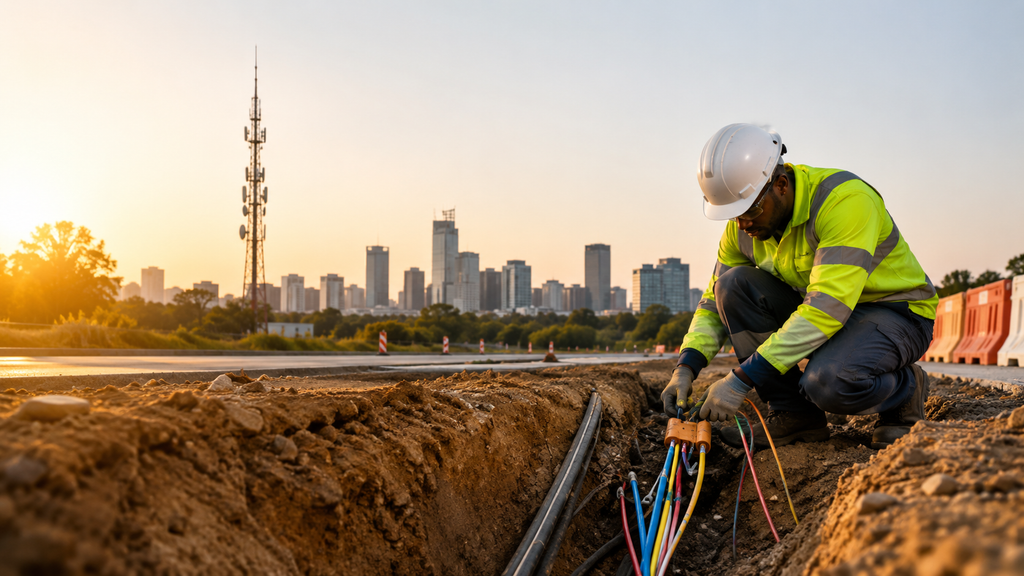
A contractor may begin excavating for a road, drainage system or other project without having sufficient information about underground infrastructure. The equipment eventually reaches a fibre cable, the cable is damaged and somewhere else, people suddenly begin experiencing poor internet service, dropped calls or a complete network disruption.
For the person holding a smartphone, the explanation may not matter.
All they know is that the network is not working.
But behind that frustrating moment could be a construction project several kilometres away and a damaged fibre cable that has suddenly interrupted someone's business, work or income.
That is what makes this issue much bigger than a technical problem.
Think about the small business owner who depends on WhatsApp to communicate with customers. Think about the POS operator waiting for a customer's payment to go through. Think about the person working remotely for an international company. Think about the student attending an online class or the online vendor waiting for customers to complete payments.
When connectivity disappears, these people do not simply lose internet access.
They can lose time.
They can lose customers.
They can lose money.
And sometimes, they can lose opportunities that cannot easily be recovered.
This is why I believe Nigerians need to start seeing telecommunications infrastructure differently. Fibre-optic cables may be buried beneath our roads, but the economic activity they support is happening everywhere around us.
Nigeria's banking system, fintech industry, e-commerce businesses, schools, hospitals, government services and countless small businesses increasingly depend on reliable connectivity.
So when a fibre cable is damaged, the consequences can travel much further than the physical location of that cable.
One network can experience an outage, forcing subscribers to move to another network. That sudden increase in traffic can place additional pressure on the other network, potentially affecting service quality for even more people.
We have already seen how serious this can become.
In February 2024, fibre cuts contributed to a major telecommunications disruption that affected millions of users for several hours and placed additional pressure on other networks as subscribers migrated to them.
For me, that experience should have made one thing very clear: telecommunications infrastructure cannot be treated as something we simply repair after it has been damaged.
Prevention has to become the priority.
And this becomes even more important when we consider where Nigeria says it wants to go.
The country is investing in digital connectivity and pursuing major fibre infrastructure initiatives, including Project BRIDGE, as part of efforts to expand broadband and digital access.
But I cannot help asking a very simple question.
What happens when we spend billions of naira building digital infrastructure and then repeatedly damage that same infrastructure during road construction?
To me, it is almost like building a beautiful house and repeatedly breaking its water pipes every time you repair the road outside.
The investment is there.
The infrastructure is there.
The ambition is there.
But poor coordination keeps creating avoidable damage.
And I think this is one of the biggest challenges Nigeria must address as it pursues a stronger digital economy.
Road construction is not the enemy.
Nigeria needs better roads. We need drainage systems. We need bridges. We need highways. We need urban development. We need infrastructure that can support growing communities and businesses.
The problem is when one form of development repeatedly damages another.
Nigeria needs roads, but Nigeria also needs fibre.
We need new buildings, but we also need reliable telecommunications networks.
We need drainage projects, but those projects should not repeatedly destroy underground digital infrastructure.
That means the answer is not to stop construction.
The answer is to make different forms of development work together.
This is why the idea of better planning, including the "dig once" approach, deserves serious consideration. Instead of treating every infrastructure project as an isolated activity, government agencies, contractors and telecommunications operators should coordinate before the first excavation begins.
If everyone who needs to know where underground infrastructure is located has the right information before construction starts, some of these incidents could potentially be prevented.
And prevention matters because every fibre cut comes with a cost.
Someone has to locate the damaged section.
Technicians have to travel to the site.
The cable has to be repaired.
Services have to be restored.
Businesses may lose money while they wait.
Customers may be unable to complete transactions.
Employees may struggle to work.
Students may miss lessons.
And all of those individual losses add up to something much bigger.
This is where I believe we need to change the way we measure the cost of fibre cuts.
The cost is not only the price of replacing a damaged cable.
There is also the cost of downtime.
There is the cost to businesses.
There is the cost to customers.
There is the cost to productivity.
And there is the cost to confidence in the digital infrastructure that Nigeria increasingly depends on.
The Office of the National Security Adviser and other government stakeholders have also recognised the importance of protecting fibre infrastructure, particularly because telecommunications infrastructure has been designated as Critical National Information Infrastructure.
That designation should tell us something.
This is not merely about protecting equipment owned by telecommunications companies.
It is about protecting a system that supports communication, commerce, financial services, public services and economic activity.
And when I look at the bigger picture, I realise that this story is really about the foundation of Nigeria's digital future.
We often talk about the digital economy by focusing on the exciting things.
We talk about artificial intelligence.
We talk about fintech.
We talk about online businesses.
We talk about social media.
We talk about digital payments.
We talk about smartphones.
But behind all of these things is something we rarely see: infrastructure.
The internet does not simply appear because we have smartphones.
There is a physical network carrying the information that makes our digital lives possible.
And if that network is constantly damaged, everyone building a business or career on top of it eventually feels the impact.
That is why I do not think the latest figure of more than 5,000 fibre cuts should disappear from the national conversation after a few news cycles.
It should force us to ask more difficult questions about how Nigeria plans and builds.
If we want a digital economy capable of supporting millions of businesses and workers, then the infrastructure supporting that economy has to be treated as a priority.
But there is another lesson I take from this story, and it is one that applies to ordinary Nigerians like me and you.
While the government and industry have a responsibility to protect the infrastructure connecting us, we also have to ask ourselves what we are doing with the connection once we have it.
Are we only using our smartphones to consume content, or are we also learning how to create value?
That question matters because the digital economy is not only something happening at the level of government policy, telecommunications companies and large technology businesses.
It is also happening in the lives of ordinary people.
Someone with a smartphone can learn content writing.
Someone else can learn social media management.
Another person can learn graphic design, virtual assistance, online tutoring or digital marketing.
Someone who already has valuable knowledge can package that knowledge into an ebook, guide, course or another digital product.
None of these opportunities should be presented as overnight riches. They are not.
They require learning, consistency, patience and the ability to solve real problems for real people.
But the important thing is that the barrier to entry can be much lower than many people imagine.
A smartphone, internet access and a willingness to learn can be the beginning.
That is why I find the fibre-cut story interesting beyond the headline.
It reminds me that the digital economy has two sides.
There is the infrastructure that connects us, and there are the people who use that connection to create value.
Nigeria must protect the first while helping more people take advantage of the second.
The government can build fibre networks, but individuals still need skills.
Telecommunications companies can improve connectivity, but entrepreneurs still need ideas.
Technology can create opportunities, but people still have to learn how to use it.
And perhaps that is the mindset we need as Nigeria continues moving deeper into the digital age.
We should not only ask how fast our internet is.
We should also ask what we are building with it.
Because a faster connection is useful, but a person who knows how to turn that connection into a skill, a service, a business or an income stream can go much further.
At the same time, none of this will reach its full potential if the infrastructure underneath it remains vulnerable.
That brings me back to those more than 5,000 fibre cuts.
The number is alarming, but the lesson behind it is even more important.
Road contractors need better information.
Government agencies need stronger coordination.
Telecommunications operators need accurate infrastructure mapping.
Construction workers need to know what is beneath the ground before excavation begins.
And regulators need to ensure that the rules protecting critical telecommunications infrastructure are actually followed.
Nigeria cannot seriously pursue the ambition of becoming a stronger digital economy while allowing the infrastructure supporting that ambition to be repeatedly damaged.
We need to build roads, but we also need to protect the digital highways running beneath them.
We need physical development, but we must plan it alongside digital development.
And as individuals, we need to move beyond simply being consumers of technology and begin looking for ways to become creators, entrepreneurs and skilled participants in the digital economy.
For me, that is the real story behind the 5,000-plus fibre cuts.
It is not simply about cables being damaged.
It is about connections being interrupted.
It is about businesses being affected.
It is about opportunities being delayed.
And ultimately, it is about the kind of economy Nigeria is trying to build.
If we want to build a modern economy, then our physical and digital infrastructure must grow together.
The roads we construct should not keep cutting the digital highways that carry our businesses, our money, our communication and increasingly, our livelihoods.
And while the government and industry work to protect those highways, there is something each of us can do too: learn, create and find meaningful ways to participate in the digital economy.
If you have an article, opinion piece, event or news story you would like published, Global News Arena would love to hear from you. And if you are ready to begin your journey toward building a profitable online content-writing business from your phone or laptop, you do not have to wait for the perfect moment. Start by learning, start by practising and start by creating value.
Send your article submissions, story ideas or enquiries to advertise@globalnewsarena.com.