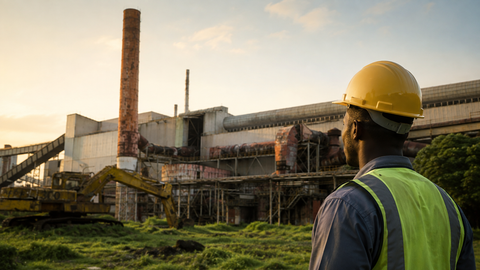

Nigeria is rapidly changing from a country that has depended heavily on imported refined petroleum products into a country that is increasingly exporting fuel to international markets, and the Dangote Petroleum Refinery is at the centre of that transformation.
That is the part of this story that immediately caught my attention.
According to the U.S. Energy Information Administration (EIA), Nigeria’s seaborne petroleum product shipments averaged about 561,000 barrels per day in the second quarter of 2026, compared with an annual average of just 79,000 barrels per day in 2023. Even more striking is the export figure: about 350,000 barrels per day were exported in the second quarter of 2026, compared with only 46,000 barrels per day in 2023.
When I look at those numbers, I see something much bigger than another headline about Dangote Refinery. I see a possible turning point in the way Nigeria participates in the global petroleum market.
For decades, Nigeria had the unusual situation of being one of the world's major crude oil producers while importing significant quantities of refined petroleum products for domestic consumption. Crude oil could leave the country, be processed elsewhere and then return as products Nigerians needed. In that process, much of the additional value created through refining was captured outside the country.
That is why the rise of domestic refining matters.
The Dangote refinery began operations in 2024 and has gradually increased its production. Following maintenance and expansion work completed in February 2026, the EIA reported that the refinery's crude oil distillation capacity increased from 650,000 barrels per day to 700,000 barrels per day.
The significance goes beyond having a very large refinery on Nigerian soil. When crude is processed locally, Nigeria has the opportunity to capture more value before petroleum products are sold to consumers at home or shipped to customers abroad.
And the trade numbers suggest that this change is already becoming visible.
Nigeria imported nearly 400,000 barrels per day of petroleum products in 2023. By the second quarter of 2026, seaborne imports had fallen to less than 130,000 barrels per day, according to the EIA. At the same time, petroleum product exports have moved sharply in the opposite direction.
That is the part I find particularly interesting.
Nigeria is not simply trying to reduce its dependence on imported fuel. It is increasingly becoming a supplier of refined petroleum products to other markets.
Europe, for example, has become an increasingly important destination for Nigerian petroleum products. Nigerian seaborne exports to Europe averaged around 130,000 barrels per day in the second quarter of 2026, compared with 40,000 barrels per day in 2025 and just 15,000 barrels per day in 2023. Exports to other African countries also reached nearly 120,000 barrels per day during the second quarter of 2026.
When I put these figures together, the direction becomes difficult to ignore. Nigeria is building a stronger position in the refined petroleum market, and the implications could extend far beyond petrol, diesel and other petroleum products.
More refining activity can create demand for transportation, logistics, storage, engineering, financial services, technology and a wide range of supporting businesses. The larger an industry becomes, the more opportunities are created around the industry itself.
And this is where I think Nigerians need to look beyond the headline.
Whenever a major company expands, many people naturally focus on the company itself. They talk about its size, investment and revenue. But I often think about the businesses and individuals standing around that company. Who is supplying the service? Who is moving the products? Who is providing information? Who is solving problems? Who is helping customers understand what is happening?
Those questions can reveal opportunities that are easy to miss.
You do not need to own a refinery to benefit from an expanding energy industry. In the same way, you do not need billions of naira to participate in the digital economy.
One of the biggest lessons I take from this story is the growing value of information.
Think about what these figures actually represent. Most people will see a statement that petroleum exports have increased seven-fold and move on. But there are millions of people who want to understand what that means for Nigeria, businesses, fuel prices, jobs, investment and the wider economy.
Someone has to explain it.
That creates an opportunity for people who can research complicated developments and turn them into simple, useful information.
A smartphone can be enough to begin that journey.
Someone who enjoys writing can start researching business and economic stories, publishing useful explanations on social media or a website and gradually building an audience. Someone with knowledge of digital marketing can help businesses communicate with customers online. Another person might turn their expertise into a digital guide, newsletter or other useful product.
The important point is not that everyone should become a business journalist. The point is that every major economic transformation creates questions, and people who can provide clear answers can create value.
That is something I believe we sometimes underestimate.
We often see billion-dollar investments and assume that the opportunities belong only to wealthy investors and large corporations. But major projects create smaller opportunities all around them. The person who learns a valuable skill, identifies a need and provides a solution can participate in that wider economic activity.
At the same time, I do not think we should celebrate the export figures without looking at the bigger picture.
A seven-fold increase in petroleum product exports is impressive, but it does not automatically mean that every Nigerian household will immediately experience cheaper fuel or a stronger standard of living. The real impact will depend on how effectively Nigeria manages its refining capacity, transportation networks, energy policies, investment environment and broader industrial development.
The country also needs to think beyond petroleum.
Nigeria's long-term economic strength cannot depend on one sector forever. The real opportunity is to use improvements in the energy sector to support manufacturing, agriculture, transportation, technology and other productive industries.
That is why the Dangote Refinery story is bigger than the refinery itself.
It is about what happens when a country begins processing more of what it produces instead of sending raw resources abroad and buying finished products back.
It is about whether local businesses can grow around that infrastructure.
It is about whether more Nigerian companies can become part of the supply chains created by large industrial projects.
And perhaps most importantly, it is about whether Nigeria can turn increased refining capacity into broader economic value.
There is another development that makes the story even more interesting. The EIA reported that Dangote Group plans to double the refinery's capacity by adding another 750,000-barrel-per-day crude oil distillation unit by 2028. If that expansion is successfully completed, Nigeria's ability to produce refined petroleum products could increase substantially.
But even with that ambitious plan, I think the biggest question remains the same: what will Nigeria do with the opportunity?
Can local businesses become stronger suppliers to the energy industry? Can more jobs and skills be developed around refining and logistics? Can Nigerian companies capture more value from petroleum before products leave our shores? Can the infrastructure created by the energy sector support other industries?
Those questions matter because economic progress should not simply be measured by how much a country produces. We should also ask how widely the benefits of that production spread.
For individuals, I believe there is a lesson here that is just as important.
We cannot always control the big economic changes happening around us, but we can learn to pay attention to them. Instead of simply reading a headline and scrolling past it, we can ask what is changing, what problems are being created, what people need and where we can provide value.
That mindset can change the way we look at opportunities.
The Dangote Refinery is a massive industrial project, but the lesson it offers is surprisingly simple: opportunities often appear when something changes.
Nigeria's petroleum export numbers are changing. The country's refining capacity is changing. The relationship between crude production, local refining and international markets is changing.
And whenever an economy changes, people who are prepared to learn, adapt and create value have an opportunity to change with it.
For me, that is the real story behind Nigeria's seven-fold increase in petroleum product exports.
It is not just about fuel leaving Nigerian ports. It is about Nigeria gradually moving toward capturing more value from the resources it produces and becoming a more significant player in the refined petroleum market.
The numbers are encouraging, but what Nigeria does with this opportunity will ultimately determine whether this becomes a temporary success story or the beginning of a much bigger transformation.
And for anyone watching from the outside, there is a lesson worth carrying forward: don't just watch the big opportunities. Look at everything growing around them.
If you have an article, opinion piece, event or news story you would like published, or you are ready to begin your journey toward building a profitable online content-writing business from your phone or laptop, Global News Arena would love to hear from you. Send an email to advertise@globalnewsarena.com.