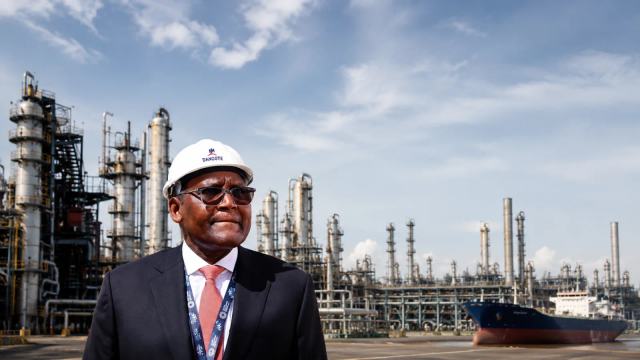

Tony Elumelu’s $500 million investment in Seplat Energy is now worth more than $1 billion, less than eight months after Heirs Holdings acquired a 20.07 per cent stake in the Nigerian energy company.
The investment, which involved approximately 120.4 million Seplat shares, was completed in December 2025 after Heirs Energies acquired the stake from French energy company Maurel & Prom. The transaction was valued at approximately $500 million and made Heirs Holdings Seplat’s largest shareholder.
By August 2026, the value of that stake had more than doubled as Seplat’s share price continued to climb. Reports on August 21 put Seplat’s shares at about N11,200.60 on the Nigerian Exchange, compared with N5,809 at the end of 2025. That represents a gain of more than 90 per cent in the share price this year and has pushed the value of Elumelu’s stake beyond the $1 billion mark.
That figure is certainly impressive, but there is something Nigerian investors need to understand before getting carried away by the headline.
The more than $1 billion figure represents the current market value of the shares. It does not mean Elumelu has already collected more than $500 million in cash profit. Unless the shares are sold, the gain remains largely unrealised, and the value can still rise or fall depending on Seplat’s share price and the broader market.
That distinction is important because investment headlines can sometimes make wealth creation look much simpler than it really is.
In this case, however, the increase in Seplat’s share price has come alongside significant changes in the underlying business.
Seplat completed its acquisition of Mobil Producing Nigeria Unlimited, or MPNU, from ExxonMobil, giving the company a much larger production base and significantly expanding its oil and gas assets. The acquisition transformed the scale of Seplat’s operations and increased its exposure to offshore production.
The company's financial performance has also been strong.
Seplat reported $2.73 billion in revenue for 2025, representing a 144 per cent increase, while adjusted EBITDA rose 137 per cent to $1.28 billion. Operating cash flow also increased significantly, while net debt declined. The company subsequently increased its total 2025 dividend by 52 per cent to 25 cents per share.
The momentum continued into 2026.
During the first half of the year, Seplat recorded about N2.50 trillion in revenue, while profit before tax rose 74 per cent to N790.4 billion. Profit after tax also increased sharply, while interest-bearing borrowings fell from approximately N1.44 trillion at the end of 2025 to N1.11 trillion by June 2026.
Production has also increased.
Seplat's average working-interest production reached 139,509 barrels of oil equivalent per day in the first half of 2026, compared with 134,492 barrels per day during the same period of the previous year. Offshore assets now account for more than half of the company's production, while natural gas liquids production has also increased significantly.
So when I look at the story, I don't think the biggest lesson is simply that Tony Elumelu invested $500 million and somehow woke up to discover that he had made another $500 million.
There is much more happening underneath the headline.
The investment was made in a company that was already an important player in Nigeria's energy industry, but which had also just completed a transformational acquisition. Heirs Holdings was effectively taking a major ownership position in a business with a significantly enlarged asset base and a different growth outlook.
That is the part I think ordinary Nigerian investors should study.
It is easy to look at the result and say, "Tony Elumelu made the right investment."
The more useful question is: Why did he make the investment in the first place?
That question takes us away from the excitement of the $1 billion headline and towards the fundamentals.
Investors should always try to understand what they are buying. A rising share price can be exciting, but what supports that price matters even more. Is the company growing? Is revenue increasing? Is the business generating cash? Is debt under control? Does the company have valuable assets? Does management have a credible plan for the future?
Those questions matter because a famous investor's decision is not a guarantee that another person's investment will succeed.
I would not tell an ordinary Nigerian to rush out and buy Seplat shares simply because Tony Elumelu's stake has increased in value. That would completely miss the point.
The better lesson is to learn how to think about investments.
Do your research.
Understand the company.
Understand the risks.
Know why you are investing.
And never put money into an investment simply because everyone on social media is talking about it.
There is another part of this story that I find particularly interesting: ownership.
Elumelu did not simply lend Seplat money or provide a short-term service to the company. He acquired a significant ownership position.
That means when the value of the company increased, the value of his stake increased too.
This is one of the reasons ownership is such an important concept when people talk about wealth creation.
The same principle applies outside the stock market.
If you build a business, you own the business.
If you create an original digital product, you can own that product.
If you build a strong website and audience, you are building a digital asset.
If you develop a valuable skill and turn it into a service business, you are creating an income-producing asset around your knowledge and ability.
And this is where I believe the Seplat story connects with something much closer to the everyday Nigerian.
You don't need $500 million to start building something you own.
You may have only a smartphone.
You may have limited capital.
You may not have an office.
You may not have employees.
But you can still begin.
A smartphone can be used to learn a digital skill, write articles, edit videos, design graphics, create social media content, research business opportunities, communicate with customers and market a service.
Someone who enjoys writing can start a content-writing business from a phone or laptop.
Someone who understands social media can help small businesses manage their pages.
Someone who knows video editing can create short-form videos for brands and content creators.
Someone with useful knowledge can turn that knowledge into an ebook, guide, template or other digital product.
Someone who has built an audience can explore legitimate affiliate marketing opportunities and earn commissions by recommending products or services that genuinely provide value.
The point is not that everyone should suddenly become an online entrepreneur.
The point is that the digital economy has created another form of ownership that did not require a traditional office to begin.
And just like investing, building a digital business requires patience.
You might publish your first article and receive very little traffic.
You might create your first digital product and make only a few sales.
You might offer a service and struggle to find your first client.
That does not necessarily mean you are failing.
It may simply mean you are still building.
This is where I believe many people make a mistake. They see the final result of someone else's success and ignore the structure underneath it.
They see the $1 billion valuation but not the investment decision.
They see the successful entrepreneur but not the years of business building.
They see a viral creator but not the hundreds of posts that nobody noticed.
They see the money but not the asset that produced it.
The Seplat story reminds me that sustainable wealth is usually connected to something valuable underneath it.
In Seplat's case, that value is connected to energy assets, production, earnings, cash flow and future business prospects.
For someone building online, the equivalent might be valuable content, a loyal audience, a useful service, a digital product, a strong brand or a skill that businesses are willing to pay for.
The asset may look completely different, but the principle is similar.
Build something valuable.
Own it.
Improve it.
Give it time.
And, importantly, understand what you are doing.
Elumelu's involvement in Seplat is also becoming more significant. He joined the company's board in January 2026 and is expected to become chairman from January 1, 2027. Seplat has also confirmed that Effiong Okon became chief executive officer and executive director on August 1, 2026.
That means the investment is not simply a financial transaction sitting quietly in the background. Elumelu is expected to have a more direct role in the company's strategic direction as its largest shareholder.
At the same time, the future value of the investment will depend on what happens next.
Seplat will have to maintain production, manage costs, protect its cash flow, manage its debt and continue delivering value to shareholders. The share price can also move in either direction.
So even though the investment has already crossed the $1 billion mark, the story is far from finished.
For Nigerian investors, that is another important lesson.
A successful investment today does not automatically guarantee a successful investment tomorrow.
Markets change.
Businesses change.
Economic conditions change.
And investors must continue paying attention.
That is why I believe the biggest takeaway from Tony Elumelu's Seplat investment is not that Nigerians should look for the next person whose investment has doubled.
It is that Nigerians should start thinking more seriously about assets, ownership and long-term value.
Instead of constantly asking, "How can I make money quickly?", perhaps the better question is, "What can I build, own or invest in that can become more valuable over time?"
That question can completely change the way someone approaches money.
It can encourage a person to learn before investing.
It can encourage an entrepreneur to build instead of constantly chasing trends.
It can encourage a young Nigerian with a smartphone to stop seeing the device only as a tool for entertainment and start seeing it as a potential business tool.
And perhaps most importantly, it can encourage people to understand that wealth creation is not always about finding one magical opportunity.
Sometimes it is about identifying value, making a thoughtful decision, staying disciplined and giving that decision enough time to produce results.
Tony Elumelu's roughly $500 million investment in Seplat now being worth more than $1 billion is certainly a remarkable business story. But the bigger story, in my view, is what the investment represents: strategic ownership, confidence in an asset, business growth and the potential rewards that can come when value increases over time.
For Nigerian investors, there is a lot to learn from that.
Don't invest because a headline is exciting.
Don't build a business because everyone else is doing it.
Don't chase every opportunity promising overnight wealth.
Instead, learn to identify value.
Learn to understand risk.
Build something useful.
Own something that can grow.
And whether that ownership comes through shares in a company, a physical business, intellectual property or a digital business built from your smartphone, the principle remains the same.
The question is no longer simply how much money you can make today.
The bigger question is what you can start building today that could be worth much more tomorrow.
If you have an article, opinion piece, event or news story you would like published, or you are ready to begin your journey toward building a profitable online content-writing business from your phone or laptop, Global News Arena would love to hear from you. Send an email to advertise@globalnewsarena.com.