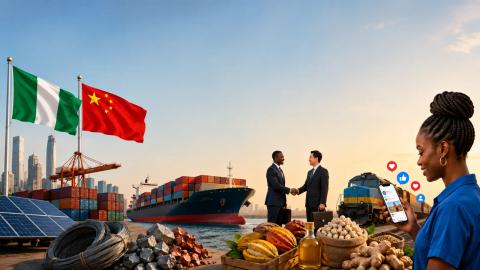
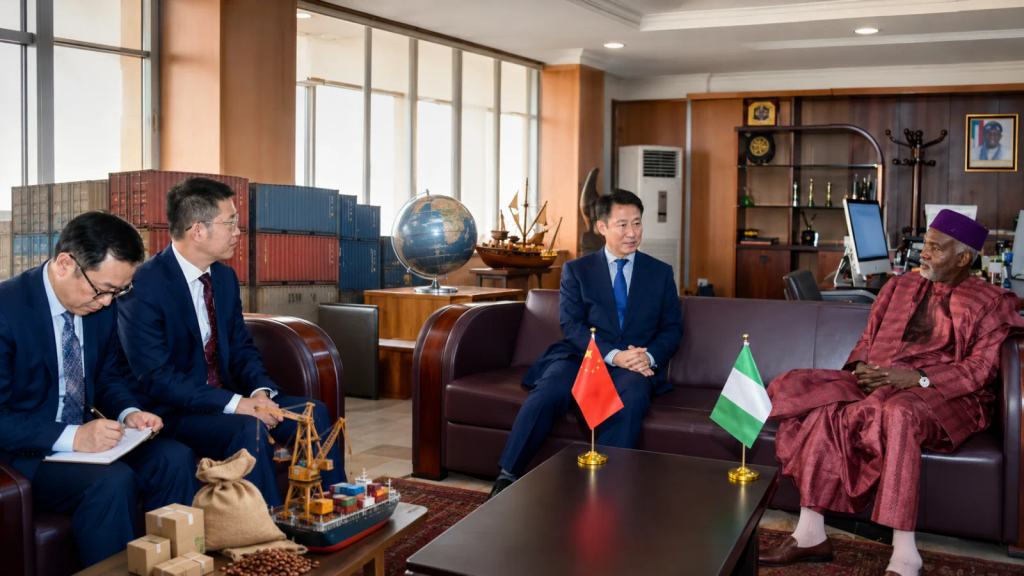
Nigeria’s trade relationship with China is entering an interesting phase, as the value of Nigerian goods exported to China jumped by 81 per cent to $2.25 billion in the first half of 2026.
The increase is particularly significant because it comes shortly after China introduced a zero-tariff policy for products from eligible African countries, including Nigeria. At a time when many Nigerian businesses are looking beyond the local market for new customers, this development could create opportunities that deserve closer attention.
According to figures released on Nigeria-China trade, total trade between both countries reached approximately $17.4 billion in the first six months of 2026, representing a 35 per cent increase compared with the same period in 2025.
But while the overall trade figure is important, I believe the $2.25 billion export figure deserves even more attention because it highlights something Nigeria has been trying to achieve for years: increasing the amount of Nigerian products that find buyers outside the country.
For a long time, conversations about Nigeria-China trade have largely focused on what Nigeria imports from China. From electronics and machinery to clothing, household goods and industrial equipment, Chinese products are already deeply present in the Nigerian market.
This latest development shifts part of that conversation.
It raises a much more important question: what can Nigeria successfully sell to China?
China’s zero-tariff policy for African products became effective on May 1, 2026, covering products from 53 African countries with which China maintains diplomatic relations, including Nigeria.
The policy is designed to make it easier for eligible African products to enter the Chinese market by removing tariffs across the covered product lines.
And the early numbers are already attracting attention.
China’s Consul General in Lagos, Yan Yuqing, said Nigerian exports to China increased by 81 per cent in the first half of 2026, while monthly growth exceeded 40 per cent in both May and June after the policy took effect.
That timing is difficult to ignore.
When a major market reduces the cost of bringing products into its country, businesses that already have the right products, quality and supply capacity are naturally positioned to benefit.
For Nigerian farmers, manufacturers, processors and exporters, this could become an important opportunity.
Products such as sesame, ginger, cashew nuts, cocoa, cassava products and aquatic products have been identified as having potential in the Chinese market. These are areas where Nigeria already has significant production capacity or natural advantages, which means the conversation should not simply be about finding something new to sell.
It should also be about improving what we already produce.
And this is where I think the real opportunity begins.
A zero-tariff policy can make market access easier, but it does not automatically make a Nigerian business competitive. An exporter still has to produce goods that meet the required quality standards, maintain consistent supply, package them properly, understand the regulations and get them to the buyer efficiently.
In other words, removing a tariff can open the door, but the business still has to be ready to walk through it.
Imagine a Chinese buyer looking for a particular Nigerian agricultural product every month. It is not enough for a supplier to have the product available today. The supplier needs to demonstrate that the same quality and quantity can be delivered consistently.
That is why Nigeria’s next challenge should not only be increasing exports. It should be building businesses capable of sustaining international demand.
This also brings the issue of value addition into the conversation.
Nigeria has enormous agricultural and natural resources, but exporting raw materials often means that much of the value is created somewhere else. The more Nigerian businesses can process, package, brand and transform local resources before exporting them, the greater the potential economic value that can remain within the country.
Instead of simply asking, "What can we export?" entrepreneurs should increasingly be asking, "How can we make what we produce more valuable?"
That change in thinking could have a much bigger impact than simply celebrating an increase in export figures.
And while large manufacturers and established exporters may appear to be the obvious beneficiaries of this development, I think there is another side of the story that young Nigerians should pay attention to.
International businesses need digital support.
An exporter needs good product descriptions. A manufacturer needs professional social media content. An agricultural business may need someone to manage its online presence. A company trying to attract foreign buyers may need videos, graphics, articles, email marketing or customer-support services.
Many of these jobs can be started with a smartphone.
This means someone does not necessarily have to own a warehouse full of goods before participating in a growing international business ecosystem.
A young Nigerian with a smartphone can learn content writing, social media management, graphic design, video editing, digital marketing or virtual assistance and offer those services to businesses that are trying to reach new markets.
That is the part of this story I find particularly interesting.
Sometimes, when we hear that billions of dollars are moving between countries, we immediately assume the opportunity belongs to people who already have huge businesses.
But economic growth creates different levels of opportunities.
The farmer can benefit from increased demand.
The processor can benefit from value addition.
The exporter can benefit from new buyers.
And the digital entrepreneur can benefit by helping those businesses market, communicate and sell.
The smartphone in your hand can therefore become more than a device for watching videos and scrolling through social media. It can become a tool for learning a skill, finding clients, creating content and building an income stream around businesses that are already growing.
Of course, nobody should interpret the latest figures as a guarantee that every Nigerian business will suddenly become successful in China.
There are still serious challenges around production capacity, infrastructure, logistics, standards, certification, financing and consistency.
There is also the question of whether Nigeria can use increased access to foreign markets to strengthen local industries instead of becoming overly dependent on exporting raw materials.
That is why I believe the real success of this policy should eventually be measured by more than the value of exports.
We should be asking how many Nigerian businesses become stronger because of the opportunity, how many jobs are created, how much more value is added locally and how many Nigerian products become recognisable brands in international markets.
The $2.25 billion figure is therefore encouraging, but it should also challenge us.
It should challenge farmers to think beyond production.
It should challenge manufacturers to think beyond the Nigerian market.
It should challenge exporters to improve quality and consistency.
It should challenge young Nigerians to learn skills that businesses increasingly need.
And it should challenge policymakers to create an environment where Nigerian businesses can actually take advantage of international opportunities when those opportunities appear.
Because global markets are not waiting for anyone.
Markets change. Policies change. Technology changes. Consumer behaviour changes. New opportunities appear, and businesses that recognise those changes early often have a better chance of positioning themselves ahead of the crowd.
For me, that is the bigger lesson behind Nigeria’s 81 per cent increase in exports to China.
The story is not simply that Nigeria sold $2.25 billion worth of goods to China.
The bigger story is that a market has opened wider, demand is changing, and Nigerian businesses now have another opportunity to prove that what is produced here can compete beyond our borders.
The question is whether we will take that opportunity seriously.
And perhaps you do not need to start with millions of naira to participate.
You can start by learning.
You can use your smartphone to research an industry, learn a digital skill, study how businesses attract customers, create useful content, build a portfolio and begin offering a service to businesses that need help.
The goal does not have to be overnight success.
It can simply be to position yourself where opportunity is moving.
Because sometimes, the smartest way to make money from a major economic development is not to own the entire business. It is to become useful to the businesses that are already benefiting from it.
As Nigeria’s trade with China continues to grow, the hope should be that the country does not remain merely a supplier of raw materials or a major buyer of imported products. The bigger opportunity is for Nigerian businesses to produce more, process more, build stronger brands and compete confidently in global markets.
And for ordinary Nigerians, there is a lesson worth holding on to: when the world changes, pay attention. The opportunity may not be obvious at first, but there is often a place for those who are willing to learn, adapt and position themselves early.
If you have an article, opinion piece, event or news story you would like published, Global News Arena would love to hear from you. If you are ready to begin your journey toward building a profitable online content-writing business from your phone or laptop, send your article, opinion, story or enquiry to advertise@globalnewsarena.com.