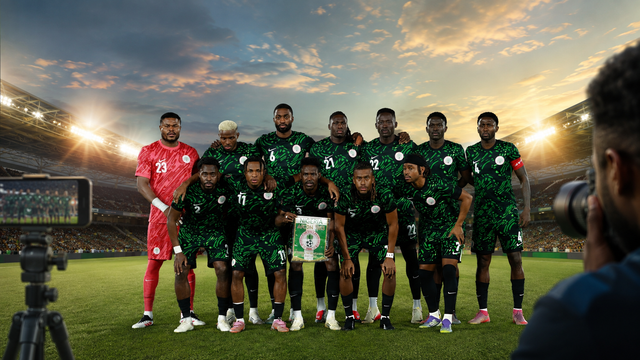
Nigeria may be watching the beginning of a new era in sports, and what makes 2026 interesting is that some of the names Nigerians could be celebrating in the future are already beginning to emerge.
From athletics to football and para-sports, a number of young Nigerian athletes are producing performances that deserve more attention. Some have already won medals on international stages, while others are still fighting for the breakthrough that could change their careers.
For me, that is what makes Nigerian sports so fascinating right now. We already know the established stars who have carried the country's flag for years, but the real question is: who is coming next?
One name Nigerians should certainly keep watching is Kayinsola Ajayi.
At just 21, Ajayi has already shown that he has the speed and confidence required to compete at the highest level. He has won a Commonwealth Games bronze medal in the men's 100m and has also recorded a Nigerian national record of 9.84 seconds.
His Commonwealth bronze was particularly significant because it ended Nigeria's long wait for a men's 100m medal at the Games.
That achievement tells me something important. Ajayi is no longer simply a young athlete with potential. He is beginning to establish himself on the international stage.
But the real test is still ahead.
Can he turn those impressive performances into consistent appearances among the world's best sprinters? Can he continue improving as the competition becomes tougher?
Those are the questions that will determine whether Ajayi becomes another promising Nigerian athlete or a genuine global sprint star.
And while Ajayi is attracting attention in the 100m, Samuel Ogazi is giving Nigerians another reason to be excited about the 400m.
Ogazi made history at the 2026 Commonwealth Games by running 44.25 seconds to win the men's 400m title, becoming the first Nigerian man to win that event at the Games.
That is a remarkable achievement, especially considering how physically demanding the 400m is.
There is nowhere to hide in that race. An athlete needs speed, endurance, strategy and tremendous mental strength. The final 100 metres can feel like a completely different race, and the ability to keep pushing when the body is demanding a slowdown is what separates many competitors.
Ogazi has now demonstrated that he can deliver when the pressure is high.
However, I believe his next challenge will be even more important.
Winning once can introduce an athlete to the world, but consistency is what creates a superstar. If Ogazi can continue producing performances at this level, Nigerians may be looking at the emergence of one of the country's most important 400m runners in years.
Then there is Temitope Adeshina, another athlete whose progress deserves our attention.
Adeshina won bronze in the women's high jump at the 2026 Commonwealth Games after clearing 1.90 metres.
High jump may not generate the same excitement in Nigeria as football or sprinting, but that is precisely why athletes like Adeshina deserve to be highlighted. Nigerian sporting talent does not exist only in the events that dominate our television screens.
It exists across different disciplines, and Adeshina is showing what is possible.
What I find particularly interesting about her journey is the potential for further growth. Every international competition gives her more experience, more exposure and another opportunity to challenge herself against some of the best athletes in the world.
And when we talk about Nigerian field events, Ruth Usoro is another name that should not be overlooked.
Usoro won silver in the women's long jump at the 2026 Commonwealth Games, continuing the country's strong tradition in the event.
Nigeria has produced outstanding long jumpers over the years, and seeing another athlete compete successfully at the international level is encouraging.
But I think there is a bigger lesson here.
A country's sporting success should never depend entirely on one superstar.
When one athlete succeeds, the next objective should be to create an environment where several others can rise behind them. That is how a sport develops depth, and that is how a country creates a sustainable sporting culture instead of waiting for one exceptional athlete to carry everything.
That brings me to Chidera Ezeakor, another young Nigerian sprinter who deserves to remain on our radar.
Ezeakor won bronze in the men's 100m at the 2026 African Championships in Accra after running 10.32 seconds in the final.
Perhaps his name is not yet as familiar to the average Nigerian sports fan as some of the country's biggest stars, but that is exactly why I think now is the time to pay attention.
Most successful sporting careers do not begin with worldwide fame.
They begin with small breakthroughs.
A continental medal.
A personal best.
A strong performance against a more experienced opponent.
Then another good performance.
Eventually, people start asking where the athlete came from.
That could be the stage Ezeakor is entering now. His challenge will be turning that continental success into consistent performances and continuing to improve as he faces stronger opposition.
Another young athlete whose progress deserves attention is Prestina Ochonogor.
Her journey is particularly interesting because moving from junior competition to senior international athletics can be one of the most difficult stages of an athlete's career.
A young athlete can dominate at junior level and suddenly discover that senior competition requires a completely different level of preparation, discipline and consistency.
That is why I am less interested in one spectacular performance and more interested in Ochonogor's development over time.
Can she continue improving?
Can she remain competitive against experienced athletes?
Can she eventually become a regular presence at major international championships?
Those are the questions that will tell us how far her career can go.
And if there is one athlete who reminds us that Nigeria's sporting future extends far beyond athletics and football, it is Eniola Bolaji.
The young para-badminton star has already made an impression internationally after winning Nigeria's first gold medal of the 2026 sporting calendar at the Egypt Para Badminton International in Cairo.
Her story is important for another reason.
Para-sports often do not receive anything close to the attention given to mainstream sporting competitions, yet athletes such as Bolaji continue to demonstrate that extraordinary talent exists in places many people rarely look.
That is why I believe Nigerians should start paying more attention to sports beyond football, athletics and the familiar competitions we see every week.
Because when we look at the competitions coming up in 2026, there are plenty of opportunities for new stars to emerge.
One of the most interesting is EKO 2026, Nigeria's inaugural National Intermediate Games, scheduled to take place in Lagos from October 1 to 15.
More than 12,000 young athletes between the ages of 15 and 18 are expected to participate across 28 sports.
Think about what that means.
Thousands of young Nigerians will be competing in one place, many of whom are still completely unknown outside their schools, clubs, communities or states.
Among them could be the next Nigerian Olympic champion.
That is why I believe Nigerians should watch EKO 2026 carefully. We should not only look at who wins medals. We should look at the young athletes who are breaking records, showing unusual determination and producing performances that suggest they could have a future at the highest level.
The National Youth Games is another competition worth watching because grassroots competitions are where much of Nigeria's sporting future begins.
These events may not always dominate social media, but they provide young athletes with the opportunity to compete against talented competitors from different parts of the country.
And sometimes, the athlete who attracts little attention today becomes the athlete everybody is talking about tomorrow.
The same applies to the 2026 Youth Olympic Games in Dakar, Senegal.
For young Nigerian athletes, competing at such an international event provides something that cannot easily be taught in training: experience.
They get to compete against athletes from different countries, experience international pressure and understand what it takes to perform outside their comfort zone.
Some of those young competitors could eventually become Nigeria's representatives at senior Olympic Games.
Football fans also have plenty to look forward to, particularly with the FIFA U-17 Women's World Cup in Morocco.
Nigeria's Flamingos have developed a strong reputation in women's youth football, and another generation of young Nigerian footballers will have the opportunity to announce themselves on the world stage.
Whenever I watch youth football competitions, I try not to focus only on the final score.
I look at the individual players.
Who has exceptional pace?
Who makes intelligent decisions?
Who looks comfortable under pressure?
Who has the discipline and personality required to progress?
Because the young player making headlines today could become the Super Falcons star Nigerians will be celebrating a few years from now.
The FIFA U-20 Women's World Cup in Poland is also important for exactly the same reason.
At that age, many players are already approaching senior international football, meaning the tournament can serve as a major stepping stone toward the Super Falcons.
Then there is the National Sports Festival, which remains one of Nigeria's most important platforms for discovering talent across different sports.
This is where I believe Nigerians should deliberately look beyond the established names.
Look at the teenagers.
Look at the athletes competing in sports that rarely trend online.
Look at the young competitors breaking personal records even when there are no cameras around them.
Some of those athletes may not receive much attention today, but that does not mean their talent is insignificant.
In fact, sometimes being unknown is simply the first stage of becoming known.
Swimming is another area where Nigeria needs to continue developing, which is why the 2026 World Aquatics Swimming Championships in Beijing will also be worth following.
Nigeria cannot build a truly powerful sporting culture by concentrating almost entirely on football and athletics.
We need stronger development in swimming, badminton, basketball, wrestling, boxing, weightlifting, table tennis and other disciplines.
The more sports we develop, the more opportunities we create for young Nigerians to discover where their talents truly belong.
And that is what I think is most exciting about Nigeria's next generation of sports stars.
They are not all coming from the same place.
They are not all competing in the same sport.
They do not all have the same story.
But they have something in common: they are trying to become better at something before the whole country knows their names.
That is a lesson I believe goes far beyond sports.
When I look at athletes such as Ajayi, Ogazi, Adeshina, Usoro, Ezeakor, Ochonogor and Bolaji, I see people who understand that success requires repetition.
They train when nobody is watching.
They compete when nobody is talking about them.
They lose.
They learn.
They return.
They improve.
Then, eventually, the world notices.
The same thing can happen to someone trying to build an income online.
Today, a smartphone is not only a device for watching TikTok videos, scrolling through Facebook or chatting on WhatsApp. It can also become a small business tool.
A Nigerian with a smartphone can learn content writing, create videos, manage social media accounts, offer freelance services, promote legitimate affiliate products, sell digital products or build a niche audience around a skill or area of knowledge.
But there is one mistake I think people make when they enter the digital space.
They expect results too quickly.
Someone publishes an article and gets 20 views, then decides blogging does not work.
Someone uploads a video and gets five likes, then concludes that content creation is not for them.
Someone promotes a legitimate product and makes no sale, then gives up on affiliate marketing.
But imagine if athletes used the same mindset.
Imagine an athlete losing one race and deciding never to compete again.
There would be no champions.
The truth is that nobody sees all the unsuccessful attempts behind a successful career.
We see the medal.
We see the celebration.
We see the interview.
We see the viral video.
But we rarely see the years of training, rejection, disappointment and sacrifice that came before that moment.
That is why the stories of these young Nigerian athletes matter.
They remind us that being unknown today does not mean you cannot become successful tomorrow.
Nigeria has talent.
What we need is to discover it, develop it, support it and give it enough opportunities to grow.
And as Nigerians, we also need to become better at telling these stories.
Because an athlete cannot become a national inspiration if nobody is paying attention to their journey.
That is why I believe the competitions of 2026 deserve more than occasional headlines after medals have been won.
We should follow the athletes before they become famous.
We should talk about the grassroots competitions.
We should celebrate young people who are putting Nigeria's name on international stages.
And we should encourage them to keep going.
Somewhere in Nigeria right now, another young athlete could be training without any major sponsorship, without a large social-media following and without thousands of people cheering.
They may not have the perfect facilities.
They may not even know how far their talent can take them.
But they could be the next big Nigerian sports story.
And interestingly, the same thing could be happening in the digital world.
Someone else could be sitting at home with nothing more than a smartphone, learning how to write, create videos, build an audience or sell a digital product.
Nobody may know their name today.
But that does not mean they should stop.
The next Nigerian sports superstar could already be preparing somewhere.
The next successful Nigerian digital entrepreneur could also be preparing somewhere.
In both cases, the journey begins long before the applause.
If you have an article, opinion piece, event or news story you would like published, or you are ready to begin your journey toward building a profitable online content-writing business from your phone or laptop, Global News Arena would love to hear from you. Send an email to advertise@globalnewsarena.com.